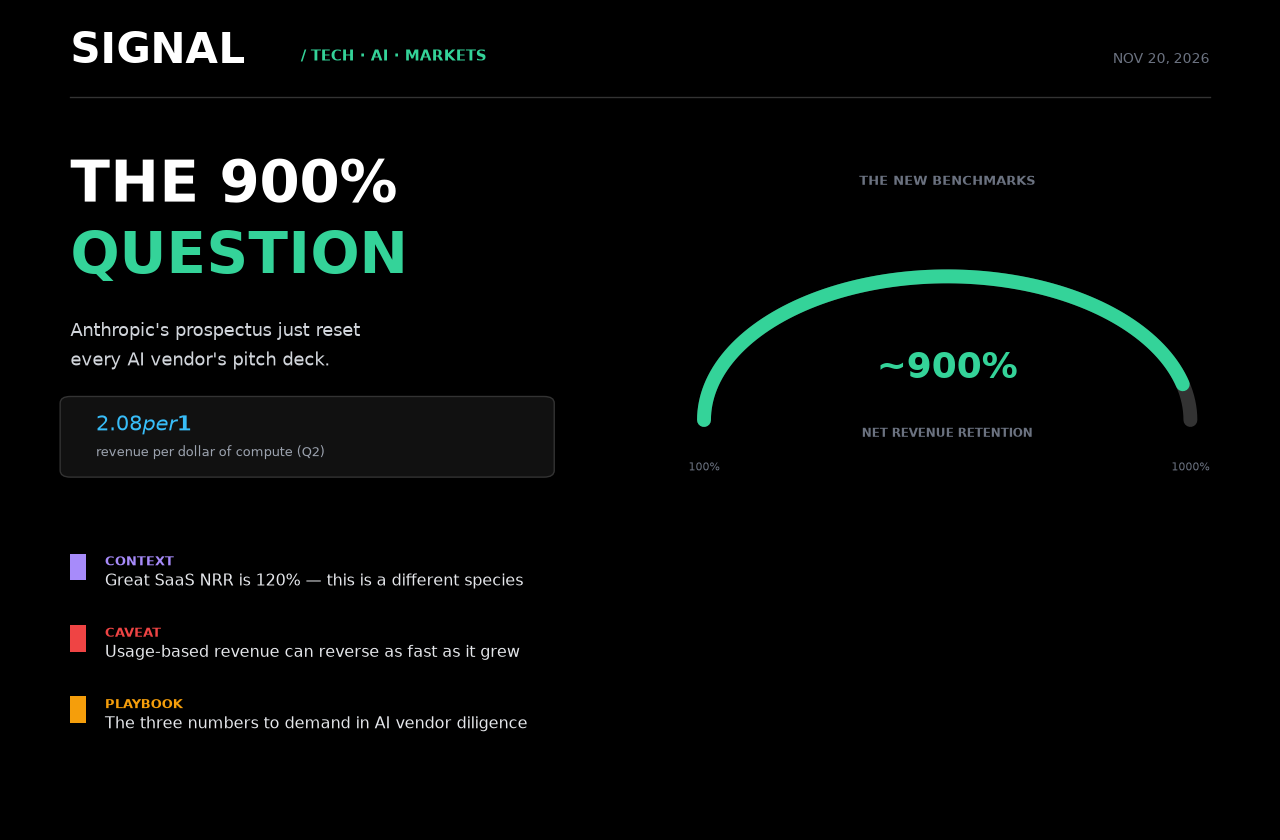
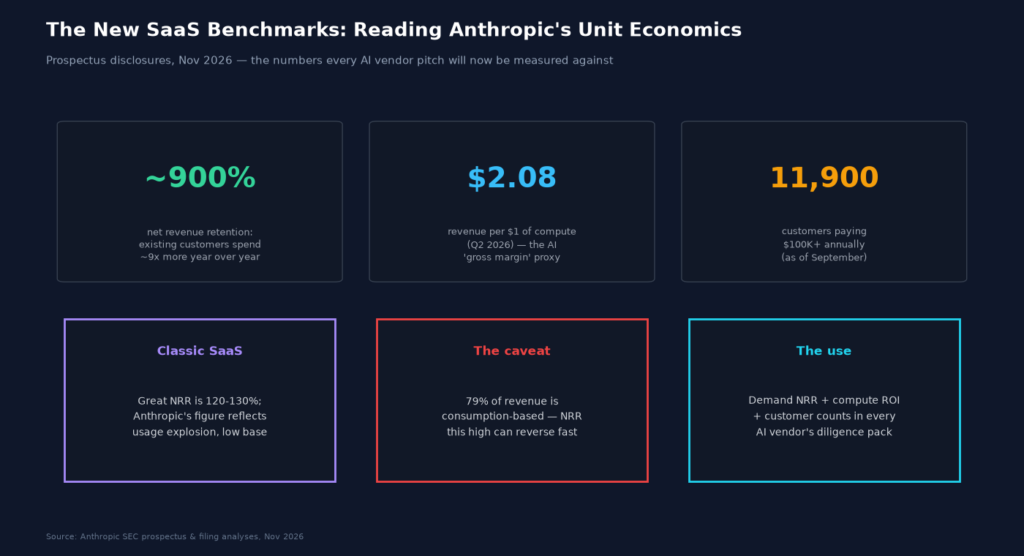
Every software category eventually gets its reference numbers — the metrics against which all comers are judged. SaaS had the Rule of 40 and 120% net revenue retention. Cloud had gross margin and committed-use discounts. As of this week, enterprise AI has its reference numbers too, and they are absurd by any prior standard: Anthropic’s IPO prospectus discloses net revenue retention around 900%, revenue of $2.08 for every dollar of compute consumed in the second quarter, and roughly 11,900 customers paying more than $100,000 annually. Whatever one concludes about the company’s valuation — and the previous article in this series documented the $900 billion commitment mismatch — these three figures will now appear, explicitly or implicitly, in every AI vendor’s fundraising deck and every enterprise buyer’s diligence checklist. Understanding what they actually measure, and where they mislead, is the most practical homework a marketing-technology buyer can do this quarter.
What 900% retention actually means
Net revenue retention measures how much a cohort of existing customers spends this year versus last, including expansion, contraction and churn. In mature SaaS, 120% is excellent — it means the installed base grows 20% annually before a single new logo. Anthropic’s ~900% means existing customers are spending roughly nine times more year over year. The number is not a typo and not fraud; it is what happens when a product’s use cases explode inside accounts faster than any seat-based pricing ever allowed. A company that piloted Claude for support drafting in 2025 is, by late 2026, running coding agents, document pipelines, and customer-facing workflows on it — consumption compounds across use cases, not seats. Two honest caveats travel with the figure. First, the base effect: retention percentages inflate when the starting cohort spend is small relative to the product’s eventual footprint; 900% from a low base is less miraculous than it sounds and will mathematically compress as the base grows. Second, the reversibility: with roughly 79% of revenue consumption-based and no contractual minimums, the same elasticity that produced 900% expansion can produce violent contraction if workloads migrate, prices shift, or a competing model wins an eval. This is not SaaS retention with its switching-cost moat; it is usage retention, and usage is a fair-weather friend.
The compute ratio: AI’s answer to gross margin
The $2.08-per-compute-dollar figure is the more novel disclosure, and arguably the more important one. Traditional software reports gross margin; AI companies have struggled to define an equivalent because their cost of goods — inference compute — varies with usage intensity, model choice, and hardware generation. A revenue-to-compute ratio above 2 establishes that serving the product generates real contribution margin before R&D, and the trend matters more than the level: as model efficiency improves (the same week’s Haiku price cut of 4x demonstrates the cascade) and hardware costs evolve, this ratio is the cleanest observable of whether an AI vendor’s unit economics improve or erode. For buyers, it translates into a negotiating insight: a vendor earning $2+ per compute dollar has room to discount committed-volume deals; a vendor below 1.5 is subsidizing your usage and will reprice or die. Ask for the proxy — served-token economics, contribution margin per workflow, whatever the vendor will disclose — because it predicts pricing behavior better than any roadmap slide.
The customer count: depth over logos
The 11,900 customers above $100,000 annual spend (with roughly 1,900 above $1 million, per the filing’s disclosures) completes the picture: this is not a consumer story dressed as enterprise, but genuine six-figure penetration across nearly twelve thousand organizations — a depth metric that matters because it survives the demo-to-pilot-to-production funnel that kills most AI adoption claims. When an AI startup pitches your team, the diligence questions now write themselves. What is your net revenue retention, computed on consumption, and how has it trended as the base grew? What revenue do you generate per dollar of inference cost, and which way is it moving? How many customers pay you six figures, and what share of revenue do they represent? None of these questions existed in standard martech diligence two years ago. All three are now answerable by any serious vendor, and the pattern of evasion is itself the signal.
The synthesis for buyers
The three numbers together describe the shape of a healthy AI business: expanding usage inside accounts, positive and improving serving economics, and deep enterprise penetration rather than logo sprawl. They also describe the shape of the risk: everything is elastic, nothing is contractual, and the benchmarks will compress as the category matures. The buyer’s posture that follows is neither cynical nor credulous — demand the metrics, discount the base effects, contract for the elasticity (price protection, exit rights, workload portability), and re-underwrite vendors annually against the moving reference. Anthropic has done the category a favor by publishing the numbers. The vendors who cannot answer the three questions are telling you something too. Listen to that answer as carefully as the pitch.






