Everyone reads the pre-order discount as a bribe — a carrot dangled to make people buy early. That reading gets the economics backwards. The discount isn’t paying you to buy. It’s paying you to tell the truth.
Start with the problem every launch faces: nobody knows if strangers want the thing. The classic fix is to ask them. Surveys, polls, “would you buy this?” panels. But asking is free, and free answers are cheap talk. Politeness inflates the yes, enthusiasm fades at checkout, and researchers have a name for the gap between what people say and what they do. Intent costs nothing; behavior costs money. A forecast built on opinions is a warehouse of guesses waiting to become markdowns.
A paid pre-order fixes this by making the answer expensive. When a buyer parts with cash weeks before a product exists — accepting delay risk, trusting an escrow — the “yes” becomes what economists call a costly signal: hard to fake, because faking it costs real money. Michael Spence built a Nobel around this logic in labor markets; Xiaomi’s crowdfunding channel applies it to demand. A thousand survey respondents saying “looks great” is noise. Thirteen and a half thousand people paying 2,499 yuan for an unbuilt robot vacuum, as happened on the Mijia campaign in 2021, is information — precise enough to become a factory order.
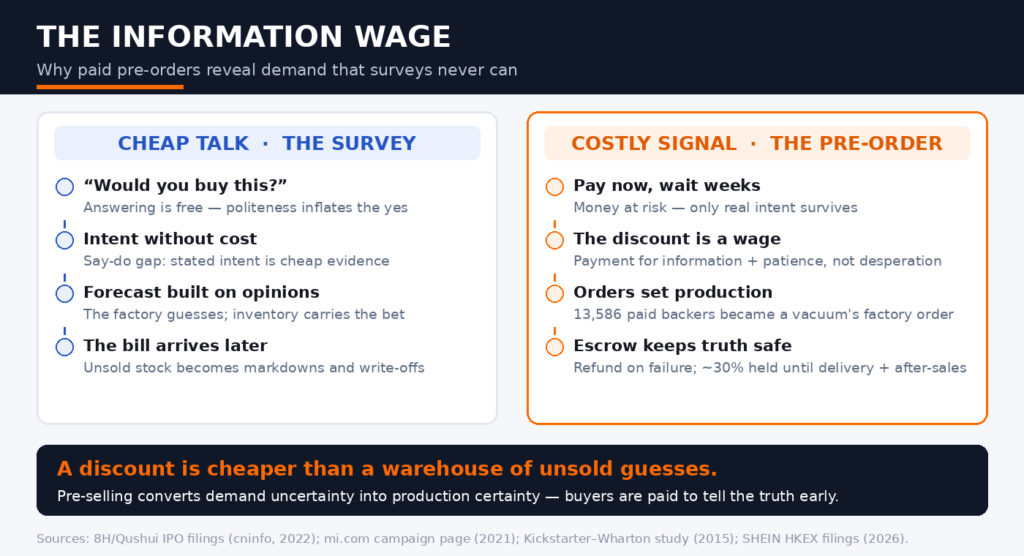
Now the discount makes sense. The early buyer supplies two scarce inputs: honest demand data and patience. The 500-yuan gap between that vacuum’s crowdfunding price and its retail price is compensation for both — a wage paid for information, denominated in margin. And it’s the cheapest research budget in commerce: SHEIN’s listing documents show the same bet at industrial scale, with unsold inventory held to low single digits and stock turning over every 36 days. A discount is cheaper than a warehouse of unsold guesses.
There’s a second reason the wage must be paid: truth needs safety. The Wharton study of Kickstarter found backers got refunds in only about 13% of failed projects — so pledges there were risk capital, and rational buyers learned to hesitate. Youpin’s contracts invert that: failed campaigns refund in full, roughly 30% of proceeds stay escrowed until delivery and after-sales windows close. Lower the cost of being wrong, and more people dare to signal early. The escrow doesn’t just protect buyers; it increases the honesty supply.
That’s the mechanism underneath the trend. Pre-selling exploded in China not because consumers love waiting, but because the system turned demand measurement into a paid, insured transaction — cheap talk replaced by costly signals at scale. The reusable lesson travels anywhere uncertainty is expensive: don’t ask people what they want and believe them. Give them a safe way to pay for it early, price the wait honestly, and let the money do the talking.



