Here is a puzzle worth sitting with. China’s livestream selling market runs at roughly RMB 5.8 trillion a year, employs 38.8 million professional hosts — and its most sophisticated operators deliberately engineer the star out of the business. Make Friends, the operator behind the country’s best-known 24-hour selling room, pushed its famous founder’s share of room GMV below one-third within months of going always-on in 2021. Why would anyone dilute their biggest asset?
Because the founder was never the asset. The room was. And the room runs on paper.
Attention here is rented, not owned
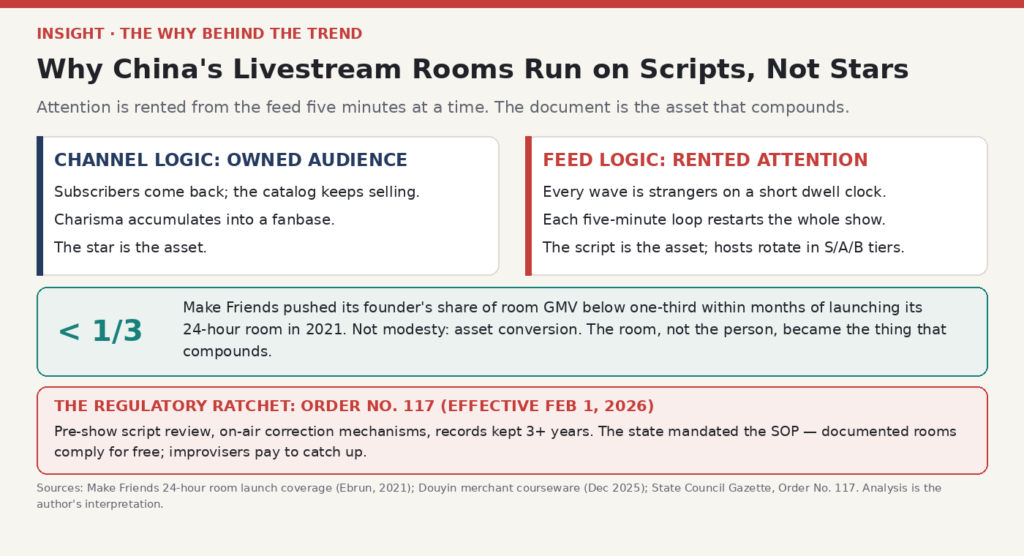
Western creator commerce is built on owned attention: subscribers who return, a back catalog that keeps selling, charisma that accumulates into a fanbase. Douyin’s feed works the opposite way. The algorithm leases you attention in short bursts, and each burst arrives as strangers on a dwell clock. A viewer who joins at minute forty has seen nothing of your first thirty-nine minutes. If the pitch does not restart for them, the rental expires unused.
That single fact explains the machinery foreign observers find baffling: the five-minute conversion loop that re-runs the full hook-to-close arc, the welfare drops scattered through the night, the S/A/B host tiers where an opener, a converter and an extender swap seats like relay runners. None of it serves the host’s fame. All of it serves the arriving stranger. When attention is rented by the minute, the only durable thing you can build is a process that converts any minute — which means a script, a sequence sheet, a cue table. Not a personality.
The document compounds; the person depreciates
Stars get tired, demand raises, and eventually leave — sometimes to a competitor, taking the audience with them. A run-of-show does the reverse. Every same-night debrief edits tomorrow’s script; every logged objection becomes a line that works on the next stranger. The asset appreciates with use. Make Friends’ founder-share decline was not modesty; it was asset conversion — moving enterprise value from a depreciating human into a compounding document, one that a two-volume operations textbook could eventually codify.
Then the regulator poured concrete over the advantage. Since February 2026, Order No. 117 requires pre-show script review, on-air correction mechanisms and three-year record retention. Read that as an economist, not a lawyer: the state has mandated the SOP. Rooms already run on documents comply for free. Rooms run on improvisation must now buy what their scripted competitors built years ago — and pay fines of up to RMB 100,000 while they catch up.
The lesson travels. Wherever your audience arrives as strangers on a clock — feed traffic, AI-referred visitors, marketplace shoppers — bet on the process, not the face. The face rents the attention. The document keeps it.