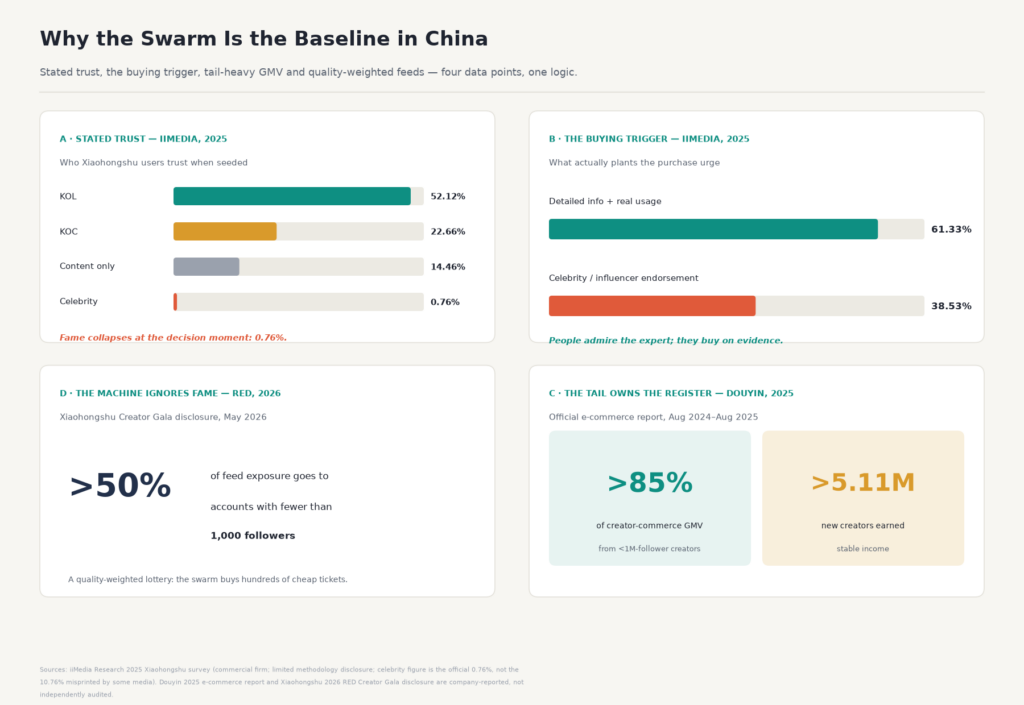
Here is a number that ought to make you uncomfortable. When iiMedia Research asked Xiaohongshu users in 2025 whose recommendation they trust when a product gets “seeded” into their feed, 52.12% picked the KOL — the professional creator with a following and a niche. Ordinary users, the KOCs, drew just 22.66%. Celebrities? A rounding error: 0.76%.
So why are brands quietly moving money away from the stars and toward the crowd?
Because trust and purchase are two different animals, and the two biggest influencer markets on earth have built their entire pricing logic around that gap — in opposite directions. The West sells reach. China sells belief. Once you see the two units of account side by side, a decade of confusing influencer headlines suddenly makes sense.
Same Word, Two Industries
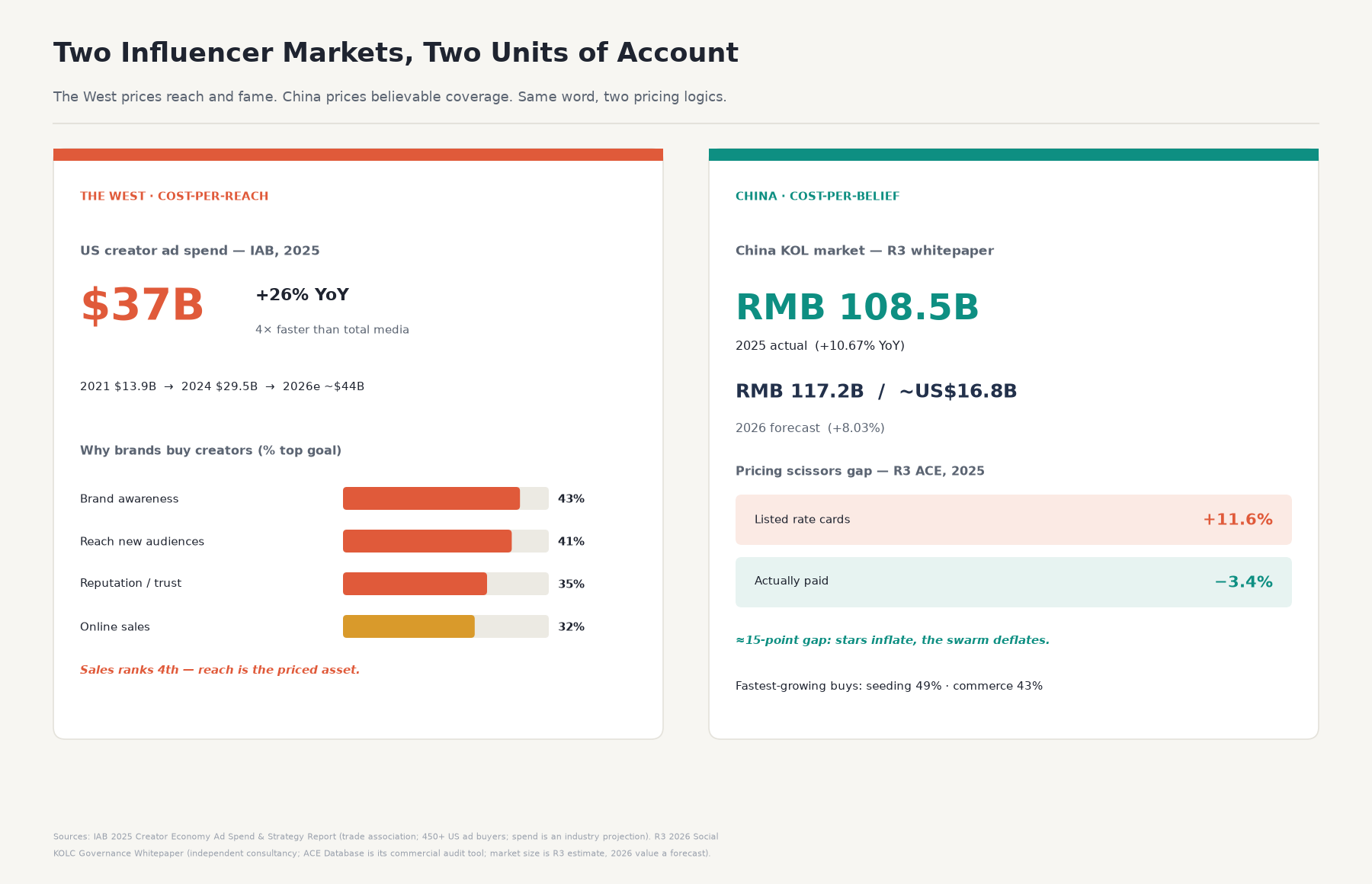
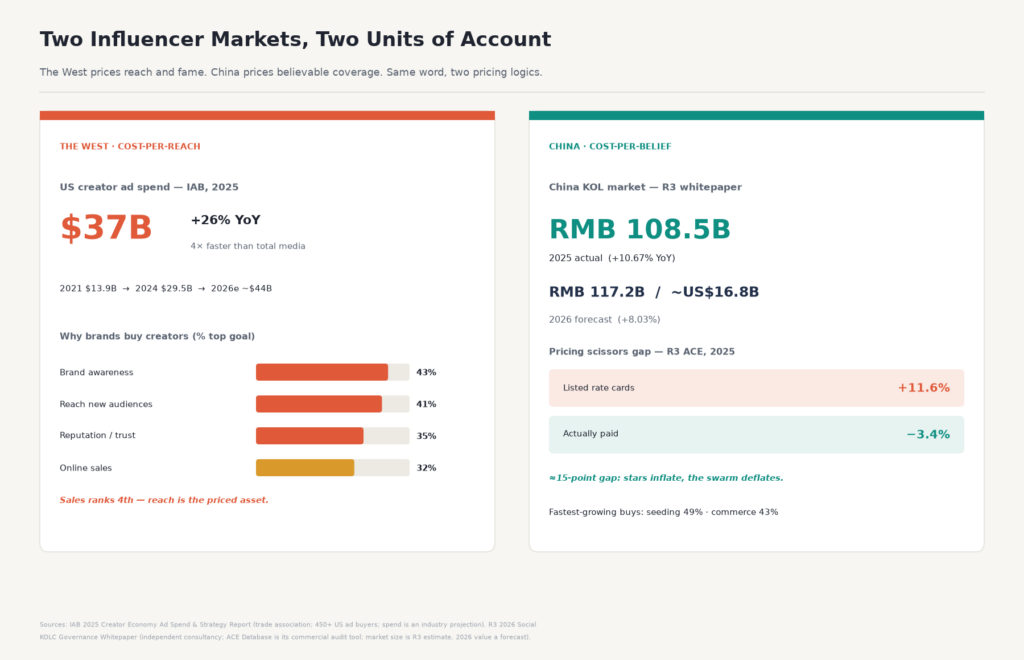
“Influencer marketing” is one phrase doing the work of two. In the United States, the Interactive Advertising Bureau — the digital ad industry’s trade association, working with Advertiser Perceptions and surveying more than 450 ad-spend decision-makers — projects creator ad spend will hit $37 billion in 2025, up 26% year over year, roughly four times faster than the media industry overall. That is real money, treated as a full-fledged channel: 48% of buyers now call creators a “must buy,” behind only paid search and social.
But look at what they are buying for. The IAB’s own goal rankings put brand awareness first at 43%, reaching new audiences second at 41%, and reputation or trust third at 35%. Driving online sales lands fourth, at 32%. The Western creator economy grew up as media. You rent an audience, you borrow a halo, you measure impressions. Reach is the asset, so reach is what gets priced.
China’s market grew up as something else. R3, the independent marketing consultancy, sizes the KOL economy at RMB 108.5 billion in 2025 and forecasts RMB 117.2 billion — about US$16.8 billion — for 2026. The fastest-growing line items are not awareness plays. They are KOL seeding (49% of marketers planning growth) and KOL-led commerce (43%). The content is attached to a checkout. The unit being bought is not “how many people saw it” but “how many people believed it enough to buy.”
The Price Signal Nobody Reads
Buried in R3’s 2026 governance whitepaper is the cleanest evidence of the split. In 2025, official KOL rate cards rose 11.6%. The prices brands actually paid fell 3.4%. That is a roughly 15-point scissors gap, and it tells you exactly where the market is heading: the premium tier is inflating on paper while the measurable tier deflates in practice.
R3 is not a neutral data bureau — it sells the very audit and governance services the whitepaper recommends, and its ACE Database is a commercial tool. Read the numbers with that caveat. But the direction is unmistakable. Brands under ROI pressure are migrating from expensive, opaque stars toward mid-tier creators and KOCs whose output can be counted, compared and scaled. The swarm is not a budget cut. It is a repricing.
Why the Markets Priced Differently
Four forces built the gap, and none of them is “Chinese consumers are just more trusting.”
The commerce attach. On Douyin and Xiaohongshu, creator content closes inside the loop — product cards, in-app checkout, per-note attribution. Conversion is measurable per creator, so the market prices believable conversion. Western content long sent traffic elsewhere; with no closed loop, reach was the only countable asset, and it got priced like media.
The trust format. Chinese buyers verify through peer evidence. A KOC note is not an endorsement; it is a receipt — messy bathroom, honest skin, third week of use. Western buyers historically leaned on institutional brand signals, so influencer content functioned as borrowed endorsement and was priced accordingly.
The platform infrastructure. China industrialized the swarm: matching marketplaces like Pugongying, sampling pipelines, brief systems, attribution dashboards. The West’s matching stayed agency-mediated and manual until TikTok Shop’s affiliate rails arrived. Infrastructure decides which tier can scale.
The algorithmic distribution. Quality-weighted feeds let tiny accounts win exposure. Xiaohongshu disclosed at its May 2026 RED Creator Gala that over 50% of feed traffic goes to accounts with fewer than 1,000 followers — a company-reported figure, but a revealing one. The swarm is a rational exploit of that physics. A follower-graph platform makes reach the bottleneck and prices it; a quality-weighted feed makes evidence the bottleneck and prices that instead.
What the Trust Data Actually Says
Now back to that iiMedia survey, because it is widely misread. People assume KOCs win on trust. They do not — KOLs win raw trust, 52.12% to 22.66%. The twist is in a second question: what actually plants the purchase urge? Detailed product information and real usage experience won at 61.33%, well ahead of celebrity or influencer endorsement at 38.53%. People admire the expert; they buy on evidence.
So KOCs win on cost-adjusted belief and coverage, not on raw trust share. And the celebrity collapse is specific: 0.76% at the decision moment, in a verification culture. (One caution: some Chinese media misprinted that celebrity figure as 10.76%; iiMedia’s official page says 0.76%, and that is the number to use.) Fame still rents attention at the top of the funnel. It just does not close the sale.
The Tail Already Owns the Register
If the trust data is the psychology, the GMV data is the proof. Douyin’s official 2025 e-commerce development report (window August 2024 to August 2025) found that creators with under one million followers drove over 85% of creator-commerce GMV, while over 5.11 million new creators earned stable income. These are company-reported percentages — Douyin does not publish the absolute GMV — but the shape is the point. The long tail is not the experiment. It is the business.
What Everyone Misunderstands
Three errors keep circulating, and each one costs brands money.
The first is “KOCs are more trusted.” The survey says otherwise; the win is economic, not psychological. The second is “the West is premium-only.” Nano and micro tiers are growing fastest there too — the difference is industrialization depth. China’s swarm is infrastructure; the West’s micro tier is still largely craft. The third is the authenticity binary. A CSCW 2025 study by University of Michigan researchers Huiran Yi and Lu Xian — nine months of ethnography on Xiaohongshu, published in the Proceedings of the ACM on Human-Computer Interaction — documents that KOC authenticity is manufactured: briefs, sampling pipelines, labor deliberately disguised as spontaneous ordinary-user posting, often with inadequate recognition and compensation. Western sponsored content is disclosed persuasion. Both are constructed. The difference is which construction the audience accepts as evidence.
The Western Unit Is Drifting
Here is where the story turns. The West is not staying still. TikTok Shop’s affiliate system pays creators for selling, not for posting — a commission on a closed-loop checkout, with per-creator GMV visible in the seller dashboard. That is the Chinese unit of account, arriving Westward.
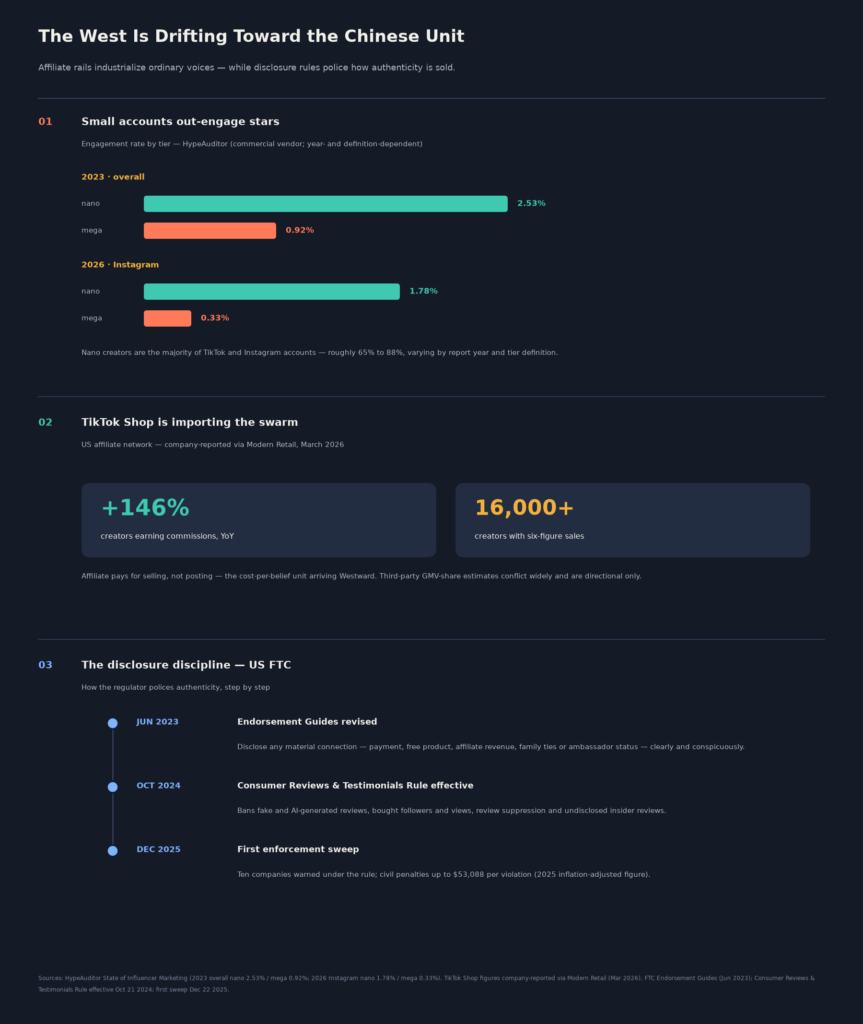
The scale is company-reported but striking. TikTok Shop told Modern Retail in March 2026 that the number of US creators earning commissions rose 146% year over year, and that over 16,000 creators now generate six-figure sales. (A later April figure cited over 20,000 — the number grows, so pin the date.) Third-party estimates of affiliate share of US GMV conflict widely across trackers and should be treated as directional, not precise. But the mechanism is clear: ordinary voices are being industrialized, and the brand that learned cost-per-belief accounting in China already holds the playbook.
The engagement physics agree. HypeAuditor’s data — a commercial analytics vendor, so read the year and tier definitions carefully — shows small accounts out-engaging stars across years: nano creators at 2.53% versus mega at 0.92% in its 2023 overall figures, and 1.78% versus 0.33% on Instagram in 2026. Nano creators make up the majority of TikTok and Instagram accounts, roughly 65% to 88% depending on the report. The swarm is not a Chinese quirk. It is what quality-weighted distribution does everywhere.
The Disclosure Textures Differ
The two markets also police authenticity differently, and the contrast is instructive. The West’s texture is disclosure. The FTC’s revised Endorsement Guides (June 2023) require any “material connection” — payment, free product, affiliate revenue, family ties, ambassador status — to be disclosed clearly and conspicuously. Its Consumer Reviews and Testimonials Rule, effective October 21, 2024, goes further: it bans fake and AI-generated reviews, bought followers and views, review suppression and undisclosed insider reviews, with civil penalties up to $53,088 per violation. In December 2025 the agency warned ten companies in its first sweep under the rule.
China’s texture is platform governance plus the same underlying demand for real evidence. Xiaohongshu punishes fake reviews and unlabeled AI content because the community’s promise is that what you read is real. The ethical charge against KOC swarms — that they are astroturf — is real, and the Yi and Xian ethnography documents it. The synthesis is that the format (peer evidence) is legitimate demand; the production method decides legitimacy. Real sampling, honest briefs and disclosure are the durable version in both markets.
What It Means for Brands
Four moves follow from the two-unit picture.
Price by the local unit of account. In China, buy believable coverage: query-mapped swarms, verified-purchase content, per-note attribution. In the West, buy reach with disclosure discipline — and negotiate toward conversion-attach as affiliate rails mature.
Sequence swarm-then-star. Validate messages with cheap mass evidence, then amplify the winners with premium reach. The Chinese operating sequence works in both markets once measurement exists.
Build the evidence supply chain. Sampling, briefs, quality control, disclosure compliance — treat creators as content infrastructure with service-level agreements, not as media placements.
Watch the convergence. TikTok Shop is importing the swarm machine Westward. Brands fluent in cost-per-belief accounting will buy the next decade’s creator economy at the right price.
The Counterargument, and Its Limit
Three objections deserve a fair hearing. “Western creators also sell” — true, LTK and Amazon Influencer have existed for years. The limit is attach rate and measurement depth: China’s in-loop attribution is per-note, the West’s affiliate tracking is per-link and partial. The gap is infrastructure completeness, not existence.
“KOC swarms are astroturf” — the charge is real, and platforms purge it. But the format is legitimate demand; the method decides legitimacy. “Fame will re-price upward with live commerce” — possibly, if Western live shopping matures. The limit is Douyin’s own trajectory: store-broadcasts and the mid-tail overtaking stars. The swarm is the baseline; stars are the spike. Plan budgets accordingly.
Conclusion: Buy the Right Unit
Two influencer markets, two units of account. The West prices fame and reach because its creator economy grew as media. China prices believable coverage because its creator economy grew as commerce infrastructure — swarms, sampling pipelines, per-note attribution. The trust data (celebrity 0.76% at the decision moment) and the GMV data (over 85% from the tail) explain why the swarm became the baseline rather than the experiment.
As affiliate rails industrialize Western ordinary voices, the units converge. The brands that learned to count belief instead of impressions will recognize the machine arriving in their own market — and they will buy it at the right price, while everyone else is still paying the fame premium.