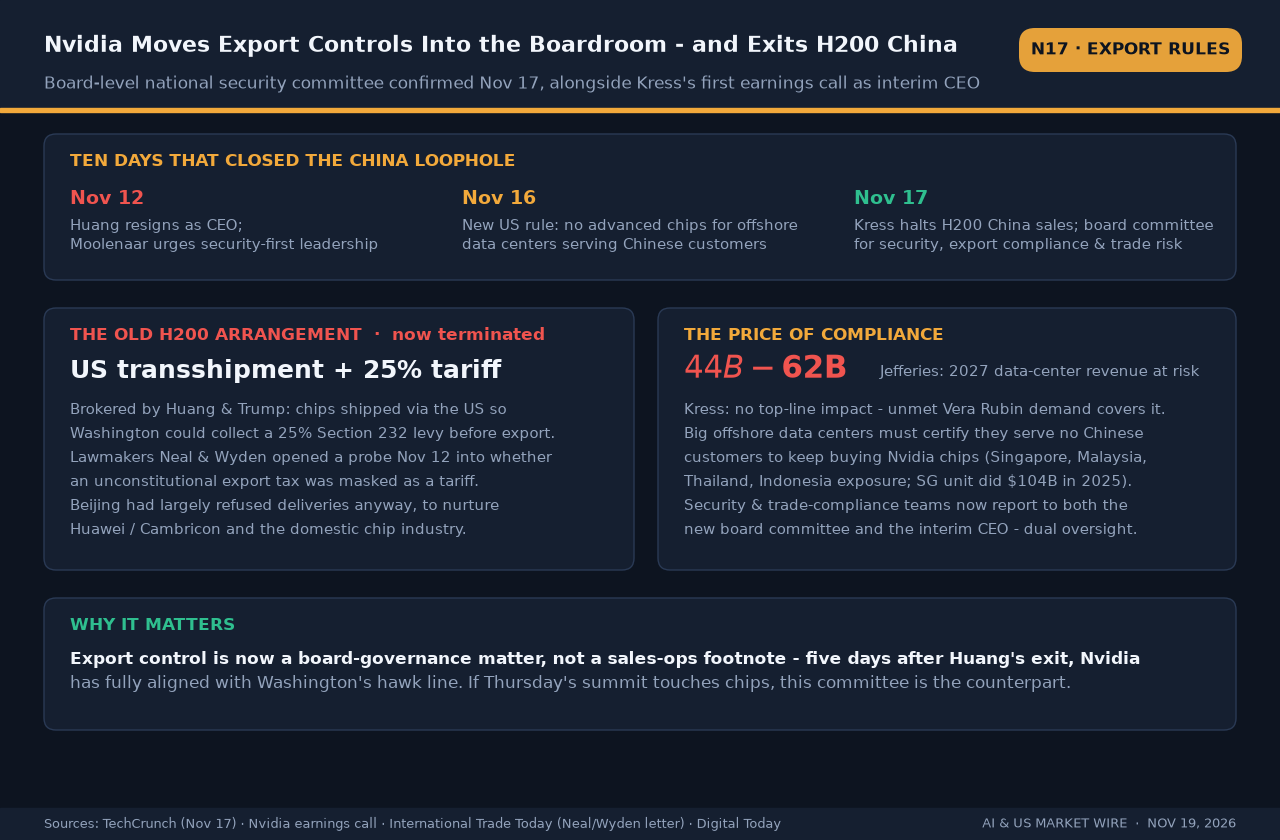
On Tuesday, November 17 — the same day as her first earnings call as interim CEO — Colette Kress confirmed Nvidia will stop selling H200 chips to China and announced a new board-level committee overseeing national-security policy, export-control compliance and global trade risk, with the company’s security and trade-compliance teams now reporting to both that committee and the interim CEO. The terminated arrangement, brokered by Jensen Huang and President Trump, required chips to transit the United States so Washington could collect a 25% Section 232 levy before export — a structure Democratic lawmakers Neal and Wyden began probing on November 12 as a possibly unconstitutional export tax masked as a tariff. The exit follows new Commerce rules issued Monday, November 16 barring advanced US chips from offshore data centers that remotely serve Chinese customers; Jefferies estimates $44–62 billion of 2027 data-center revenue at risk (Singapore, Malaysia, Thailand and Indonesia exposure — the Singapore unit alone booked $104 billion in 2025), though Kress insisted unmet Vera Rubin demand means no top-line impact. Five days after Huang’s resignation — and Representative Moolenaar’s November 12 demand for security-first leadership — export control has become a board-governance matter, and if Thursday’s summit touches chips, this committee is the institutional counterpart.