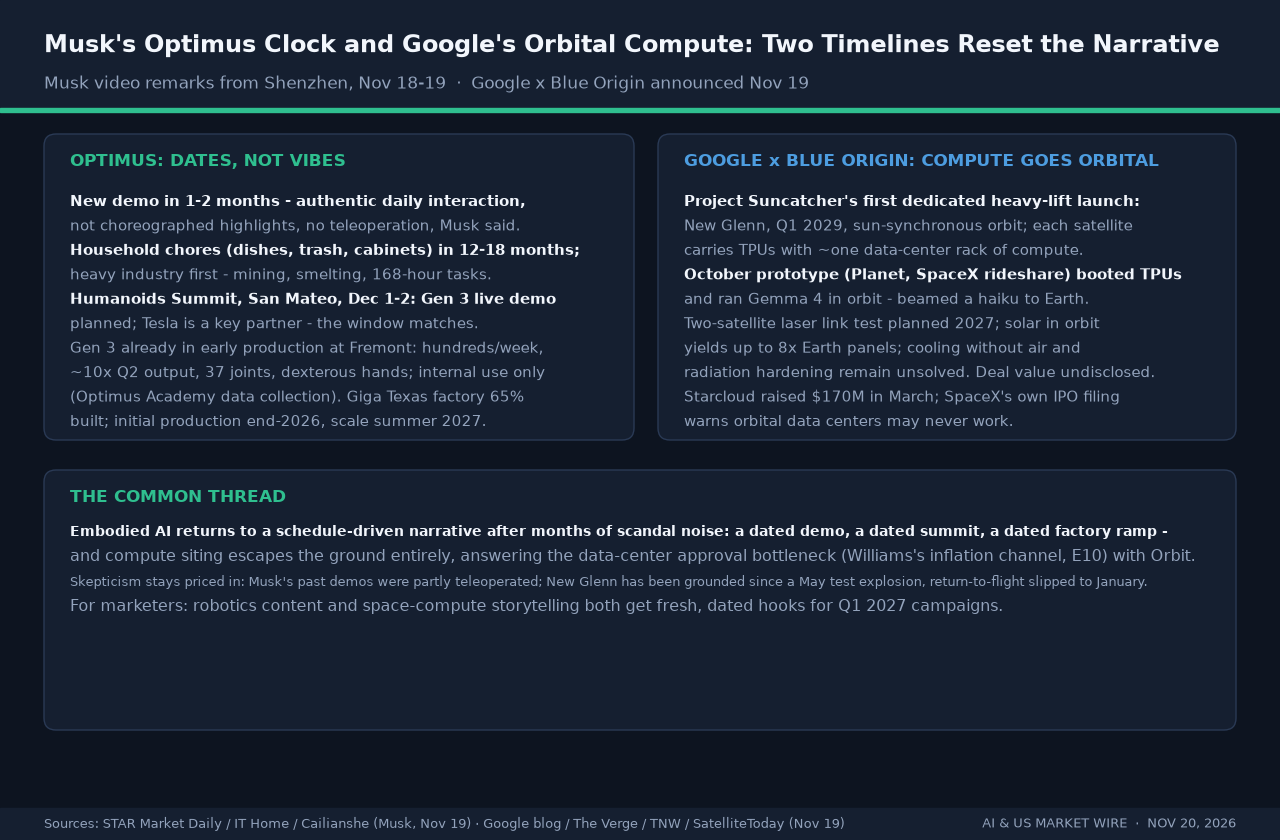
Speaking by video from Shenzhen during APEC (November 18–19, at Austin’s TomorrowX Summit and a second US event), Elon Musk put Optimus back on a schedule: a new demo within one to two months emphasizing “authentic” daily interaction — no choreography, no teleoperation — and household chores (dishes, trash, cabinets) within 12–18 months, heavy industry first; the Humanoids Summit in San Mateo on December 1–2, where Tesla is a key partner, plans a live Gen 3 demo inside that window. Correction to the wire’s “Gen 3 may debut”: Gen 3 is already in early production at Fremont — hundreds per week, ~10x Q2 output, 37 joints and dexterous hands — deployed internally for Optimus Academy data collection, with the 7-million-square-foot Giga Texas factory 65% structurally complete, initial production targeted end-2026 and scale by summer 2027; Musk calls hand-and-forearm engineering harder than the rest of the robot combined.
The same day, Google announced Blue Origin will fly Project Suncatcher’s first dedicated heavy-lift mission — New Glenn, Q1 2029, sun-synchronous orbit, each satellite carrying TPUs with roughly one data-center rack of compute — after October’s Planet-built prototype booted TPUs in orbit and ran Gemma 4 to beam a haiku home; a two-satellite laser link is planned for 2027, orbital solar yields up to 8x Earth panels, and cooling-without-air plus radiation hardening remain unsolved (Starcloud raised $170M in March; SpaceX’s IPO filing warns orbital data centers may never work; New Glenn itself has been grounded since a May test explosion).
The common thread: embodied AI returns to dated milestones after months of scandal noise, and compute siting escapes the ground entirely — an orbital answer to the data-center approval bottleneck that Jefferson just named as an inflation channel.