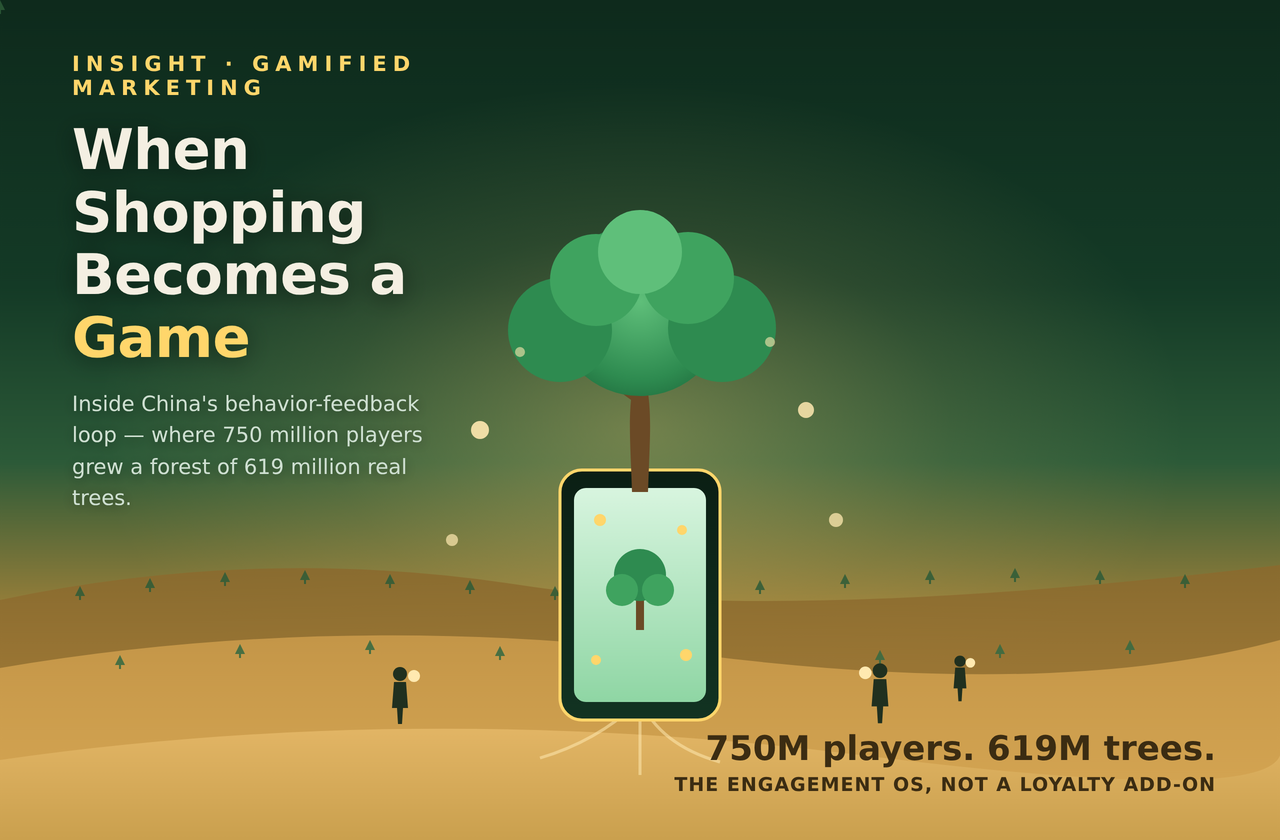
Open Alipay on a bus in Lanzhou and you’ll see it: someone watering a tree that doesn’t exist. Except it does. Somewhere in the Gobi Desert, a shrub with a number attached to it is alive because a stranger took the subway instead of a taxi. That is Ant Forest, and it might be the most successful piece of marketing ever built — a game inside a payment app that has planted 619 million real trees.
We need to talk about what China figured out, because the West keeps getting gamification wrong.
The Loyalty Add-On vs. the Engagement OS
In most Western apps, gamification is a garnish. Points here, a badge there, a progress bar toward “Gold tier.” The game sits beside the product, politely asking for attention.
In China’s super-apps, the game is the operating system of engagement. Shopping happens inside the game, not next to it. Taobao’s Baba Farm, Pinduoduo’s Duo Duo Orchard, JD’s farm clone, Double 11 team battles — these aren’t promotions. They’re daily rituals for tens of millions of people, sitting on the app’s home screen like a heartbeat.
The difference isn’t cosmetic. It’s structural. And the canonical proof is a tree-planting game that the United Nations gave its highest environmental honor.
Ant Forest by the Numbers
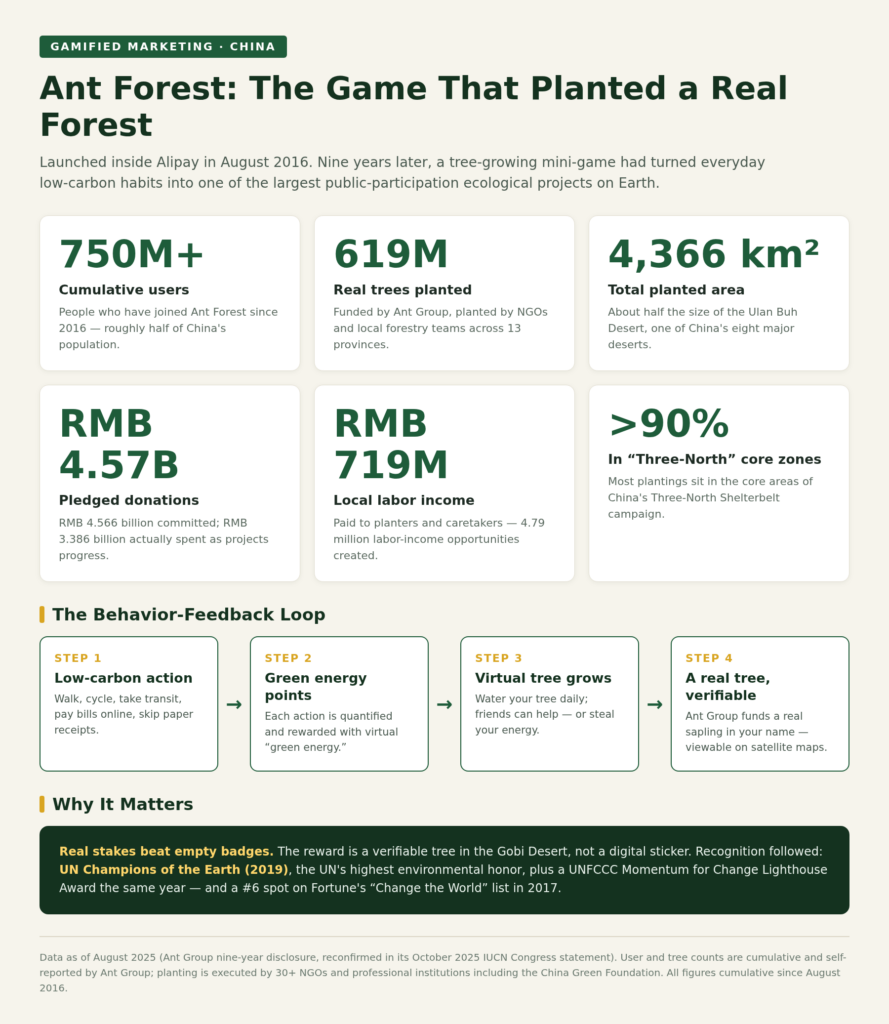
Let’s ground this before we theorize. Ant Forest launched inside Alipay in August 2016. As of August 2025, per Ant Group’s own nine-year disclosure — figures the company repeated at the IUCN World Conservation Congress that October — the scoreboard reads:
- 750 million+ cumulative users. Roughly half of China’s population has played.
- 619 million real trees planted, funded by Ant Group and planted by NGOs and forestry teams across 13 provinces.
- 4,366 square kilometers of planted area — about half the size of the Ulan Buh Desert.
- RMB 4.566 billion pledged in donations, of which RMB 3.386 billion has actually been spent as projects progress.
- RMB 719 million of that went to local planters and caretakers as labor income — 4.79 million labor-income opportunities in total.
- Over 90% of plantings sit in the core zones of China’s Three-North Shelterbelt program, the state’s mega reforestation campaign.
A note on rigor: these are cumulative, company-reported figures. The planting itself is executed by more than 30 independent organizations, including the China Green Foundation, which gives the “real trees” claim institutional backing beyond corporate PR. In 2019, UNEP awarded Ant Forest the Champions of the Earth prize — the UN’s highest environmental honor — and the UNFCCC named it a Momentum for Change Lighthouse Activity the same year. Fortune had already put Ant Financial at #6 on its “Change the World” list in 2017.
This is not a coupon campaign. This is a game that altered a desert.
The Behavior-Feedback Loop: Four Gears
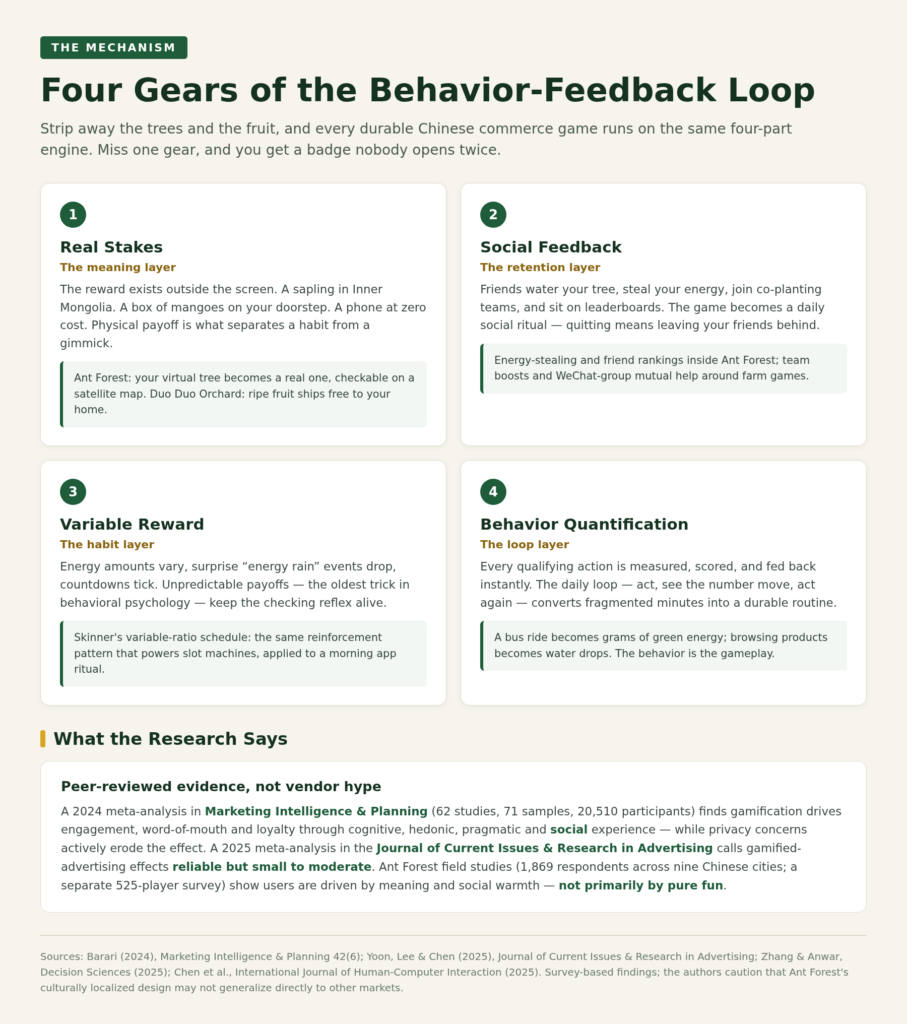
Strip away the trees and the fruit, and every durable Chinese commerce game runs on the same engine. Four gears, meshing:
Gear one: real stakes. The reward exists outside the screen. A sapling in Inner Mongolia you can find on a satellite map. A box of mangoes shipped free to your door. Meaning is what separates a habit from a gimmick — your brain knows the difference between a tree and a sticker.
Gear two: social feedback. Friends water your tree. They also steal your energy — yes, that’s a feature. Leaderboards rank your greenery; co-planting lets couples and families grow a shared tree. Quitting the game means leaving your friends behind, and that’s the retention moat no points balance can buy.
Gear three: variable reward. Energy amounts fluctuate. Surprise “energy rain” events drop. Countdowns tick. This is Skinner’s variable-ratio schedule — the reinforcement pattern behind slot machines — pointed at a morning app ritual. Predictable rewards bore us; unpredictable ones hook us.
Gear four: behavior quantification. Every qualifying action is measured and fed back instantly. A bus ride becomes grams of green energy. Browsing products becomes water drops. The behavior is the gameplay, and the loop — act, watch the number move, act again — converts fragmented minutes into routine.
What the Research Actually Says
Here’s where we leave the marketing blogs and check the science, because “gamification works” deserves an asterisk.
A 2024 meta-analysis by Barari in Marketing Intelligence & Planning pooled 62 studies, 71 independent samples and 20,510 participants. Gamification does drive engagement, word-of-mouth and loyalty — through cognitive, hedonic, pragmatic and social experience components. But privacy concerns actively corrode the effect. The game works until users feel watched.
A 2025 meta-analysis by Yoon, Lee and Chen in the Journal of Current Issues & Research in Advertising is blunter: gamified advertising produces reliable but small-to-moderate effects. Not magic. A tool.
The Ant Forest-specific studies are the interesting part. A survey of 1,869 users across nine Chinese cities, published in Decision Sciences by Zhang and Anwar, found the game satisfies deep psychological needs — autonomy, competence, relatedness — which reshape users’ green self-identity and, through it, actual behavior. A separate 525-player study in the International Journal of Human-Computer Interaction found something counterintuitive: users aren’t primarily driven by pure fun. They stay for the meaning and the warm glow. One caveat the authors themselves flag: Ant Forest is deeply localized, so don’t assume the findings export cleanly to other markets.
Read together, the evidence says the loop is real, the effect sizes are modest, and meaning plus social warmth — not entertainment alone — carries the long haul. Which explains why nine years in, people still water that tree.
The Commercial Twins: Orchards That Ship Fruit
Ant Forest is the prosocial extreme. The commercial versions run the identical loop with edible stakes.
Pinduoduo launched Duo Duo Orchard in May 2018: water a virtual fruit tree with drops earned by checking in, browsing products and recruiting friends, and when the fruit ripens, a real box arrives free. By the second half of 2018 the game was shipping over a million jin of fruit daily — roughly 500 metric tons. In May 2019, the team said the orchard had added more than 11 million daily active users since the start of the year. By 2020 its DAU had passed 50 million.
Taobao’s Baba Farm plays the same tune. A September 2024 research report jointly produced by Renmin University’s agriculture school and Taotian Group’s research center — note the co-branding: the platform has an obvious interest in flattering numbers — put the farm at 50 million+ daily active users redeeming over 450,000 portions of farm produce every day. Platform-sourced demographics reported by media say nearly half of players were born in the 1990s. These are young urbanites farming virtual orchards for real pears.
And the commercial punchline, from a 2020 industry report quoting a Baba Farm operator: coupons and red packets handed out inside the farm game were redeemed at a 60–70% rate. That’s platform-reported, so treat it as directional — but compare it with the low-single-digit redemption typical of emailed coupons and you see why every Chinese e-commerce app grew an orchard. The game isn’t distracting people from shopping. The game is the storefront.
The Scale Check: Mini-Games Became an Industry
Still think this is a quirky retention trick? Look at the money.
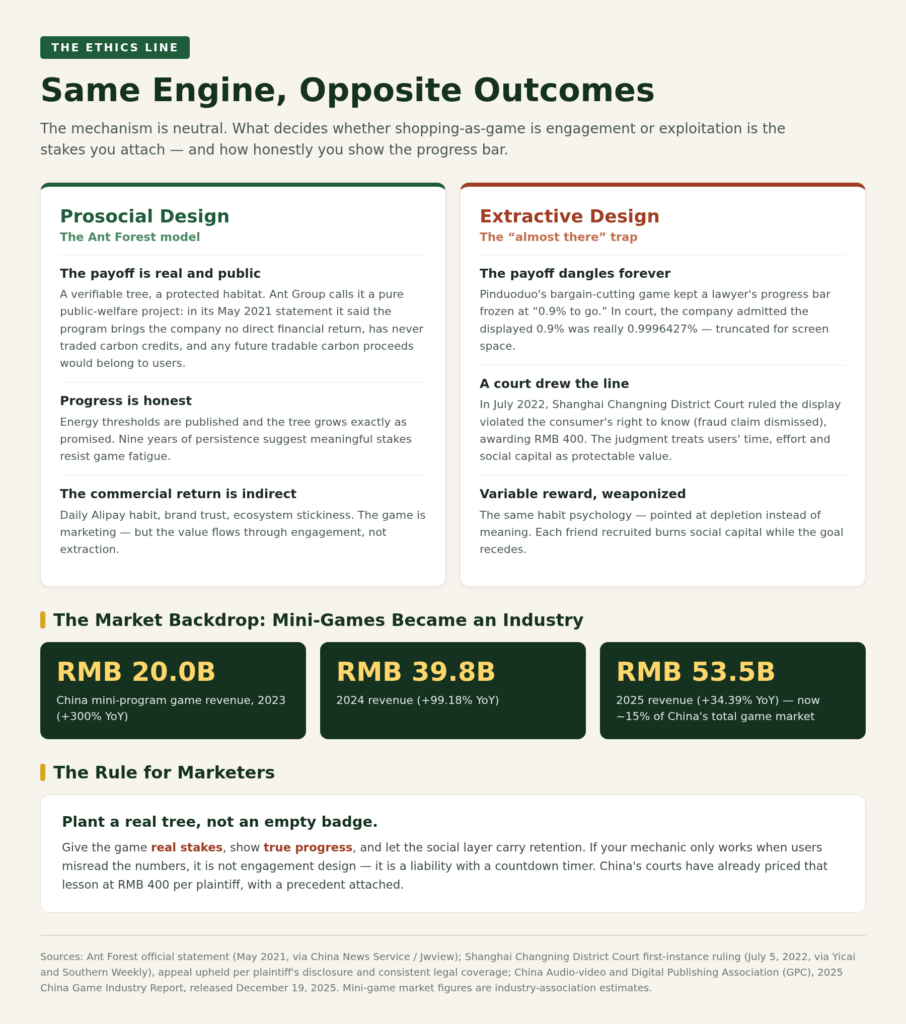
China’s industry association, the China Audio-video and Digital Publishing Association’s game committee (GPC), reported in December 2025 that mini-program games — the category these farm-and-bargain mechanics live in — generated RMB 53.5 billion in 2025, up 34.39% year over year. The trajectory: RMB 20 billion in 2023, RMB 39.8 billion in 2024, RMB 53.5 billion in 2025. Mini-games now account for roughly 15% of China’s entire game market, which totaled RMB 350.8 billion. Nearly a third of mini-game revenue comes from ads, the rest from in-app purchases.
A category that tripled, then doubled, then grew a third again is not a fad burning out. It’s infrastructure. The “game layer” of Chinese commerce has its own industry report now.
The Ethics Line: 0.9% Forever
Now the dark twin. Same engine, opposite soul.
Pinduoduo’s bargain-cutting game — kan yi dao, “cut one slice” — promises a free product if friends help you slice the price to zero. In March 2021, a Shanghai lawyer named Liu Yuhang joined in, bought a RMB 9.9 accelerator pack, recruited dozens of friends, and watched the progress bar freeze at “only 0.9% to go.” So he sued.
In court, Pinduoduo’s defense became legendary: the displayed 0.9% was actually 0.9996427%, truncated because screens have limited space. The number you saw was true the way a mirage is true. Each slice cuts a vanishing amount; the finish line recedes as you run.
In July 2022, Shanghai’s Changning District Court ruled the display violated the consumer’s right to know — grounding its reasoning in the disclosure duties of China’s Consumer Protection Law and E-Commerce Law — while dismissing the fraud claim. Damages: RMB 400. The plaintiff’s own account and consistent legal coverage say the appeal was upheld in 2023. The money is trivial; the precedent isn’t. The judgment treats the time, effort and social capital users burn in these games as protectable value, and it puts “almost there” design on notice: if your progress bar only works when users misread it, you’re building a liability, not a loyalty program.
Clearing Up the Carbon Rumor
One clarification, because it circulates in English-language coverage: no, Ant Forest does not secretly sell your carbon savings.
In May 2021, after self-media claimed Ant was packaging users’ reductions into sellable carbon credits, the program’s lead published a point-by-point denial: Ant Forest is a pure public-welfare project bringing Ant Group no direct financial return; it has never participated in carbon-credit trading; the trees and their carbon sinks belong to the state and society, with any future sinks contractually dedicated to public welfare; and if personal carbon reductions ever become tradable, the proceeds would belong to users. Ant’s own corporate carbon-neutrality plan explicitly excludes Ant Forest. There’s even a technical wrinkle: over 80% of the plantings are desert shrubs like saxaul, whose carbon sinks current methodologies can barely measure. The “trillion-yuan carbon market hidden in your phone” story was a rumor, officially denied and never substantiated.
Does Ant Group benefit? Obviously — in engagement, habit and brand trust, not carbon revenue. Which brings us to the honest framing: the prosocial game is still marketing. It’s just marketing whose value flows through meaning instead of extraction.
What Everyone Misunderstands
Four errors keep repeating in gamification decks:
“Gamification means badges.” Empty badges fail because they have no stakes and no witnesses. The tree is real, the fruit is real, your friends are watching. That’s the difference between a sticker chart and a ritual.
“It’s all manipulation.” The mechanism is neutral; the stakes decide. Ant Forest’s loop and kan yi dao’s loop share the same psychology. One plants forests and wins UN awards; the other ended up in a courtroom over a truncated decimal. Judge the design, not the category.
“The game distracts from shopping.” Backwards. In the Chinese model the game is where shopping lives — browsing earns water drops, coupons drop inside the orchard, purchases accelerate the harvest. Remove the game and you remove the store’s front door.
“Our points program is the same thing.” It isn’t. An add-on asks for spare attention; an engagement OS organizes daily behavior. Depth, real stakes and social fabric are the gap — not feature count.
The Playbook for Brands
What can you actually steal from this? Four moves, in order:
- Give the game real stakes. A physical reward, a verifiable impact, a genuine bargain. If the payoff only exists in your database, budget for fatigue. Nike’s Recycle-A-Shoe mini-program inside Alipay is a working template: send in worn shoes, they become Nike Grind sports courts, you earn Ant Forest energy. Ant Group’s October 2025 disclosure counts 430,000 pairs recycled and 50 courts built — company-reported numbers, but the design lesson stands: borrow a loop that already has meaning instead of inventing hollow points.
- Build the social layer before the reward layer. Co-play, gifting, team goals, friendly theft. Retention lives in the relationships, not the balance.
- Use variable reward — with a transparency floor. Surprise bonuses are fine. False progress bars are actionable. Publish your odds, show true progress, and never let the goalpost move silently. The RMB 400 judgment is cheap; the precedent is expensive.
- Design shopping inside the game. Make the commercial action a game move — browsing earns resources, purchasing accelerates progress — rather than an ad interrupting play.
And respect the research’s warning label: effects are small-to-moderate on average, privacy anxiety erodes them, and cultural fit matters. A transplanted orchard without local social habits is just another mini-game nobody opens twice.
The Counterargument, and Its Limit
Fair pushback: games fatigue. Novelty decays, and most gamified campaigns spike then flatline. True — for empty games. Ant Forest’s nine-year persistence is the counterexample: real stakes plus social fabric plus a slowly compounding public good keep the loop alive long after novelty dies. The fatigue argument is an argument against bad stakes, not against games.
Second pushback: Ant Forest isn’t really marketing, it’s charity. Also fair, as far as it goes — the company insists there’s no direct revenue. But a daily habit shared by hundreds of millions inside your payment app is the most valuable real estate in commerce. Calling it “not marketing” mistakes the invoice for the value.
Conclusion: Plant a Real Tree, Not an Empty Badge
Chinese gamification isn’t a loyalty add-on; it’s the engagement OS. Ant Forest proved the behavior-feedback loop at planetary scale — 750 million players, 619 million verifiable trees — and the orchards proved it commercially, with fruit boxes as the payoff and coupon redemption as the revenue. The science says the effect is real but modest, carried by meaning and social warmth rather than fun alone. And the ethics line is now case law: honest stakes engage, hidden decimals extract.
The mechanism is neutral. The stakes decide. So before you ship another badge system, ask the only question that matters: when your user closes the app, does something real exist that didn’t exist before? If yes, you’ve built a forest. If no, you’ve built a mirage — and someone with a law degree is already screenshotting it.