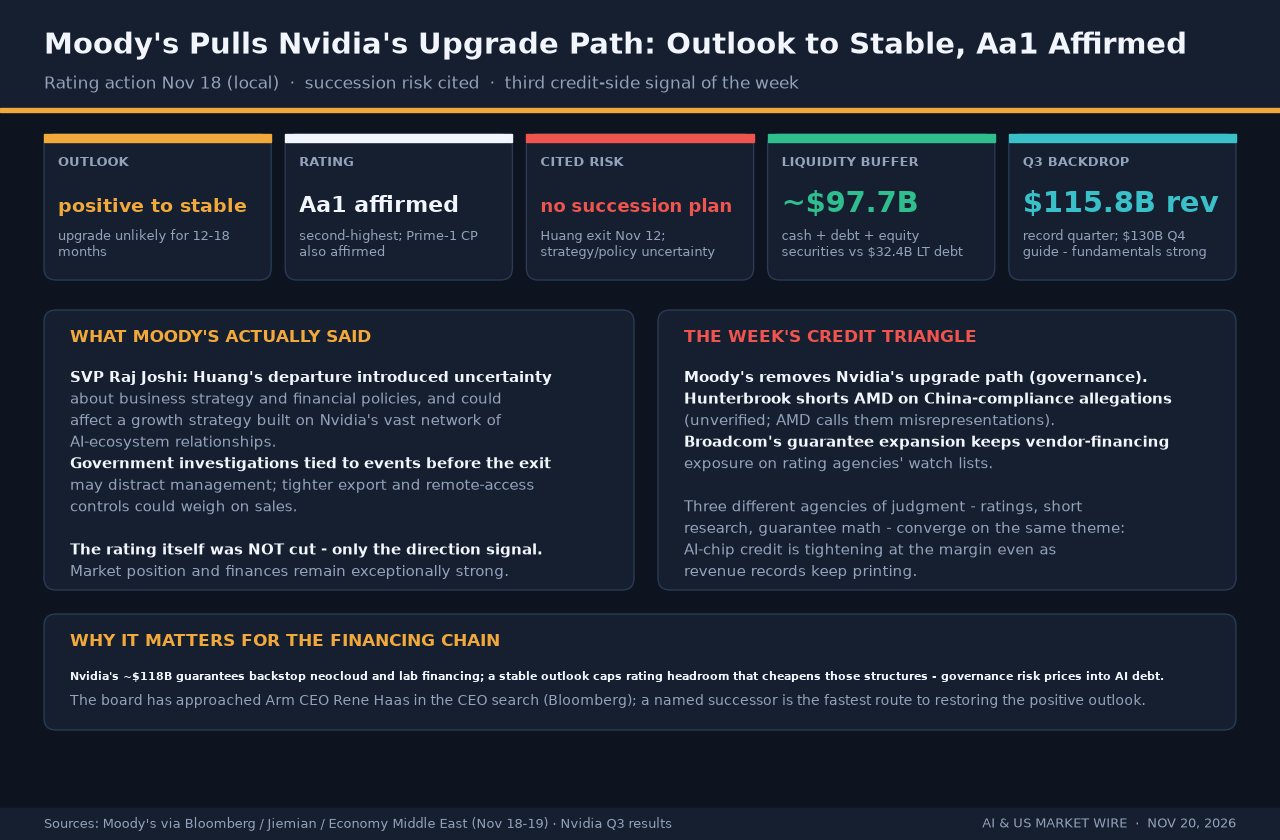
Moody’s Ratings acted on November 18 (local time), affirming Nvidia’s Aa1 senior unsecured rating and Prime-1 commercial-paper grade while cutting the outlook from positive to stable — meaning an upgrade is unlikely over the next 12–18 months — with SVP Raj Joshi citing Jensen Huang’s abrupt November 12 departure and the “lack of a formal succession plan” as introducing uncertainty about business strategy and financial policies, potentially affecting a growth strategy built on Nvidia’s vast AI-ecosystem relationships; government investigations tied to events before the exit may distract management, and tighter export and remote-access controls could weigh on sales.
The rating itself was not cut: Moody’s still calls market position and finances exceptionally strong, backed by the record $115.8 billion quarter, $130 billion Q4 guide, and ~$97.7 billion of cash plus securities against $32.4 billion of long-term debt.
The action completes the week’s credit-side triangle — Moody’s removes the upgrade path (governance), Hunterbrook shorts AMD on unverified China-compliance allegations, and Broadcom’s guarantee expansion keeps vendor-financing exposure on watch — three different instruments of judgment converging on marginal tightening of AI-chip credit even as revenue records print; with Nvidia’s ~$118 billion of guarantees backstopping neocloud and lab financing, a stable outlook caps the rating headroom that cheapens those structures, and a named successor (the board has approached Arm CEO René Haas, per Bloomberg) is the fastest route back to positive.