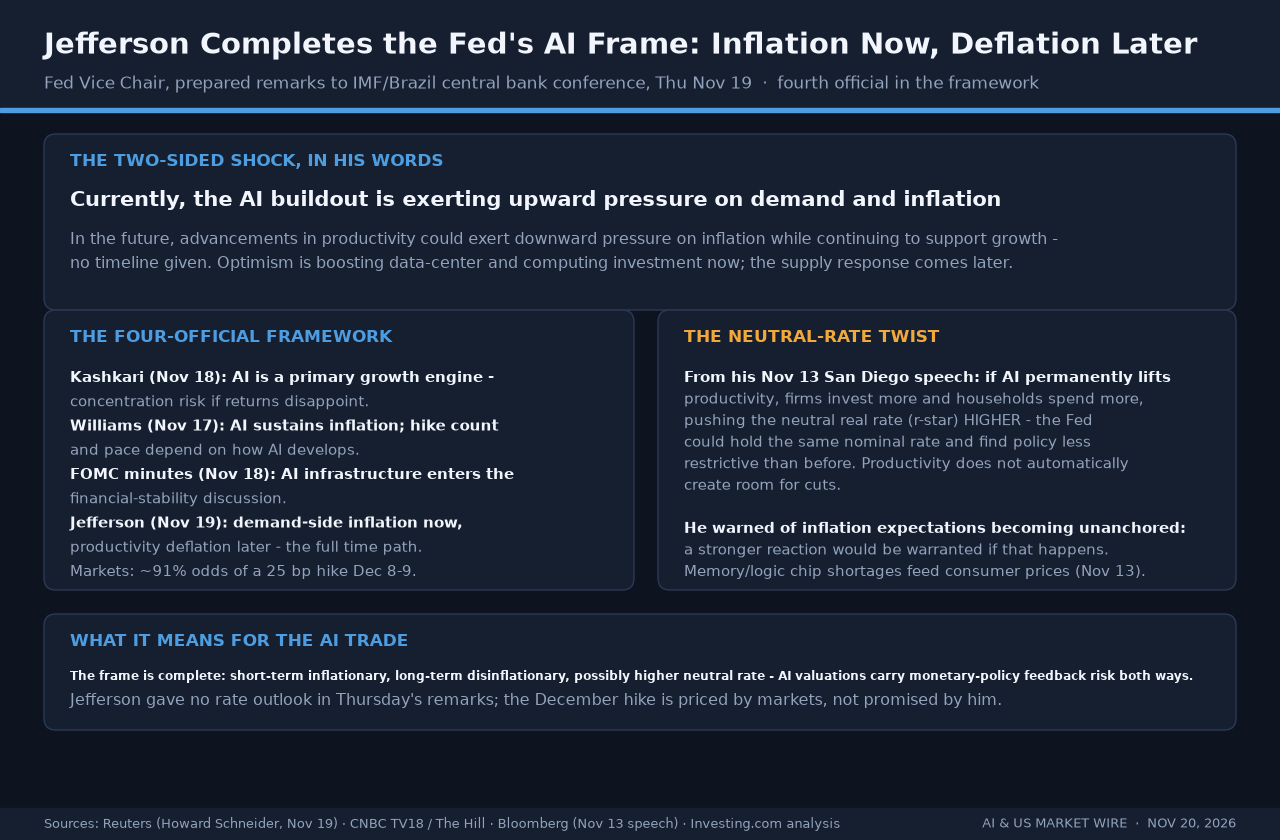
In prepared remarks to an IMF/Bank of Brazil conference on Thursday, November 19, Fed Vice Chair Philip Jefferson became the fourth official to complete the institution’s AI framework: “currently, the AI buildout is exerting upward pressure on demand and inflation” — optimism boosting data-center and computing investment now — while “in the future, advancements in productivity could exert downward pressure on inflation while continuing to support growth,” with no timeline given and no rate outlook stated.
The four-piece frame now reads: Kashkari (Nov 18) — AI is a primary growth engine with concentration risk; Williams (Nov 17) — AI sustains inflation and the hike count depends on its path; the FOMC minutes (Nov 18) — AI infrastructure enters financial-stability discussion; Jefferson (Nov 19) — the full time path, short-term inflationary and long-term disinflationary. His November 13 San Diego speech adds the twist markets underprice: if AI permanently lifts productivity, firms invest more and households spend more, pushing the neutral real rate (r-star) higher — the Fed could hold the same nominal rate and find policy less restrictive, so productivity does not automatically create room for cuts; he also warned that unanchored inflation expectations would warrant a stronger reaction, and flagged memory/logic chip shortages feeding consumer prices.
Markets price ~91% odds of a 25 bp hike at the December 8–9 meeting; for AI valuations the institutional message is a monetary-policy feedback risk in both directions.