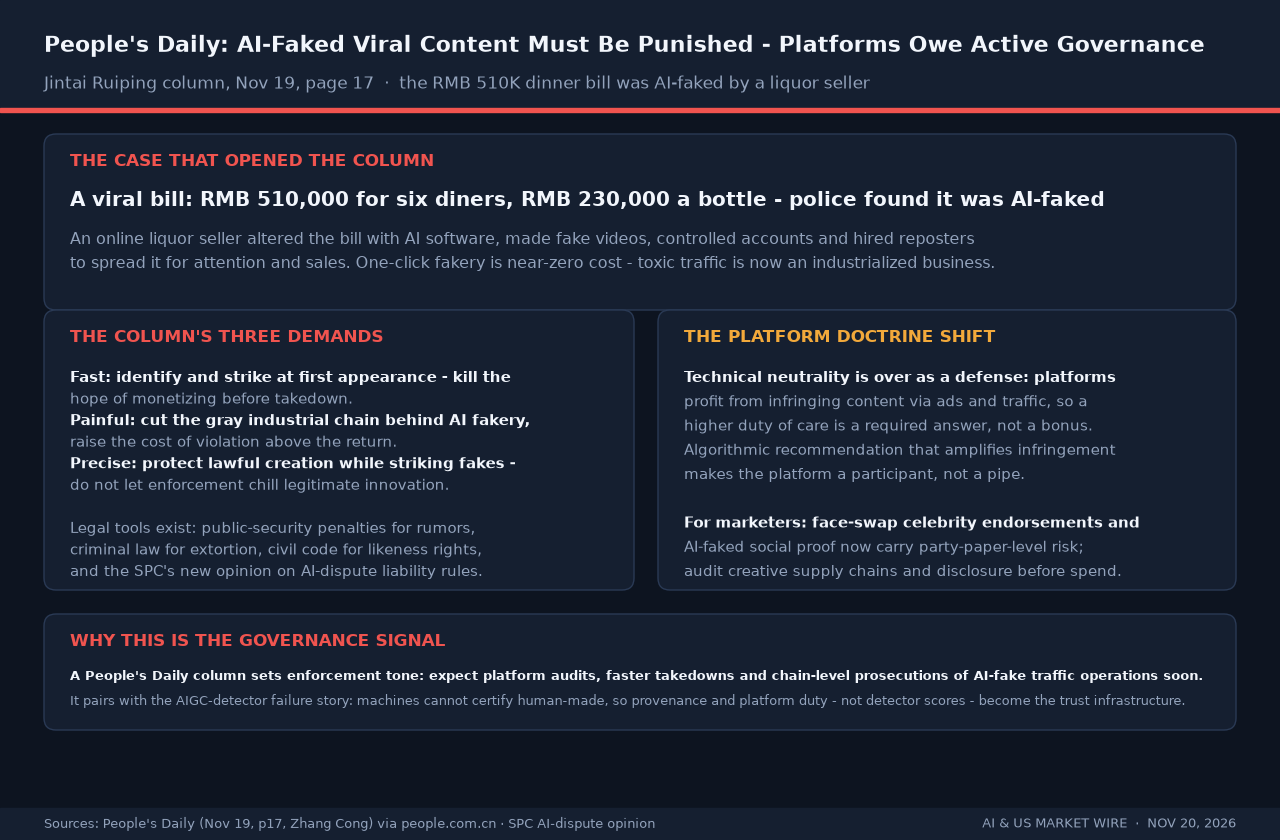
The People’s Daily’s Jintai Ruiping column (November 19, by Zhang Cong) opened with the case that sets the enforcement tone: a viral bill showing RMB 510,000 for six diners and RMB 230,000 for a single bottle of liquor turned out, per police, to be AI-faked by an online liquor seller who altered the bill with AI software, produced fake videos, controlled accounts and hired reposters to spread it for attention and sales — one-click fakery at near-zero cost has industrialized “toxic traffic” into a low-cost, high-return business, from rumor-mongering to face-swapped celebrity endorsements. The column’s doctrine shift is the news: technical neutrality is over as a platform defense — since platforms profit from infringing content through ads and traffic and their recommendation algorithms can amplify infringement, a higher duty of care is “a required answer, not a bonus”; enforcement must be fast (strike at first appearance), painful (cut the gray chain, raise violation costs above returns) and precise (protect lawful creation), with the legal toolkit already in place — public-security penalties, criminal law, civil-code likeness rights and the Supreme Court’s new opinion on AI-dispute liability.
For marketers this is party-paper-level risk signaling for face-swap endorsements and AI-faked social proof: audit creative supply chains and disclosure before spend, and expect platform audits, faster takedowns and chain-level prosecutions in the coming weeks — paired with the AIGC-detector failure story, provenance and platform duty, not detector scores, become the trust infrastructure.