The estimates were wrong — spectacularly, and in the wrong direction. A day after third-party trackers put Grand Theft Auto VI’s launch at roughly $2.36 billion, Rockstar Games and parent Take-Two Interactive published the official numbers: $3.79 billion in worldwide retail sales on day one, with 32.5 million copies sold before release, an all-platform record. The official figure runs about 60% above the Sensor Tower estimate that had circulated through the financial press. When a launch is this big, even the professionals低估 it.
The comparisons stop being meaningful at a certain point, but here they are anyway. GTA V’s first day in 2013 brought in $815.7 million; GTA VI did nearly five times that. GTA V’s entire launch-quarter retail sales were about $1.49 billion — GTA VI cleared more than double that in twenty-four hours. Take-Two’s framing is simply “the biggest launch for any entertainment product in history,” and no film opening, album release or console launch on record comes close. The critical reception matches the commercial one: a 99 average on Metacritic ties the highest-rated game ever tracked by the site.
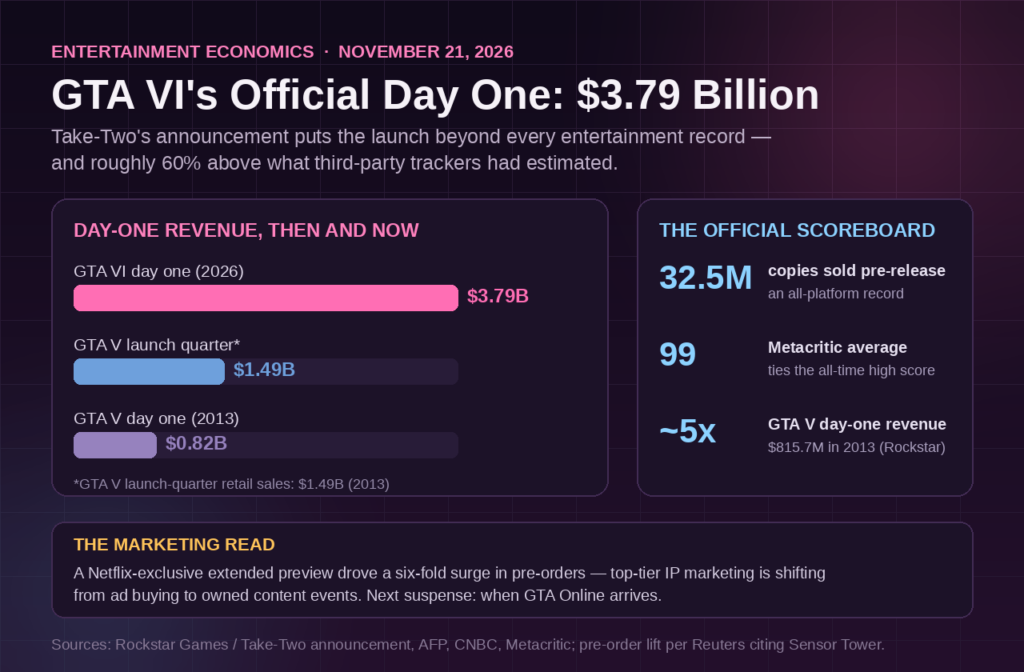
For marketers, the most instructive number in this launch is not the revenue. It is the six-fold pre-order surge that followed August’s Netflix-exclusive extended preview, documented by Reuters citing Sensor Tower data. Rockstar ran no conventional ad blitz. Instead it turned its marketing budget into an owned content event — placing the game’s deepest look inside the world’s largest streaming subscription, where attention already lives. The playbook implication is blunt: for top-tier IP, the highest-leverage marketing spend increasingly buys exclusive content moments, not impressions. Scarcity plus cultural placement beat reach.
The gap between estimate and official number carries its own lesson. Third-party trackers model pre-orders and digital storefronts; they systematically miss physical retail, bundle attach rates and the sheer breadth of a mass-market launch. Analysts and journalists quoting tracker data as fact spent a day understating the biggest entertainment event ever measured — a reminder to keep “estimated” attached to every pre-official number, in gaming and in any category where launch hype outruns measurement.
What comes next is the part Take-Two’s own bulls care about most. TD Cowen has argued that the timing and scale of GTA Online matter more to the investment case than boxed sales — recurring revenue is where a launch becomes a franchise economy. The Online rollout date is now the single most anticipated announcement in the industry, and the next natural peak in a news cycle that has already rewritten the record books. For brands still circling the GTA conversation, the window is not closing: the story has simply moved from “will it sell?” to “what does it become?”






