In the early hours of November 21, Beijing time, Tencent’s Hunyuan team did something no Chinese frontier lab had done before: it sat down on Reddit’s r/LocalLLaMA and answered questions from anyone. For 120 minutes, researchers behind the Hy model family — with chief AI scientist Shunyu Yao appearing in the thread — fielded more than 300 comments and answered close to a hundred questions. The timing was deliberate. Hours earlier, Tencent had published the full weights of Hy4, its 770-billion-parameter flagship, alongside a system card.
The most consequential answers were about scale. Asked why Tencent stays around 700 billion parameters while ByteDance and Moonshot push toward three or even five trillion, the team argued that Hy3 and Hy4 prove well-trained smaller models can beat bigger ones — at lower cost, with more learned along the way. But this is not a retreat from scale: the next-generation Hy model “will definitely expand its scale significantly,” the team said, adding that it firmly believes in scaling laws and is investing heavily in large-scale reinforcement learning. On the export restrictions that limit access to advanced chips, the answer was candid: the team is making the fullest possible use of existing resources to catch the frontier.
The roadmap news developers wanted also came out. Hy4-mini is officially in the works, along with models designed for 24GB-VRAM devices, a lightweight Flash-Lite variant, and possibly dense models in the 24–31 billion range. Smaller open image models are under consideration, and a new video model was teased. The economics pitch is aggressive: in Tencent’s own blind test covering 85 internal users and 259 work tasks, Hy4 flash — 224 billion total parameters but only 12 billion active per token — completed a task for about 0.26 yuan, roughly four US cents, or one-twentieth of the flagship’s cost.
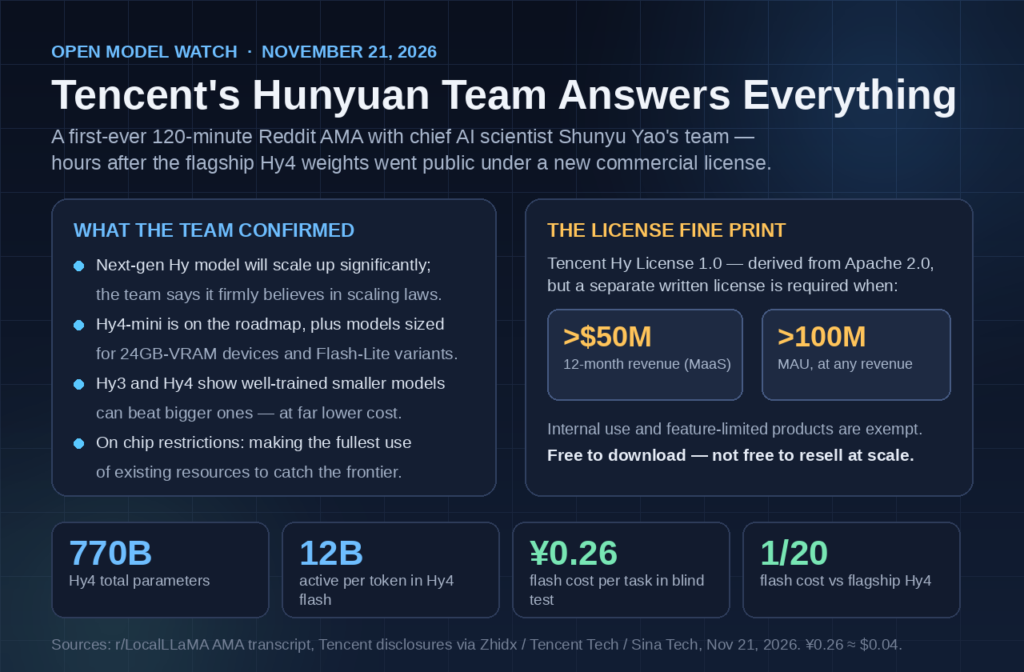
The part of this release that will outlive the AMA, though, is the paperwork. Hy4’s weights ship under the Tencent Hy License 1.0 — derived from Apache 2.0, but explicitly not Apache 2.0. Download, modification, and most commercial use remain free. The catch targets scale: operators offering general-purpose model-as-a-service access to third parties need a separate written license once their aggregate worldwide revenue exceeds $50 million in any consecutive twelve months — whether or not that revenue comes from the model — or before deploying it in any product with more than 100 million monthly active users. Internal use and feature-limited end-user products are exempt, and the license excludes no territory.
That design says something about where open AI is heading in 2026. Tencent is not banning anyone; it is taxing scale. A startup building on Hy4 faces essentially Apache-like freedom. A cloud provider reselling Hy4 inference at volume faces a negotiation. Compare that with regional exclusions in some competing licenses, and the strategy is clear: maximize ecosystem adoption while keeping pricing power over the biggest resellers. For marketing and product teams evaluating open-weight vendors, the practical lesson is that “is it open source?” is now the wrong question. The right one is “what does the license do when we succeed?”