The fight over AI stopped being abstract this year. It moved into zoning hearings, water contracts and utility bills — and journalist Paris Marx has written the field guide. In his new book “Hyperscale,” Marx goes inside the data centers themselves; in a TechCrunch interview with Anthony Ha published November 22, he explains why these buildings became the most visible target of a broad, bipartisan backlash against Big Tech.
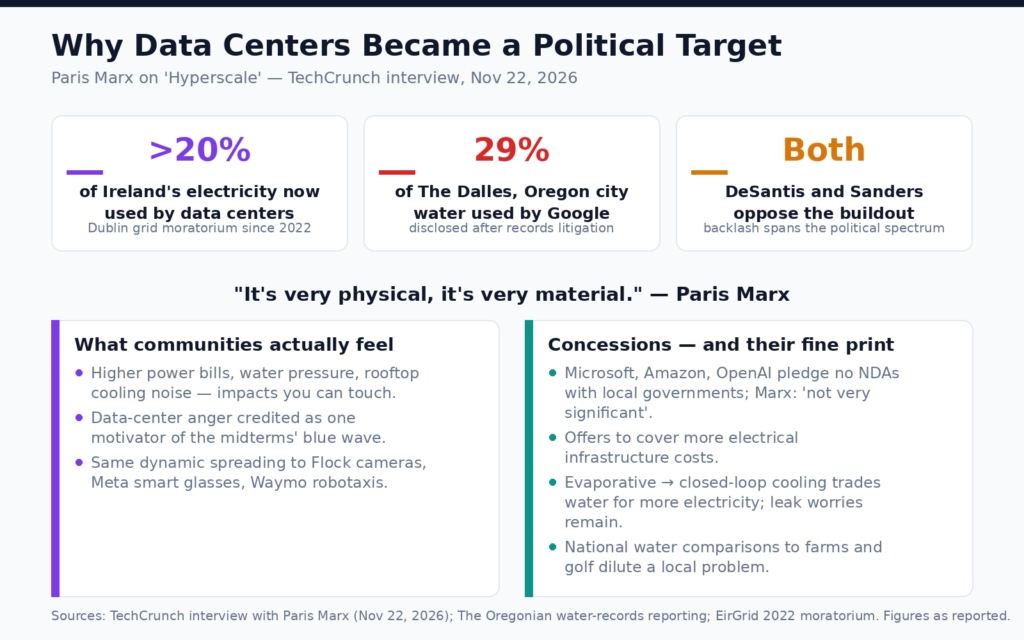
Start with the numbers that made communities organize. Data centers now consume more than 20% of Ireland’s electricity, and the grid operator imposed a moratorium on new Dublin-area connections back in 2022 — before the generative-AI boom added a single server. In The Dalles, Oregon, where Google built its first company-operated data centers about twenty years ago, a renewal fight over water ended in litigation against a newspaper’s records request; when the data finally emerged, Google was using 29% of the city’s water. Around Santiago, Chile, Google and Microsoft projects triggered community activism over water access.
Marx’s explanation for the politics is disarmingly simple: “It’s very physical, it’s very material.” You experience generative AI through a screen; you experience a data center through your power bill, your water pressure and the roar of rooftop cooling units. That is why opposition spans Ron DeSantis and Bernie Sanders, and why data-center anger is credited as one of the motivators of the recent midterms’ blue wave. Marx sees the same dynamic spreading to other physical manifestations of tech: Flock surveillance cameras, Meta’s smart glasses, Waymo’s robotaxis. Deleting an app changes nothing; blocking a building changes a balance sheet.
The industry’s concessions, in his telling, are reactions rather than transformations. Microsoft, Amazon and OpenAI have said they will stop using NDAs in negotiations with local governments — Marx rates the shift “not very significant,” noting secrecy became a liability once communities learned to ask questions. Companies now offer to pay more of the electrical infrastructure costs and promise a switch from evaporative to closed-loop cooling. But closed-loop systems trade water for electricity, a tradeoff rarely mentioned in the pitch, and communities worry about coolant and chemical leaks into water supplies. He also flags a rhetorical migration: national water comparisons to agriculture and golf courses are used to dilute what is fundamentally a local problem.
Getting inside was its own story. After rejections and site visits in northern Virginia and Ireland, Marx toured a New Zealand facility: passport submitted in advance, verified on arrival, key cards at every locked door, and a server hall so piercingly loud that earplugs became mandatory. Researchers told him access was easier before the AI spotlight.
Marx insists he is not anti-technology; his target is scale without consent, and a “single future” narrative in which a county’s water rights become a discountable variable. His alternatives — digital sovereignty and publicly developed technology — put “who builds, and for whom” back on the table. For an industry whose bottleneck has shifted from chips to power, land and permission, that question is no longer philosophical. It is the schedule.