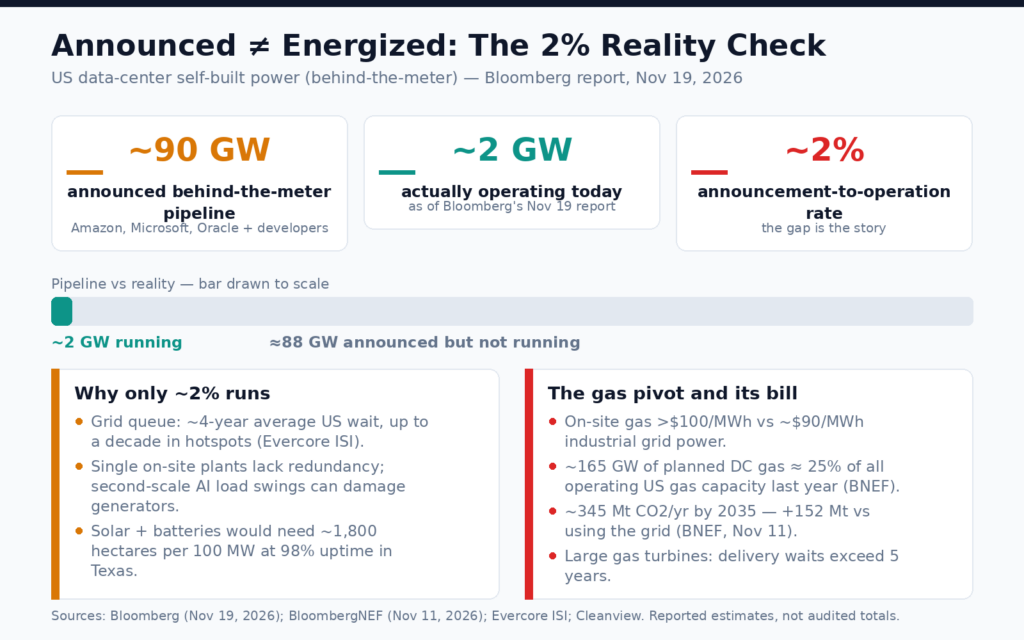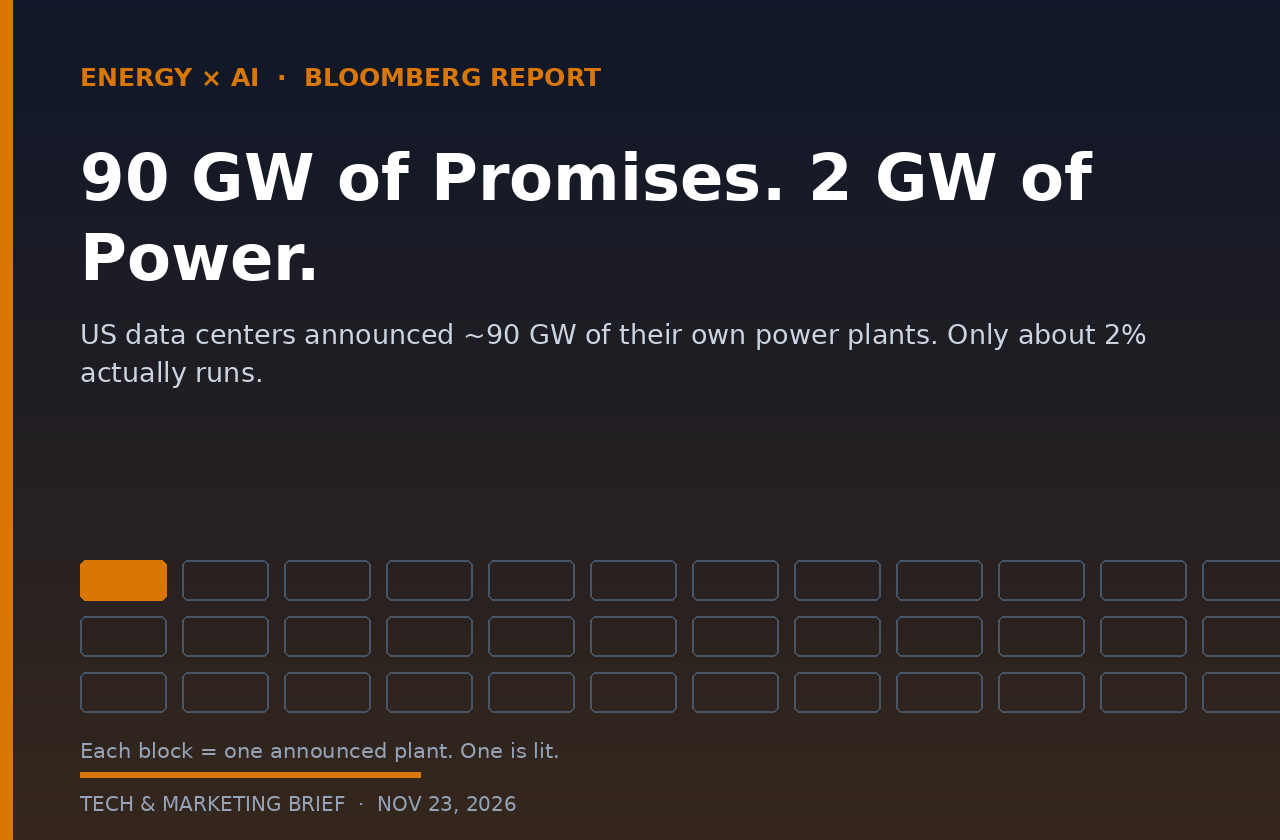
America’s AI buildout has a power problem, and its favorite workaround is mostly a press release. Bloomberg reported this week that US data-center developers have announced roughly 90 gigawatts of their own power plants — the “behind-the-meter” model, where generation sits inside or next to the campus instead of coming through the grid. Only about 2 GW of that is actually running. That is a completion rate of roughly 2%.
The announcement-to-operation gap is the story. Hyperscalers including Amazon, Microsoft and Oracle embraced self-generation because waiting for a grid connection has become intolerable: Evercore ISI puts the average US wait at nearly four years, stretching to a decade in hotspots. Building your own plant looks like a way to buy time. In practice, most developers treat on-site generation as a bridge until the grid connection arrives — not as a permanent exit from the grid.
The engineering explains the caution. A grid connection draws on many plants and lines, so one failed machine doesn’t stop the electrons. A single on-site plant has no such redundancy, and AI workloads swing demand within seconds — swings violent enough to damage some on-site generators. The clean alternative is land-hungry: Bloomberg’s analysis indicates solar-plus-batteries would need almost 1,800 hectares to keep a 100 MW Texas data center running 98% of the year. So the rush off-grid is, for now, a rush to gas.
That pivot has a price tag and a carbon tail. On-site gas for a 500 MW-class site costs more than $100 per megawatt-hour, against roughly $90 for industrial grid power — a premium companies pay to energize sooner. BloombergNEF tallies about 165 GW of planned gas projects tied to US data centers, equivalent to a quarter of all operating US gas capacity last year if all were built. In a November 11 report commissioned by Bloomberg Philanthropies, BNEF estimates planned behind-the-meter gas plants could emit about 345 million metric tons of CO2 annually by 2035 — 152 million tons more than if those campuses simply used the grid.
The supply chain is queuing up too. Large gas turbines now carry delivery waits exceeding five years, pushing developers toward aeroderivative turbines and reciprocating engines. And politics is tightening: after midterms left governors supporting data-center construction pauses in about a dozen states, air-permit hurdles for on-site gas plants are likely to rise, even as Washington’s nonbinding Ratepayer Protection Pledge pushes developers to fund their own power.
For AI roadmaps, the lesson is uncomfortable. Announced gigawatts are not electrons, and the scarce asset is not capital but time-to-power: turbines, transformers, permits. Anyone modeling AI capacity from headline power announcements should apply the 2% reality check first — and watch how much of the 90 GW pipeline survives contact with a permit office.