A Chinese AI lab says one of its internal models has started doing something that usually takes a cryptography PhD years to attempt: finding real weaknesses in published cipher designs. MiniMax disclosed that an unreleased internal model, running an automated cryptanalysis workflow, produced results across three categories — and, importantly for anyone reading headlines about “AI breaking encryption,” none of them touch the algorithms that actually protect your bank account.
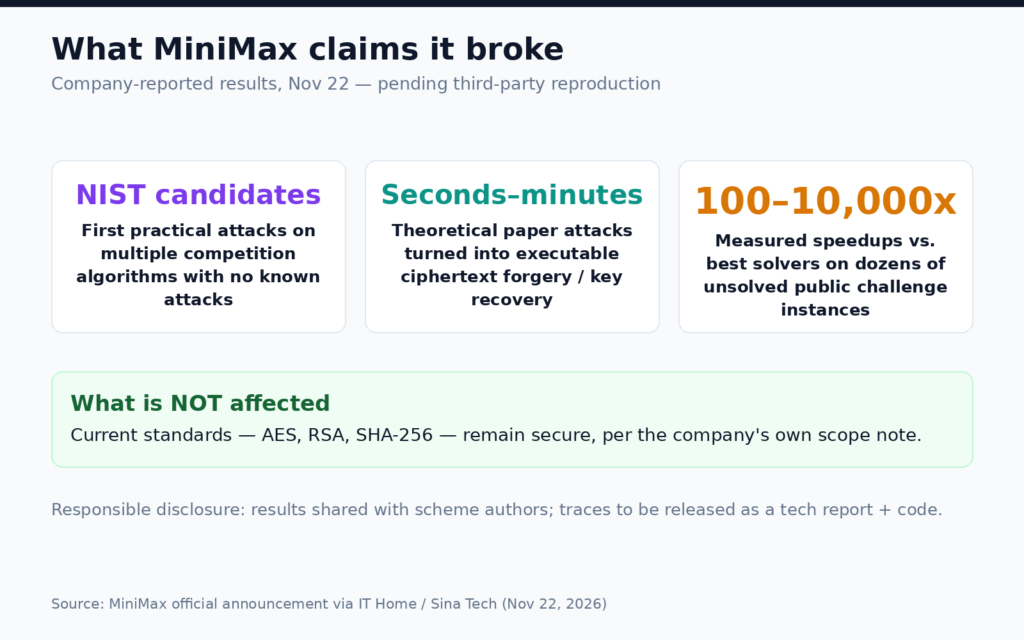
According to the disclosure, relayed in detail by Chinese tech outlet IT Home, the first category is a break against a candidate cipher from a NIST standardization process — a design under evaluation, not a deployed standard. The second covers schemes published at top academic venues: the workflow produced ciphertext-forgery and key-recovery results, including what MiniMax describes as a record for the highest number of rounds broken on a newer block cipher. The third category is speed: on public cryptanalysis challenge instances, the system reportedly ran hundreds to tens of thousands of times faster than prior approaches.
The company was explicit about the boundary that matters. AES, RSA and SHA-256 — the workhorses of everyday encryption and signing — are not affected. That distinction is the whole story. Academic cryptanalysis advances by attacking reduced-round versions and candidate designs; a result against round-reduced variants of a new cipher is a contribution to the design literature, not a break of production cryptography. MiniMax says it has notified the authors of the affected designs and plans to release a technical report and code, which is the step that will let the cryptography community verify or dismantle the claims.
Until that report lands and third parties reproduce the results, every number here carries the same label: vendor-reported. Automated cryptanalysis is a plausible frontier for capable models — the search space is formal, verification is cheap relative to discovery, and progress is measurable, which makes it unusually well suited to AI-driven search. That plausibility is exactly why independent reproduction matters more than usual. A confirmed result would be a genuine milestone for AI-assisted security research; an unreproduced one would join a growing pile of impressive internal demos.
For security and engineering teams, the actionable takeaways are modest and boring, which is the point. Keep using standards-track algorithms with long public scrutiny histories. Treat “AI broke a cipher” headlines by checking which cipher, how many rounds, and whether the result is peer-reviewed. And watch this space: if MiniMax’s report survives scrutiny, automated cryptanalysis becomes one more domain where AI compresses years of expert search into compute-hours — with obvious implications for how fast new cryptographic designs can be vetted before deployment.
The interesting claim is not that encryption is doomed. It is that a general-purpose model may now be a credible research assistant in one of the most specialized fields in computer science. The proof, as always in cryptography, will be public.