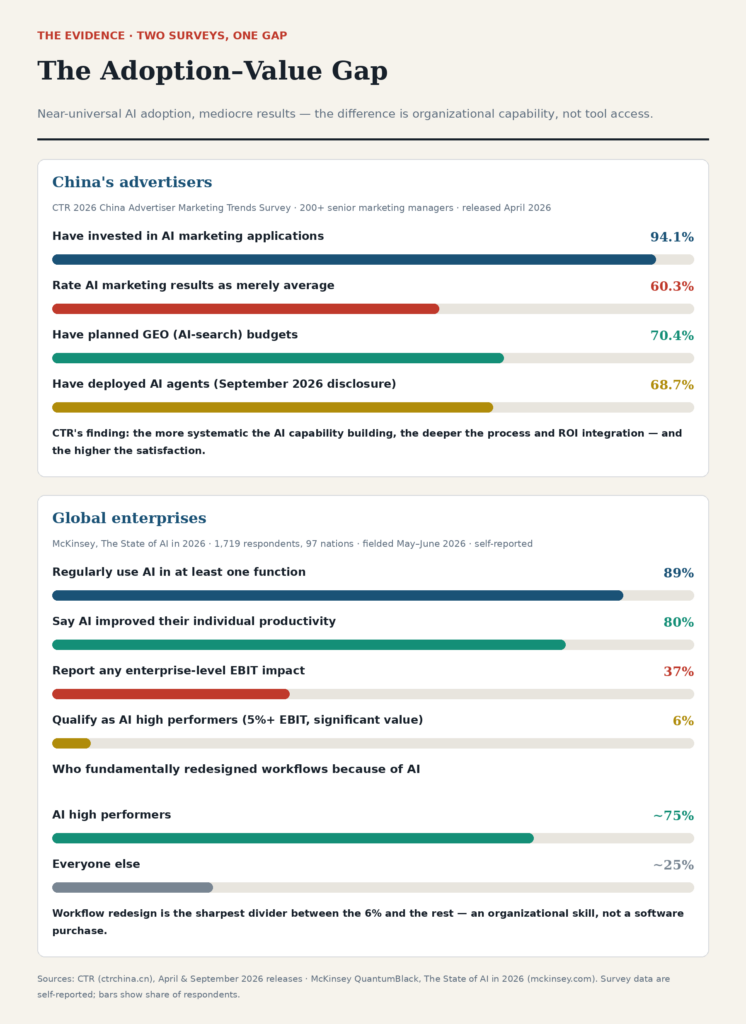
Two numbers should keep every marketing leader awake. In China, 94.1% of advertisers have already invested in AI marketing. And 60.3% of those same advertisers rate the results as merely average. Read that again: nearly everyone bought in, and a solid majority is underwhelmed. If tools were the answer, those two numbers could not coexist.
They coexist because the missing variable was never access. It is capability — the capability of the team as an operating unit, not the enthusiasm of its most AI-fluent employee. This piece gives you a way to locate that capability: a four-level model, a twenty-question self-assessment you can run this week, and a training path for each rung. No vendor pitch attached. Just a mirror.
A Market Where Everyone Already Has the Tools
The backdrop matters, because China is the most saturated consumer AI market on earth. The China Internet Network Information Center — the state internet statistics body — counted 602 million generative-AI users as of December 2025, up 141.7% in a year, with penetration reaching 42.8% of the population, a 25.2-percentage-point jump. Those figures come from its 57th statistical report, released February 5, 2026; a follow-up CNNIC report published September 29, 2026 showed the base passing 700 million by mid-year.
The commercial tracker QuestMobile tells the same story at app level. By March 2026, AI-native apps in China counted 446 million monthly active users — roughly 135 million more than four months earlier. Doubao led with 345 million, Alibaba’s Qwen reached 166 million, DeepSeek held 127 million. The average user opened these apps 87.1 times a month and spent 173.3 minutes inside them, both up sharply year over year.
Sit with the implication. Your customers are already fluent in the technology your team is still debating. The audience learned AI on its own time, for its own reasons. Whether your team can operate at that level of fluency — together, repeatably, safely — is the actual competitive question of 2026.
The Value Gap Is Global
The Chinese advertiser figures come from CTR, the CCTV-affiliated market research firm, whose 2026 advertiser survey — its eighteenth consecutive edition — polled more than 200 senior marketing managers and was released jointly with the Communication University of China on April 28, 2026. The most useful sentence in that release is not the 94.1% or the 60.3%. It is this: the more systematic an advertiser’s AI capability building, the deeper its AI use runs into process optimization and ROI loops — and the higher its satisfaction. The researchers found the ladder. Most teams have not climbed it.
McKinsey’s 2026 State of AI survey confirms the pattern globally: 1,719 respondents across 97 nations, fielded May to June 2026. Some 89% of organizations regularly use AI in at least one function, and 80% of respondents say it improved their personal productivity. Yet only 37% report any enterprise-level EBIT impact — essentially flat year over year — and just 6% qualify as high performers. What separates that 6%? Nearly three-quarters of them fundamentally redesigned workflows because of AI, against roughly a quarter of everyone else. Not better models. Not bigger budgets. Rebuilt work. Note the kicker for our profession: marketing and sales is the function respondents most often credit with AI-driven revenue gains. The prize is real. It is just gated behind organizational skill. (All of these are self-reported survey figures, not audited financials.)
The Pyramid: Four Levels of Team Capability
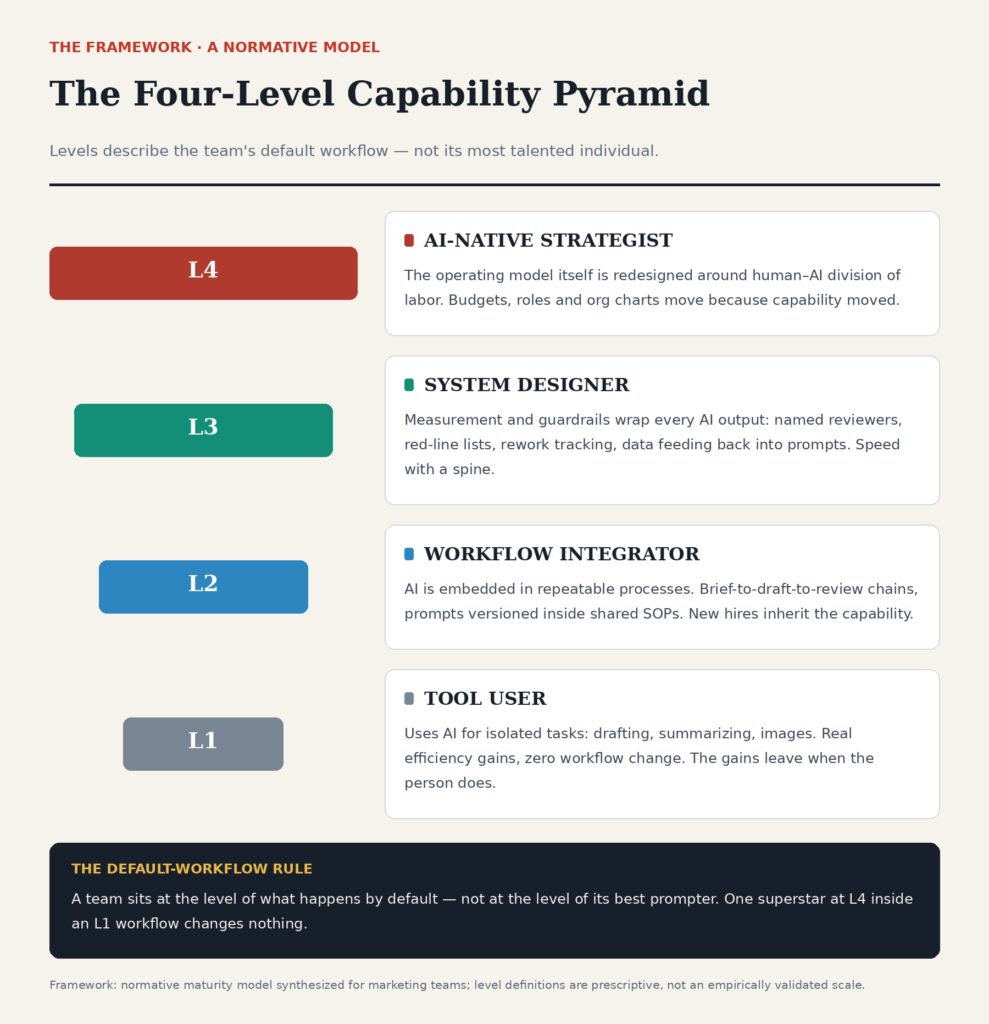
Here is the model. Four levels, each defined by what the team’s work looks like by default. It is a normative framework — a prescription for how to build capability, not an empirically validated scale — but every rung is anchored in what the surveys above show separating winners from stallers.
Level 1 — The Tool User
People use AI for isolated tasks: draft this caption, summarize that report, generate an image. The gains are real — McKinsey’s 80% productivity figure lives here — but they are personal, not organizational. Nothing about the workflow changes. When your best prompter goes on vacation, the capability goes with her.
Level 2 — The Workflow Integrator
AI is embedded in repeatable processes. The brief-to-draft-to-review chain has documented AI steps. Prompts live inside shared SOPs, versioned, not in someone’s private notes app. A new hire can inherit the team’s capability by reading documentation. This is the first level where capability survives personnel changes — the first level that compounds.
Level 3 — The System Designer
The team builds measurement and guardrails around AI output: named human reviewers, written red-line lists, rework tracking, and performance data flowing back into prompts and templates. Level 3 is where speed gets a spine. It maps directly to the trust-system and red-line playbooks in this series’ companion modules — capability and verification are built together or not at all.
Level 4 — The AI-Native Strategist
The operating model itself is redesigned around a human–AI division of labor. Budgets shift because capability shifted. Roles get rewritten. Build-versus-buy decisions account for what the team can now make itself — McKinsey found 32% of organizations already skipped a software purchase for exactly that reason. Level 4 is not “we use AI a lot.” It is “we are organized differently because AI exists.”
The Default-Workflow Rule
One rule makes this model honest: a team sits at the level of its default workflow, not its best person. A brilliant L4 thinker inside an L1 workflow is a consultant the team occasionally consults, not a capability the team owns. Ask what happens on a normal Tuesday when nobody is being heroic. That is your level. This is also why “we hired an AI expert” so often disappoints: the expert joins, the workflows stay, and the org chart absorbs the novelty without absorbing the skill.
Why Teams Stall Between Level 1 and Level 2
The stall is the most common failure in the data, and it has three causes.
First, the prompt-hoarding trap. Individual tricks do not compound; shared SOPs do. When discoveries stay personal, the team pays the same learning cost over and over. The SOP-library module in this series exists precisely to convert private cleverness into public infrastructure.
Second, the review-gate vacuum. Without named reviewers and written standards, AI output feels risky, so people quietly revert to manual work — and the pilot dies of politeness. Trust gates are not bureaucracy; they are the permission structure that lets speed scale.
Third, incentive misalignment. If you measure output volume, AI floods you with volume. If you measure reviewed quality and rework, AI helps you raise the bar. Teams get the behavior they meter.
The training data explains why the stall persists. The Marketing AI Institute’s 2025 survey of 1,882 marketers found lack of education and training was the top adoption barrier for the fifth consecutive year (62%), and 68% said their companies provide no AI training at all. Respondents clustered exactly where our model predicts: 40% experimenting, 26% integrating, 17% transforming. Two caveats, stated plainly: the sample skews toward people already interested in AI — likely flattering the true picture — and the Institute sells AI training, so it profits from the gap it measures. Even discounted, the direction matches CTR and McKinsey: individuals are ahead of their organizations.
The 20-Question Self-Assessment
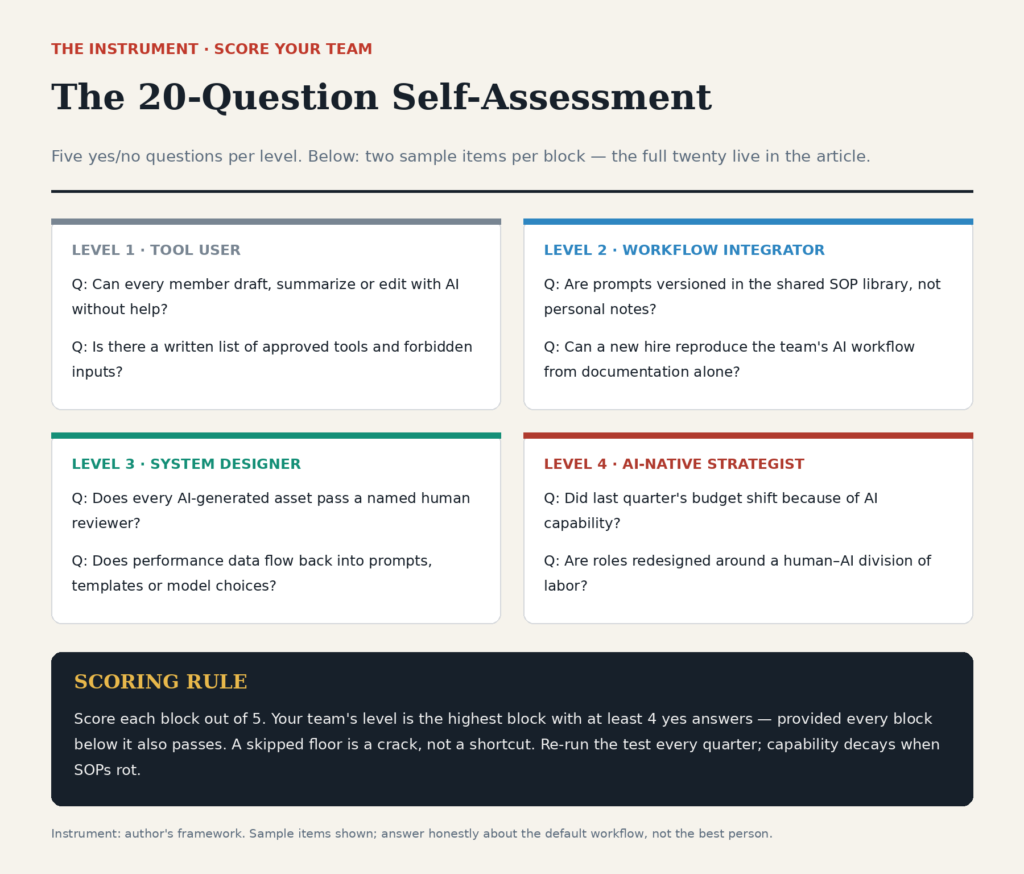
Run this with your team in one meeting. Answer yes only when the statement describes the default, documented reality — not intent, not your star performer. Five questions per level.
Level 1 — Tool User
- Can every team member draft, summarize and edit with AI without hand-holding?
- Is there a written list of approved AI tools for work use?
- Does everyone know what must never enter a prompt — customer data, unpublished pricing, credentials?
- Does everyone use AI at least weekly for real deliverables, not demos?
- Can team members spot a confidently wrong AI answer and verify it before use?
Level 2 — Workflow Integrator
- Are the team’s best prompts versioned in a shared SOP library rather than personal notes?
- Do recurring tasks — brief to draft to review — have documented AI-assisted workflows?
- Could a new hire reproduce the team’s AI workflow from documentation alone?
- Are those SOPs reviewed and refreshed on a set schedule?
- When someone finds a better prompt, does it reach the whole team within a week?
Level 3 — System Designer
- Does every AI-generated asset pass a named human reviewer before it ships externally?
- Is there a written red-line list — forbidden claims, data rules, legal boundaries — that reviewers enforce?
- Do you track the rework rate of AI-assisted output?
- Does performance data flow back into prompts, templates or model choices?
- Could you show a client or regulator who reviewed what, and when?
Level 4 — AI-Native Strategist
- Did last quarter’s budget shift because of AI capability?
- Are roles and job descriptions redesigned around a human–AI division of labor?
- Does leadership treat capability metrics as operating KPIs, not IT trivia?
- Do build-versus-buy decisions account for what the team can now build itself?
- Is there a named owner of the operating model — not just of the tool licenses?
Scoring: each block scores out of 5. Your team’s level is the highest block with at least 4 yes answers — provided every block below it also passes. A skipped floor is a crack, not a shortcut. Re-run quarterly; capability decays when SOPs rot.
Training Paths That Actually Move Teams
The World Economic Forum’s Future of Jobs Report 2025 — over 1,000 employers representing 14 million workers across 55 economies — gives the macro stakes: employers expect 39% of workers’ core skills to change by 2030, and 59 of every 100 workers will need training. Of those 59, employers expect 29 can be upskilled in their current roles and 19 redeployed after retraining; 11 are unlikely to get the training they need. Skill gaps are the single biggest barrier to transformation, cited by 63% of employers, and 85% plan to prioritize upskilling. The teams that win will be the ones that treat that as an operations plan, not an HR slogan.
Here is the plan per rung. Time budgets are our recommendation, not survey findings — calibrate to your team size.
- L1 to L2 (allow four to six weeks): run prompt-to-SOP conversion workshops. Every personal trick that survives peer review becomes a documented step. Pair writing with review checklists from day one, so integration never outruns verification.
- L2 to L3 (allow a quarter): teach measurement literacy — what to track, what a rework rate means, how feedback changes prompts. Run red-line drills: feed the team plausible but non-compliant drafts and time how fast the gate catches them.
- L3 to L4 (allow two quarters): study operating-model redesign cases and run budget simulations. If AI cut production cost by half, where does the freed budget go — more experiments, deeper research, fewer agencies? Level 4 is rehearsed in spreadsheets before it is announced in org charts.
Who Needs Which Level
Not everyone needs L4. Forcing analysts to strategize or strategists to prompt is its own waste. Map roles to minimums:
| Role | Minimum level | Evidence to look for |
|---|---|---|
| Content producers | L2 | Drafts follow SOP-linked prompts and pass review |
| Channel operators | L2 | Platform routines documented, versioned, shared |
| Analysts | L3 | Own measurement loops and feedback into prompts |
| Team leads | L3 | Own review gates, red lines, rework metrics |
| CMO / system owners | L4 | Budget and org decisions reflect capability |
The logic: whoever owns a gate needs L3; whoever owns the operating model needs L4. Everyone else needs L2 plus honesty about what they do not own.
The Capability–Trust Interlock
Capability and trust are twin frameworks, and each fails alone. Capability without review gates produces unverified claims at machine speed — the fastest route to a correction, a lawsuit, or a fine. Gates without capability produce slow, manual everything. You need both, built in the same motion.
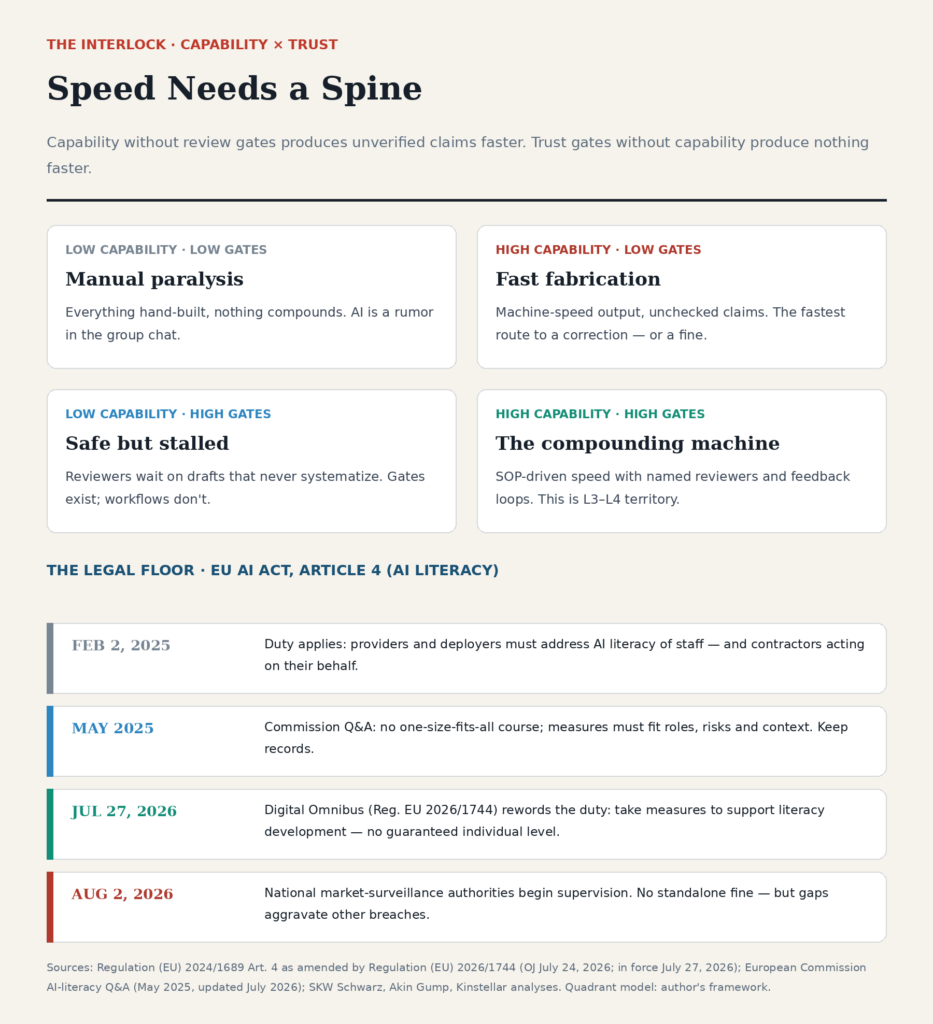
If your team touches the EU, this interlock now has a legal floor. Article 4 of the EU AI Act has required AI-literacy measures since February 2, 2025, covering staff and contractors operating AI on your behalf. The Commission’s May 2025 guidance is blunt: no one-size-fits-all course; measures must fit roles, risks and context, and you should keep records. Note the fresh wrinkle most articles miss: the Digital Omnibus — Regulation (EU) 2026/1744, in force since July 27, 2026 — rewrote Article 4. Providers and deployers must now take measures to support the development of AI literacy, explicitly without guaranteeing any individual’s level. Lawyers call it a shift from an obligation of result to an obligation of effort. The duty did not vanish; national market-surveillance authorities began supervising in August 2026, and missing literacy measures aggravate other breaches. Conveniently, the evidence an auditor wants — role-tailored training, dated records — is exactly what the L2-to-L3 path produces.
Measure Capability, Not Licenses
Tool spend measures procurement, not skill. Track these instead: the share of core workflows with a live AI SOP; review-gate pass rates; the rework rate on AI-assisted output; time-to-publish for standard deliverables; and the quarterly self-assessment score itself. Five numbers, one dashboard, reviewed on the same cadence as your campaign calendar. If licenses rise while these stand still, you are funding Level 1 forever.
Four Ways This Goes Wrong
The failure modes are boringly consistent. Buying tools as the strategy — the 94.1% who invested and the 60.3% who shrugged. Training once without capturing SOPs — the workshop high fades in three weeks. Promoting the best prompter instead of building the system — the genius gets a title, the workflow stays L1. And skipping L3 guardrails to move fast — which works right up until the first public correction, when the speed advantage converts into a trust debt with interest.
Honest Boundaries
Three admissions keep this framework honest. First, the pyramid is normative: a design pattern synthesized from survey evidence, not a validated measurement scale — treat your score as a diagnostic conversation, not a grade. Second, capability is not judgment: an L4 team can still make terrible strategic bets, faster and more efficiently than ever. Third, manage expectations with data, not drama: McKinsey found 32% of respondents expected AI-driven headcount cuts a year ago, but only 14% actually reported them. Fear overstates the near term and undersells the real work — which is redesign, not replacement.
The Bottom Line
Adoption is solved. Everyone has the tools; your customers included. Value is not solved — it sits behind a capability ladder that most teams have never mapped. Locate your default workflow on the pyramid, run the twenty questions, close the lowest failing block first, and re-test next quarter. The 6% did not buy better AI. They built better teams around the same AI you already have.