Two-pass fact-checked English manuscript · November 2026 · Infographics embedded with English captions · No citation markers in body (sources consolidated at end).
Executive Summary
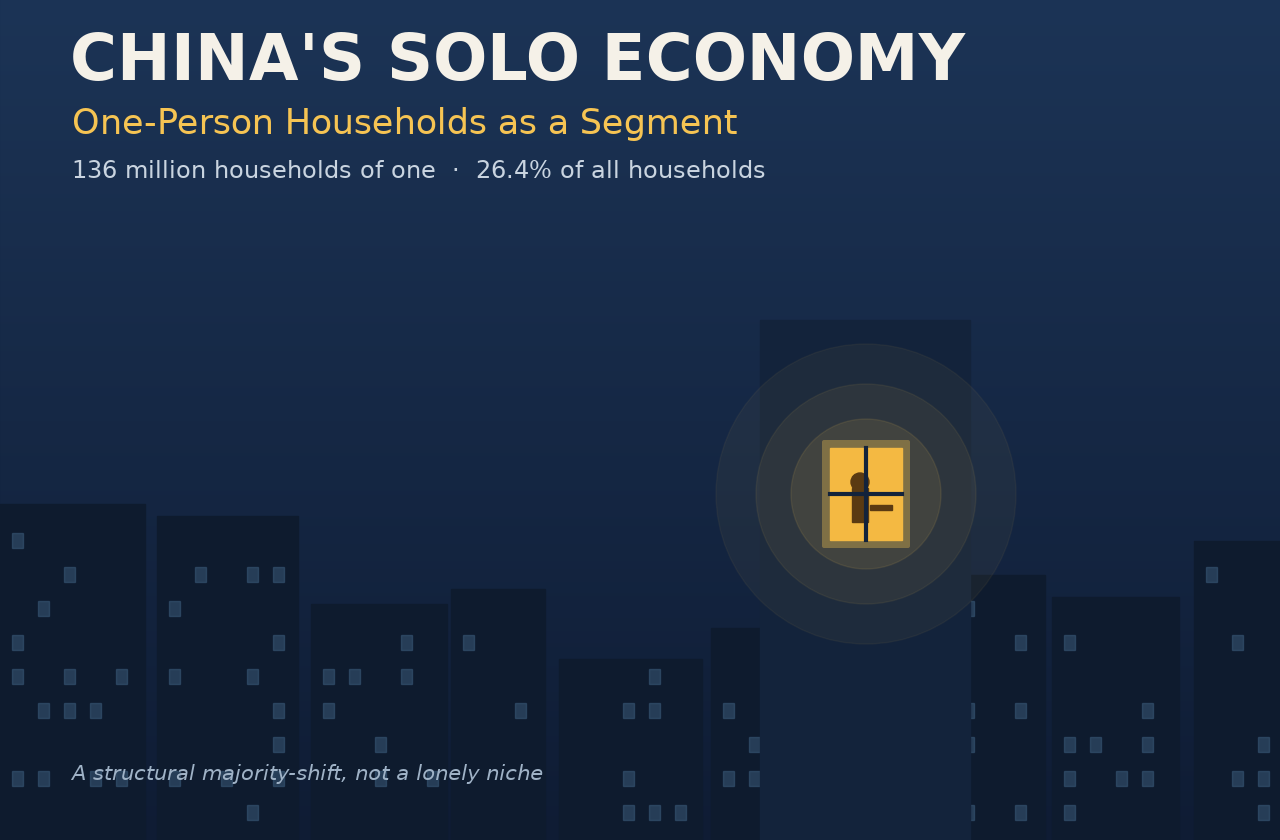
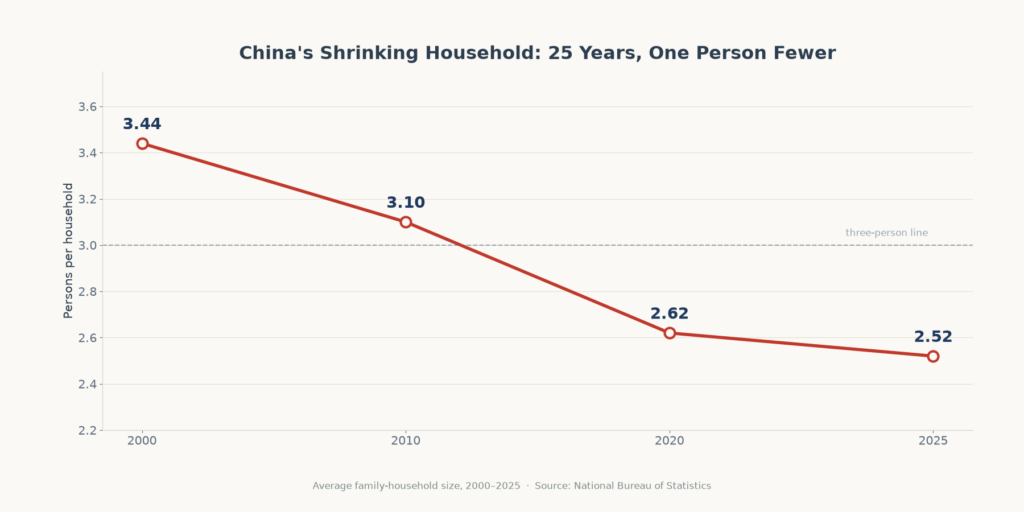
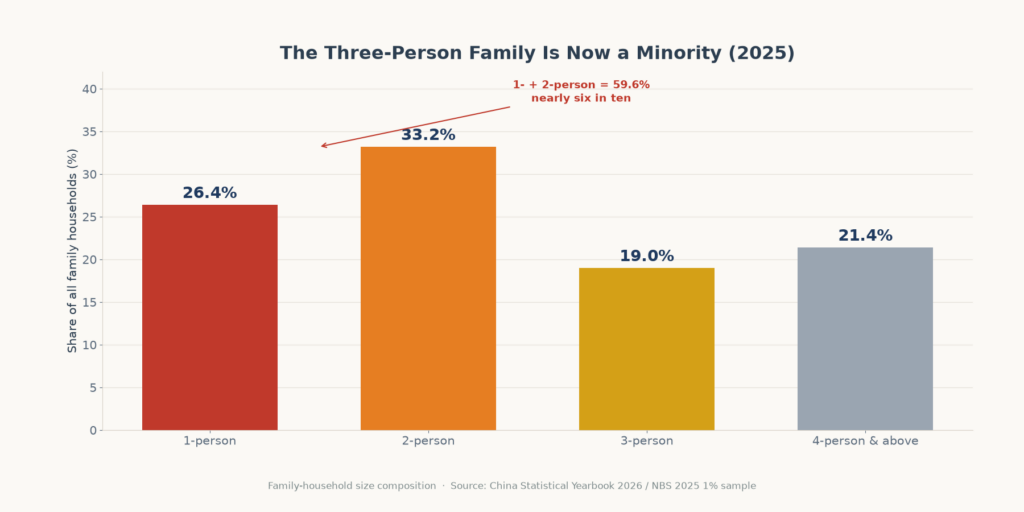
Chinese marketing still designs for the three-person family — the family pack, the “share with loved ones” copy, the bulk SKU. The census says that household is no longer the default. One-person households now make up 26.4% of all family households (about 136 million), two-person households 33.2% — together 59.6%, nearly six in ten. Average household size has fallen to 2.52 people, below three for the first time, down from 3.44 in 2000. The three-person household is just 19.0%.
The solo economy is not a lonely-hearts niche. It is a structural majority-shift spanning three very different populations: young never-married urban migrants, divorced middle-aged adults, and widowed elders (roughly three-quarters of them women). Each needs different products, but all share the physics of the household-of-one: right-sized portions, single-serve formats, solo dining without stigma, security, and companionship. The brands that redesign the default for one inherit the majority. The brands still pitching family sharing are addressing a minority.
1. The Household Structure Flip
Start with the number that should reset every category plan in China. The National Bureau of Statistics’ 2025 national 1% population sample, published in May 2026 and carried into the China Statistical Yearbook 2026, counts 514.65 million family households holding 1.297 billion people — an average of 2.52 persons per household.
Put the last twenty-five years side by side and the direction is unmistakable: 3.44 in 2000, 3.10 in 2010, 2.62 in 2020, 2.52 in 2025. A quarter-century, and the average Chinese household lost almost a whole person. Houses got bigger; the families inside them got smaller.
The composition tells the same story. One-person households are 26.4% of the total; two-person households 33.2%. Add them and you get 59.6% — nearly six in ten households with two people or fewer. The three-person household, long treated as the natural unit of Chinese consumption, is down to 19.0%. Four-person-and-larger households make up the remaining 21.4%.
This is not a blip. It is the downstream result of three forces that are still releasing: fewer births (the 2025 birth rate of 5.63‰ is the lowest in the yearbook series), better housing that lets generations live apart instead of stacked in one flat, and mass migration that splits a household every time a young worker moves. Demographers expect the average to keep drifting toward the 2.0–2.2 range where most developed economies have settled.
2. Who Actually Lives Alone
Here is where most solo-economy marketing goes wrong before it starts. “One-person household” is not a synonym for “young single urbanite.” The category contains at least three distinct populations, and the stereotype captures only one of them.
The first is the young never-married migrant. China’s floating population reached 357.88 million in the 2025 sample. Most are young, most form one- or two-person households in the cities where they work, and most leave aging parents behind in the home province. Every move splits a family.
The second is the divorced middle-aged. In 2025, 3.937 million couples legally divorced — 2.744 million through civil-affairs registration and 1.194 million through court judgment or mediation. The crude divorce rate of 2.8‰ was the highest in five years. Divorce does not just end marriages; it manufactures new one-person households.
The third, and the most overlooked, is the widowed elderly. The yearbook’s marital-status data show widowed people at 6.2% of the population aged 15 and over — an estimated 70 million-plus, roughly three-quarters of them women. Women live longer and tend to marry older men, so the late-life household-of-one in China is, overwhelmingly, a woman’s household. If your solo campaign only pictures a 27-year-old with a cat and a cold-brew machine, you are ignoring the largest and fastest-growing slice of the segment.
A caveat worth stating plainly: the 70-million widowed figure is an estimate scaled from the sample, not a registered count, and “three-quarters” is an approximation. Treat it as directional, not decimal-point precise.
3. The Geography Is Uneven
National averages hide the real map. The solo-and-two-person share is highest in the Northeast — Heilongjiang 70.4%, Liaoning 69.5%, Jilin 69.2%. Seven in ten households there have two people or fewer. At the other end, Hainan sits at 41.5%, the only province below 45%.
Average household size runs the same direction: Hainan highest at 3.20 persons, Heilongjiang lowest at 2.17, Beijing 2.23. The gap between the largest and smallest provincial household is a full person.
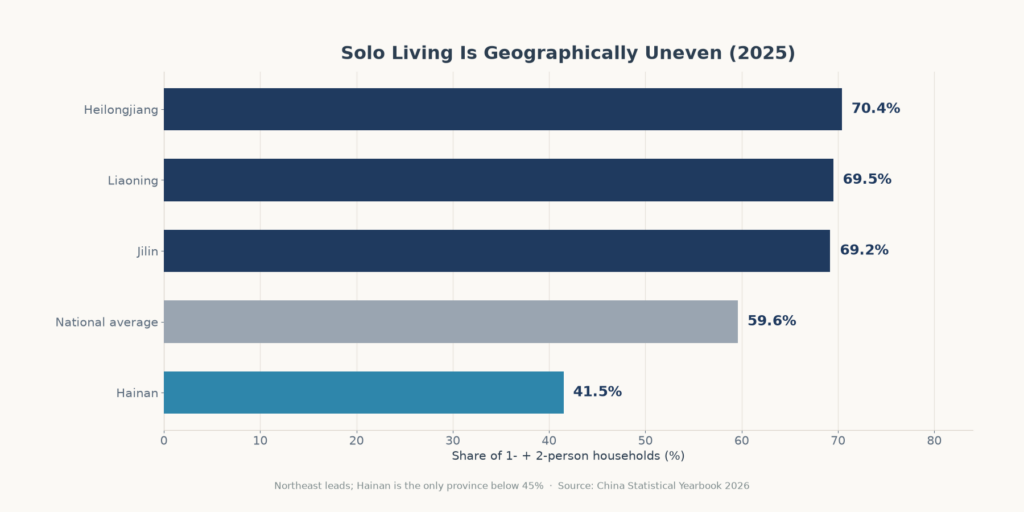
The Northeast is where all three shrinking forces compound at once: the lowest birth rates, sustained youth outflow, and the oldest remaining populations. Liaoning’s old-age dependency ratio hit 33.7%, the highest in the country. Guangdong offers the counter-intuitive mirror image: it leads the nation in births (1.003 million in 2025, first for eight straight years) yet its average household is only 2.50 — below the national mean — because the young migrants flooding in form small households of their own. Small households are not one lifestyle. They are the sum of whichever force — fewer babies, more elders, more movers — dominates locally. Go-to-market has to be region-split, not national-average.
4. The Household-of-One Physics
Strip away the demographics and every solo household obeys the same five design constraints. Think of them as the physics of living alone — the brief any product, channel, or message has to satisfy.
Portion and pack. The family pack is waste for one. Single-serve food, half-portion produce, small rice packs, one-person hotpot: the right-size premium converts because it removes the leftover problem, not because it is cute.
Appliance and format. Mini rice cookers, single-cup coffee, compact washers, one-person furniture. The dwelling is smaller and the portion is smaller, so the hardware has to shrink with it — but shrink intelligently, not just proportionally (more on that trap below).
Dining and delivery. Solo dining formats — partitioned seating, one-person hotpot counters, no-minimum ordering. The job is not “feed one person.” It is “let one person eat well without the stigma of eating alone.”
Security and care. Smart locks, cameras, emergency call, check-in services. The anxiety is “nobody is home with me,” and it is most acute for the elderly solo. This is where the silver-economy policy tailwind meets a genuine consumer need.
Companionship and community. Pets, hobby circles, activity partners (the “dazi” phenomenon), third-place formats. Alone is not the same as lonely; the infrastructure that keeps solo living socially connected is its own market.
5. The Evidence: Dining, Appliances, and the Right-Size Premium
The demand is real, and the platform data show it. On Meituan, “one-person dining” orders grew more than 40%, and searches for “small-portion dishes” rose over 32% year on year — platform figures disclosed by Meituan’s delivery business head in late 2025. A joint study by the Chinese Academy of Agricultural Sciences’ Agricultural Information Institute and Ele.me, the 2023 “Small-Portion Meal” food-loss and carbon assessment, found that each small-portion delivery order cuts food waste by 110.23 grams, a 53.3% reduction. Right-sizing is not just a preference; it is measurable waste reduction.
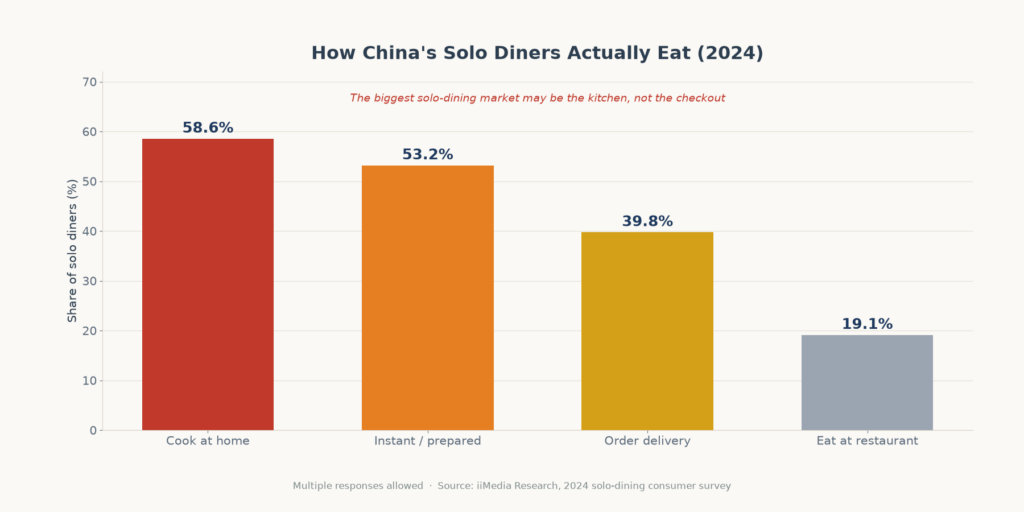
But the behavioral data correct a lazy assumption. iiMedia Research’s 2024 solo-dining study found that when eating alone, 58.56% of consumers cook for themselves, 53.19% buy instant or prepared food, 39.77% order delivery, and only 19.13% go to a restaurant. Instant noodles remain the most-chosen convenience food (61.51%). The solo diner is not primarily a restaurant-goer or a delivery addict — she is often a home cook trying to make one portion work. That reframes the opportunity: the biggest solo-dining market may be the kitchen, not the checkout.
On appliances, the picture is more nuanced than “mini everything sells.” AVC’s 2025 kitchen small-appliance annual report puts the category at RMB 66.3 billion in retail value, up 3.8%, with average price up 4.2% to RMB 247 — growth driven by value, not volume. Crucially, AVC notes that “ultra-small capacity” products have briefly saturated, while steamers, stew pots, air fryers and ovens are trending toward larger capacities. The solo buyer does not want everything miniaturized; she wants the right tool at the right size. And in the first five months of 2026, with the overall appliance market down 8%, compact kitchen appliances still grew 11.6% — the structural bright spot in a shrinking market.
A note on market-size figures: widely circulated claims that China’s “solo dining economy” hit RMB 1.8 trillion in 2025 trace back to a commercial research house’s estimate that cannot be verified against a primary report. We do not cite it. The defensible anchor is the population base — 136 million households-of-one — plus the verified behavior and platform data above.
6. What Everyone Misunderstands
Four errors recur in solo-economy marketing, and each one costs reach.
Solo equals young single. The widowed elderly (mostly women) and the divorced middle-aged are enormous solo populations. Aim only at young urbanites and you miss the aging-solo majority in much of the country.
The lonely-pity frame. Solo is not lonely. A large share of solo living is chosen — for autonomy, for peace. iiMedia’s 2025 single-economy survey found 45.9% of single respondents enjoy single life or are in no hurry to partner. Copy that pities the single person insults the autonomous soloist. The value proposition is freedom and right-sizing, not consolation.
The family-pack default. Bulk and family formats assume a sharing household that is now the minority. The default SKU should be single-serve, with family as the variant — not the other way around.
The monolith error. A 25-year-old migrant’s solo needs (convenience, community, pets) are not a 75-year-old widow’s (security, care, accessibility). Segment by lifecycle within solo, not by solo alone.
7. The Japan Preview
China is not the first economy to walk this road, and the destination is visible. In Japan’s 2020 census, single-person households reached 38.0% of all households. The National Institute of Population and Social Security Research projects that share will climb to 44.3% by 2050. Japan turned the small household into mature industries — solo dining, compact apartments, convenience-store economics, companionship robots.
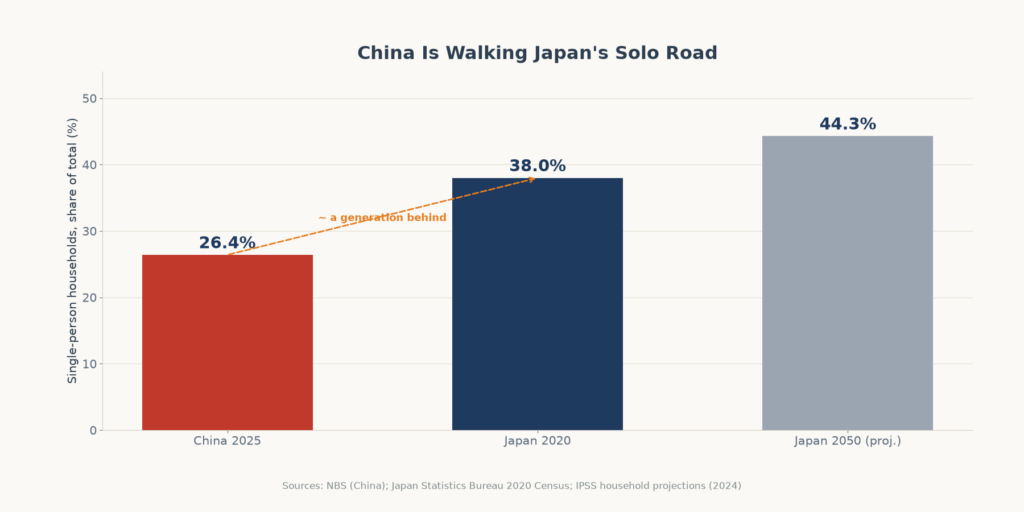
China’s 26.4% today sits roughly where Japan was a generation ago. The trajectory — not the snapshot — is the strategic signal. Beike Research’s “New Solo-Living Era” report projects China’s solo-living population reaching 150–200 million by 2030, with solo-living young adults aged 20–39 rising from 18 million in 2010 to 40–70 million. The brands that build for the household-of-one now are building for the majority of 2035.
8. What It Means for Brands and Marketers
Make single-serve the default. Portion, pack, and appliance format designed for one; family as the variant. The default-SKU flip is the structural move, not a limited edition.
Design solo dining without stigma. Partitioned seating, one-person counters, no-minimum delivery. And remember the home cook: single-portion ingredients, small-pack staples, and kitchen tools sized for one are as important as the restaurant format.
Segment solo by lifecycle. Young-migrant (convenience, community, pets) versus elderly-solo (security, care, accessibility). Different products, same household physics. The elderly front carries a policy tailwind: the State Council’s 2024 silver-economy opinion (Guo Ban Fa [2024] No. 1) pushes elder meal assistance and home age-friendly renovation, and by 2026 China had 82,000 elder meal-assistance sites, 495,000 family elder-care beds, and 2.24 million age-friendly home renovations for hardship elders. Opportunity and compliance arrive together.
Sell freedom, not consolation. Autonomy and right-sizing, not pity. The autonomous soloist is the buyer; the lonely frame repels her.
Split the map. Northeast solo-heavy, southern family-heavy. A national-average campaign misreads both.
9. Risks and Honest Caveats
The caliber floor. “Family household” excludes collective households — dorms, institutions. A dorm resident lives solo but counts as collective, so 26.4% is a floor on solo living, not a ceiling.
The trajectory, not a caliber gap. One-person households were already 25.4% (about 125 million) at the 2020 census, up from roughly 58 million in 2010. The move to 26.4% in 2025 is a smooth continuation, not a statistical artifact. Older yearbook snapshots and the 2025 sample differ in base year and method; use the 2025 sample as current and describe the trajectory rather than blending series.
The marriage rebound. Do not over-read “later marriage” as a one-way fall. Marriages actually rebounded in 2025 to 6.765 million, up 10.8% from 6.106 million in 2024. The structural driver of solo growth is migration, divorce, and widowhood — not a simple collapse in marriage.
The policy-sensitive elderly front. Elderly-solo care intersects silver-economy policy and age-friendly mandates. That is both opportunity and compliance obligation.
Conclusion
China’s household structure flipped. One-person households are 26.4% — about 136 million — and two-person households 33.2%; nearly six in ten households have two people or fewer, and the three-person family is a 19% minority. The solo economy is a structural majority-shift spanning young migrants, divorced middle-aged, and widowed elders, all sharing the household-of-one physics: right-size portions, single-serve formats, solo dining without stigma, security, companionship. The brands redesigning the default for one — segmenting solo by lifecycle, selling freedom not pity, splitting the map by region — inherit the majority. The family pack was the twentieth century’s default. The household-of-one is the twenty-first’s.