How China’s most famous traffic-arbitrage brand became a skincare company — and why the moat is still rented. A case study built on SEC filings through Q2 2026.
The $16 Billion Lesson Nobody Finished Reading
Everyone knows the first half of this story. A scrappy Guangzhou startup industrialized influencer seeding, rode the cheapest attention window in Chinese internet history, and turned a lipstick brand into a $16 billion market cap in under four years. Then the story collapsed, and most commentators stopped reading.
That’s a mistake. The second half — the part happening right now — is where the actual lessons live.
Here’s the headline we’ll defend across the next few thousand words: Perfect Diary didn’t die, and it didn’t recover. It became something else — a skincare company wearing a color-cosmetics legacy — and the transformation changed the category economics without yet changing the business model. The distinction matters more than any single quarterly number, because it’s the difference between a turnaround and a treadmill.
We’ve rebuilt this case study from primary sources: Yatsen’s SEC filings from FY2019 through Q2 2026, its Form 20-F annual reports, earnings-call transcripts, and the company’s own acquisition and financing announcements. Where media reports conflicted with filings — and several did, including a widely circulated selling-expense ratio that mixed quarterly and annual calibers — we sided with the filings and flagged the discrepancy.
Let’s start at the beginning, because the beginning contains the seed of everything that followed.
Background: The Seeding Arbitrage (2017–2021)
A window that was always going to close
Yatsen was founded in 2016 by Huang Jinfeng — a former P&G consumer-insights manager, Harvard MBA, and ex-VP at Yujiahui — together with two Sun Yat-sen University alumni. The Perfect Diary brand launched in March 2017, and its Tmall flagship store opened that August.
The timing was the strategy. In 2017–2019, Xiaohongshu (RedNote) was still an under-monetized discovery platform: KOC notes were cheap, user trust in peer reviews was high, and the feed wasn’t yet saturated with commercial content. Perfect Diary didn’t invent seeding — it industrialized it.
By September 30, 2020, the company’s F-1 prospectus disclosed partnerships with close to 15,000 KOLs, over 800 of them with more than a million followers, managed through a proprietary direct-to-KOL system rather than agencies. A pyramid structure did the work: a few celebrities and top-tier anchors for credibility, a thick middle of mid-tier creators for tutorials and swatches, and a base of everyday users whose “real experience” notes made the brand feel ambient — everywhere at once, recommended by everyone, advertised by no one.
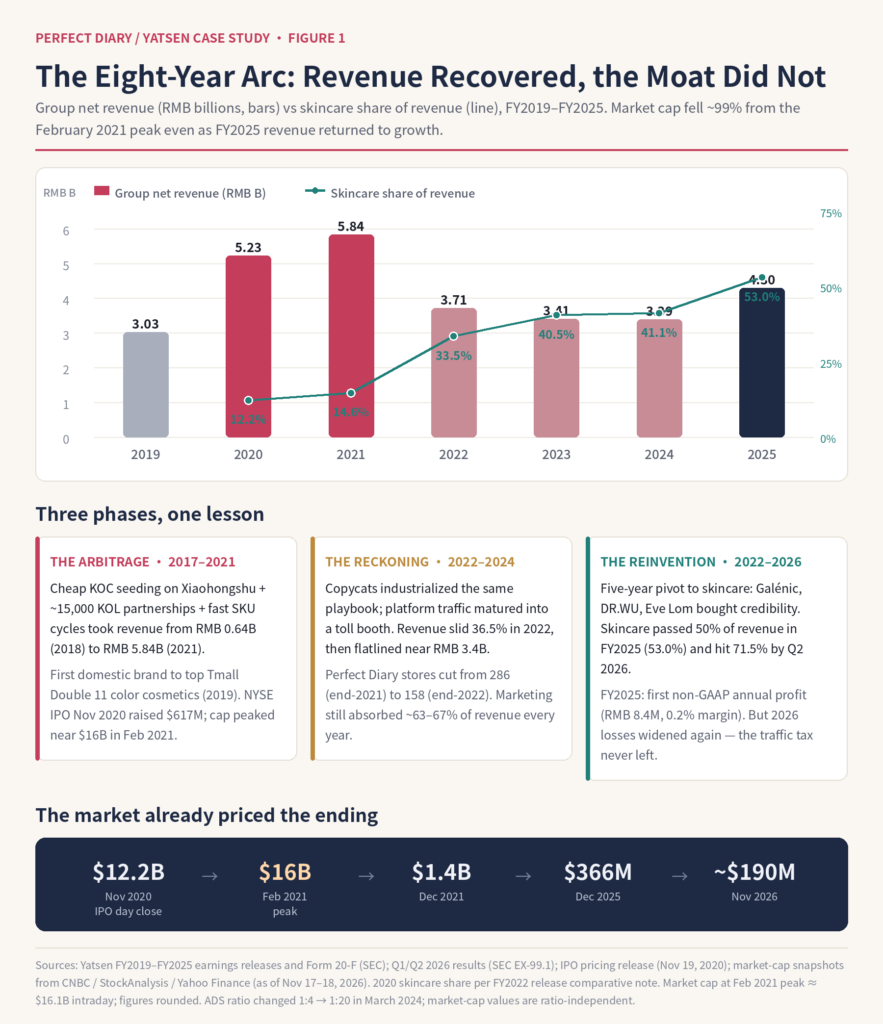
The results were spectacular. In the 2019 Double 11 festival, Perfect Diary became the first domestic brand ever to top Tmall’s color-cosmetics sales chart, a position international majors had held across the festival’s first ten editions. It passed RMB 100 million in sales within 28 minutes — beating its own entire 2018 Double 11 day in less than half an hour — and took the #1 spot in eyeshadow, lip glaze, mascara and eyeliner simultaneously. Per the CIC report cited in the prospectus, it was China’s largest color-cosmetics brand by online retail sales value in 2019. That year, 96.7% of gross sales came through online channels.
The machine behind the magic
Two operating capabilities made the seeding machine compound. First, product velocity: a data-driven development cycle that took concepts to shelf in roughly six months — against the 7–18 months typical of international brands — feeding a constant stream of IP collaborations (Discovery Channel, the British Museum, Chinese National Geography) that gave the content machine fresh ammunition. Second, a private-domain retention layer: the fictional beauty-advisor persona “Xiao Wanzi”, operated across hundreds of WeChat accounts, pulled buyers out of platform traffic into owned communities. Prospectus-derived data shows repeat-purchase rates climbing from 8.1% (2017–18 cohort) to 41.5% (2019–20 cohort).
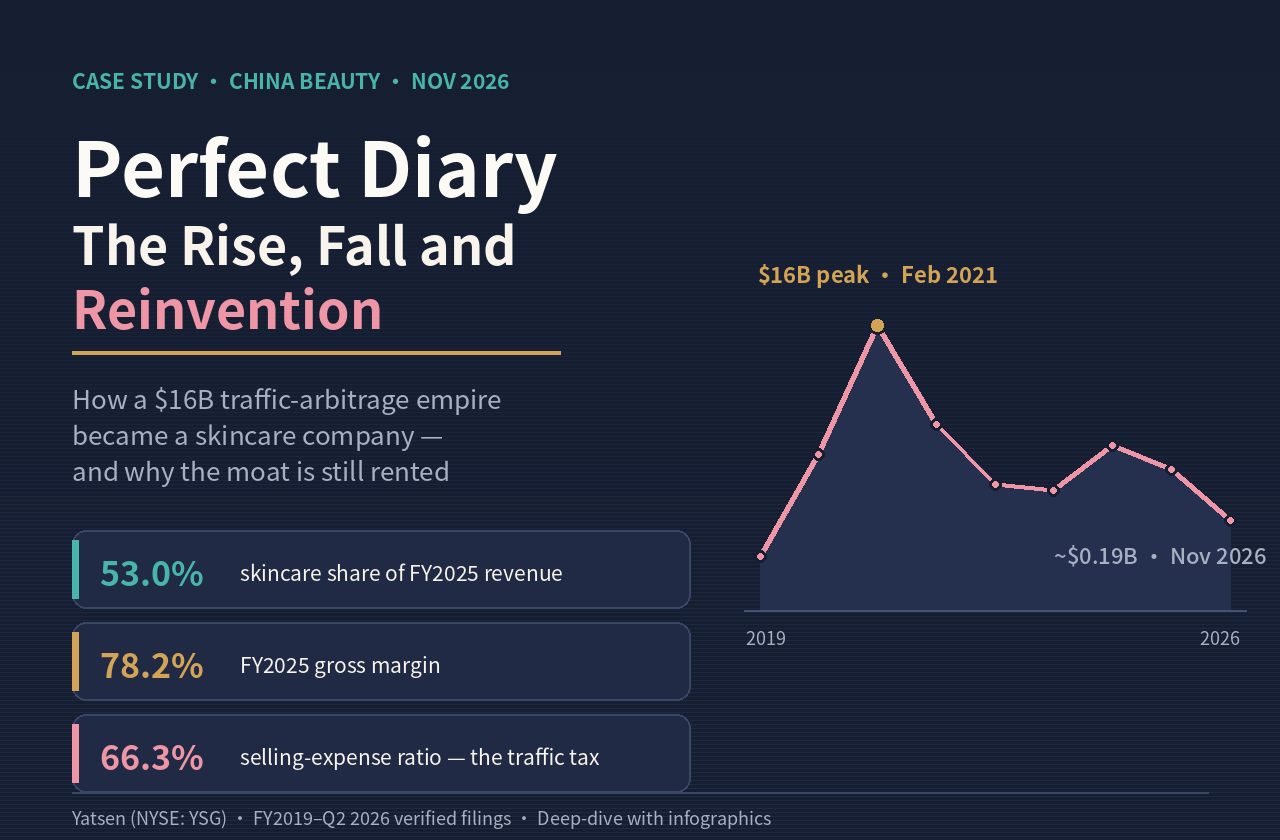
Revenue told the story: RMB 3.03 billion in 2019, RMB 5.23 billion in 2020 (+72.6%), RMB 5.84 billion in 2021. On November 19, 2020, Yatsen listed on the NYSE at $10.50 per ADS, raising $616.9 million; the stock closed its first day at $18.40, up 75%, valuing the company around $12.2 billion. By February 2021 it touched $25.47 intraday — a market cap of roughly $16 billion, and the first domestic Chinese beauty company ever valued above RMB 100 billion.
But look closely at what the market was actually pricing. Not brand equity in the L’Oréal sense — decades of pricing power and shelf dominance. It was pricing the throughput of a customer-acquisition machine whose input costs were temporarily, artificially low. The prospectus itself showed the strain: marketing spend ran at 41–49% of revenue in 2018–19, then jumped past 62% in the first nine months of 2020 as the company bought growth ahead of its IPO. The arbitrage was real. It was also, by construction, temporary.
The Fall: When the Arbitrage Closed (2021–2024)
The scissor: CAC up, LTV flat
What kills a traffic-arbitrage business is never one bad quarter. It’s a scissor — two blades closing from opposite directions.
The first blade: copycat saturation. The seeding playbook wasn’t a secret; it was a conference talk. Hundreds of new domestic brands replicated the pyramid-KOL structure note for note, bidding against each other for the same mid-tier creators. Meanwhile the platforms themselves matured: Xiaohongshu and Douyin converted organic discovery into auctioned inventory. Attention that once cost a product sample now cost a CPM. Yatsen’s own filings would later name the mechanism explicitly — “higher traffic acquisition costs” on Douyin, quarter after quarter.
The second blade: the category gene. Color cosmetics is trend-driven. Loyalty attaches to this season’s hit shade, not to the house that made it. The repeat purchase a color brand earns is “the next trend” — which any competitor can supply. So customer lifetime value stayed structurally flat while acquisition costs compounded. The 41.5% repeat rate was real, but it lived inside a discount-fed private domain; it measured deal-seeking behavior at least as much as brand love.
The financial consequence was brutal and fast. Revenue fell 36.5% in 2022 to RMB 3.71 billion, then flatlined: RMB 3.41 billion in 2023, RMB 3.39 billion in 2024. The offline expansion — over 200 experience stores by late 2020 — reversed hard: Perfect Diary’s store count went from 286 at the end of 2021 to 158 at the end of 2022, per the CEO’s prepared remarks on the Q4 2022 earnings call. (A “486 stores” figure circulated from the call’s Q&A session; the prepared-remarks number is the brand-level caliber we use.) By the 2023 Double 11, Perfect Diary had vanished from Tmall’s color-cosmetics presale top-10 — a list where the #10 slot that year required roughly RMB 66 million in presales, and where Proya’s Caitang claimed the domestic crown.
Not a product failure — a business-model failure
Here’s the reframe most post-mortems miss: the products were fine. The palettes were good; the price-value equation was genuinely strong. What failed was the assumption underneath the model — that cheap traffic and information asymmetry were durable assets rather than consumable resources.
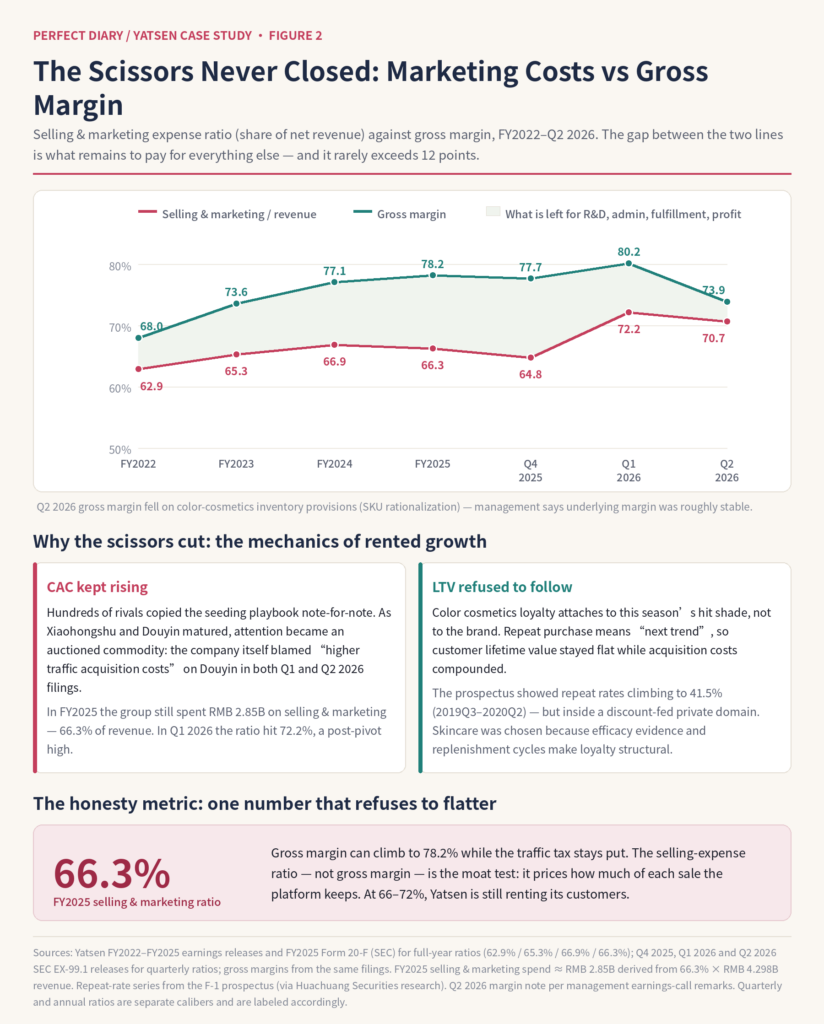
Every yuan of “growth” bought through rented attention had to be re-bought the next quarter. When the rent went up, the P&L had no shock absorber: no pricing power, no irreplaceable product, no structural retention. Gross margin actually improved through the downturn — 68.0% in 2022, 73.6% in 2023, 77.1% in 2024 — because the mix was shifting toward skincare and discounts were tightened. But the selling-and-marketing ratio barely moved: 62.9% → 65.3% → 66.9% across those same years. The company was running faster just to stay in place.
That gap — between a rising gross margin and an unmovable marketing ratio — is the single most honest diagnostic in this entire case. We’ll return to it.
The Reinvention: Buying a Second Engine (2020–2026)
The acquisition timeline — earlier than the legend suggests
The popular version of this story says Yatsen “pivoted to skincare in 2022.” The filings say otherwise: the pivot’s hardware was bought before the fall was even visible.
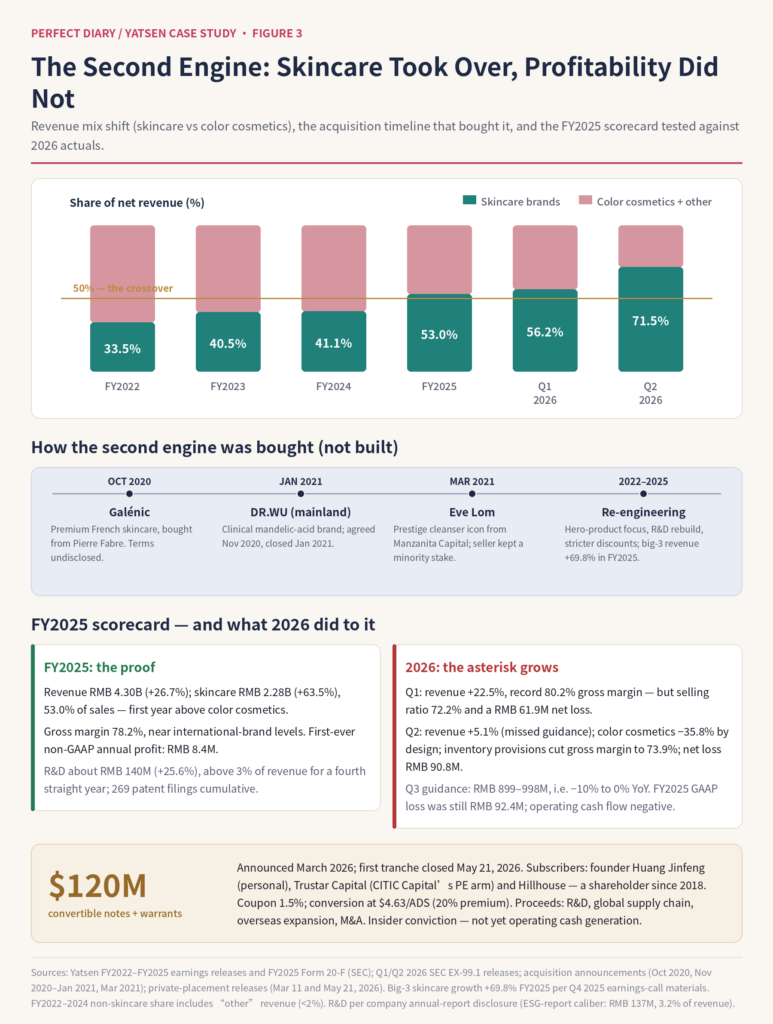
- October 2020 — agreement to acquire Galénic, the premium French skincare brand, from Pierre Fabre (terms undisclosed); completed within 2020, weeks before the IPO.
- November 2020 – January 2021 — agreement and closing for the mainland China business of DR.WU, the dermatologist-developed clinical brand built around mandelic-acid serums.
- March 2021 — announcement of the Eve Lom acquisition from Manzanita Capital, the London family-office investor that kept a minority stake and stayed on as strategic partner.
What came in 2022 was the software: Huang’s “second entrepreneurship”, coined internally in late 2021 and formalized as a five-year strategic plan in early 2022 — skincare-first portfolio, hero-product focus, disciplined discounting, store rationalization, and an R&D rebuild. The distinction matters. Buying brands is a capital decision; re-engineering them is an operating decision. Yatsen needed both, and the second one took years: DR.WU was relaunched with a simplified line-up around its core acid serum; Galénic was rebuilt for China with proprietary-ingredient storytelling; Eve Lom leaned on its cleanser heritage.
Why skincare? Because it inverts the category gene. Efficacy takes weeks to judge, which creates switching costs. Regimens create replenishment cycles, which create structural repeat. Evidence — clinical data, patents, dermatologist endorsement — creates the kind of trust that a trend cycle can’t erode. In the 20-F’s own words, skincare brands “typically feature higher gross margin and greater customer loyalty.” Yatsen wasn’t just changing what it sold. It was changing the physics of its retention.
FY2025: the proof — and the asterisk
The transformation’s showcase year was 2025, and the numbers genuinely impressed:
- Revenue RMB 4.30 billion, +26.7% — the first meaningful growth since 2021.
- Skincare revenue RMB 2.28 billion, +63.5%, reaching 53.0% of total revenue — the first full year skincare outsold color cosmetics. The three premium brands (Galénic, DR.WU, Eve Lom) grew a combined 69.8%.
- Gross margin 78.2%, territory occupied by international prestige houses.
- First-ever non-GAAP annual profit: RMB 8.4 million. After five years of losses, the adjusted line crossed zero.
- R&D spend around RMB 140 million (+25.6%), above 3% of revenue for a fourth consecutive year; cumulative patent filings reached 269.
- Q4 2025 even produced a small GAAP net income of RMB 3.0 million.
But read the asterisks, because they’re load-bearing.
The non-GAAP profit was 0.2% of revenue — a breakeven signal, not profitability. The GAAP net loss for the year was still RMB 92.4 million. Operating cash flow was negative RMB 94.7 million, a reversal from +243.7 million in 2024. Cash, restricted cash and short-term investments fell from RMB 1.36 billion to 1.05 billion. And the full-year selling-and-marketing ratio, per the 20-F, was 66.3% — essentially unchanged from 66.9% in 2024. (Several Chinese outlets reported “20.8%” or applied the Q4 ratio of 64.8% to the full year; both are caliber errors. The audited annual figure is 66.3%.)
The category switch had worked on product economics. It had not yet touched the traffic dependence.
2026: the plot twist
If this case study had been written in March 2026, it would have ended on that cautiously optimistic note. The next two quarters rewrote the ending.
Q1 2026 looked strong on the surface: revenue +22.5% to RMB 1.02 billion, skincare +58.5% (56.2% of sales), a record 80.2% gross margin. Underneath, the selling ratio spiked to 72.2% — the company cited brand-equity investment plus Douyin traffic costs — and the quarter posted a RMB 61.9 million net loss, reversing the prior year’s small profit.
Q2 2026 was worse. Revenue grew just 5.1% to RMB 1.14 billion, missing the company’s own RMB 1.20–1.30 billion guidance. Skincare hit 71.5% of revenue (+40.4%) — the mix transition is now essentially complete. But color cosmetics fell 35.8%, which management framed as deliberate SKU rationalization, and the associated inventory provisions dragged gross margin down to 73.9%. Net loss widened to RMB 90.8 million; the non-GAAP line swung to a RMB 99.4 million loss. Q3 guidance: RMB 899–998 million — a 0–10% year-over-year decline.
Two governance signals deserve attention. In May 2026, the first tranche of a $120 million convertible-notes placement closed, subscribed by founder Huang personally, Trustar Capital (CITIC Capital’s PE arm) and Hillhouse — a shareholder since 2018. Insider money at a 1.5% coupon and a $4.63 conversion price (a 20% premium) is a conviction signal. And in September 2026, Yatsen appointed Li Wang, former CFO of Proya, as Co-CFO, slated to succeed Donghao Yang after the FY2026 annual report. The IPO-era capital-markets operator is handing the keys to a consumer-goods cost disciplinarian. That tells you exactly which problem the board thinks it has.
The market’s verdict has been merciless: from ~$366 million at the end of 2025 to roughly $190–195 million by mid-November 2026, with the stock near $2 and a 52-week range of $1.67–$6.59 (CNBC, as of November 17). Q3 results are due around November 25 as of this writing.
What Everyone Misunderstands
“Perfect Diary is dead.” The brand stalled; the company transformed. Judge Yatsen, not the flagship. The color-cosmetics segment still generated RMB 2.01 billion in FY2025 (+1.9%), and the brand’s Biolip essence lipstick — a “makeup-meets-skincare” hybrid launched in September 2023 — has sold over 6 million units cumulatively with sales above RMB 800 million, per company disclosures. (Its Frost & Sullivan “#1 Chinese-brand lipstick SKU globally” certification is a commissioned study; treat it as company-cited marketing evidence, not independent audit.) The brand is being repositioned upmarket, not buried — though Q2 2026’s deliberate 35.8% color decline shows the repositioning now includes shrinking.
“The pivot succeeded because skincare is 53% of revenue.” Mix is an input, not an outcome. The outcome is profit and cash — and on those, 2026 went backwards. A 0.2% non-GAAP margin followed by two loss-making quarters is not a completed turnaround. It’s a category transition that outran its business-model repair.
“Buying brands is a shortcut that doesn’t work.” The gross-margin arc (68.0% → 78.2% in three years) and the big-3’s 69.8% growth say the acquisitions delivered exactly what they were bought for: credibility and repeat economics, faster than organic building could have. The unresolved test isn’t the buying — it’s whether marketing efficiency follows. So far, it hasn’t.
“The market cap collapse means the reinvention failed.” At ~$190 million against RMB 1.06 billion of cash, restricted cash and short-term investments (June 2026), the market is pricing something closer to a liquidation-adjacent option on the turnaround than a going-concern growth story. That’s a verdict on timing and burn, not on the skincare assets themselves. Both readings can be true at once.
The Reusable Methodology
Strip away the beauty-industry specifics and four transferable rules remain — for any DTC or traffic-native brand, in any market.
1. Audit whether your moat is owned or rented. Channel dividends have a half-life. List what fraction of your growth would survive if your primary platform doubled its traffic prices tomorrow. If the answer is “most of it wouldn’t”, you don’t have a moat — you have a lease. Budget for its expiry while the arbitrage still funds the transition.
2. Treat category choice as a retention strategy. Trend-driven categories (color cosmetics, fast fashion, novelty gadgets) amplify CAC dependence because LTV can’t compound. Efficacy-driven, replenishment-driven categories (skincare, supplements, consumables with switching costs) let retention do structural work. Yatsen’s pivot was, at root, a decision to change which physics its P&L lived under.
3. Start the second engine while the first still pays for it. The acquisitions began in October 2020 — at the peak, before the fall. By the time revenue collapsed in 2022, the skincare assets were already in-house and being re-engineered. Late pivots die because they need capital precisely when capital is least available. The timing of the second curve is the survival variable.
4. Use the selling-expense ratio as your honesty metric. Gross margin flatters; it measures product economics, not customer-acquisition economics. The selling ratio prices how much of each sale the platform keeps. Yatsen’s stayed at 63–67% through the entire “transformation” and spiked to 70–72% in 2026. Until that number structurally falls — through brand pull, owned channels, or repeat economics — the moat is still rented, whatever the mix chart says.
Risks and Honest Caveats
A few discipline notes, because a case study that hides its calibers is just marketing.
- Caliber discipline. Skincare share: 53.0% full-year FY2025 (company filing) vs 61.1% in Q4 alone vs 71.5% by Q2 2026. Selling ratio: 66.3% FY2025 vs 64.8% Q4 2025 vs 72.2% Q1 2026. Media reports frequently mixed these; we haven’t.
- Profit quality. FY2025’s non-GAAP profit excludes share-based compensation, acquisition intangible amortization and impairments — and the Q4 2025 release disclosed RMB 14.6 million of out-of-period corrections. Accounting breakeven is not cash generation; operating cash flow was negative in FY2025 and both quarters of 2026.
- Concentration risk. Skincare growth leans on two acquired brands (DR.WU, Galénic). Flagship dependence has been replaced by acquired-brand dependence; integration and key-person risk at those brands is now the company’s central operating exposure.
- A harder competitive tier. The pivot moved Yatsen from mass color (where it pioneered) into premium/clinical skincare — against Proya’s incubated big-single-item machine, Botanee’s medical trust, Mao Geping’s prestige positioning, and the international majors. The 2026 margin compression suggests the new tier charges tuition.
- Macro caliber. China’s NBS reported 2024 above-designated-size cosmetics retail at RMB 435.7 billion, down 1.1% on a comparable basis — only the second decline in a decade, though the statistic’s sample changes yearly and isn’t the total market. Management cited NBS-adjusted 2025 beauty retail growth of 5.1%; the recovery is real but uneven, and festival-period traffic inflation is its shadow.
- What we don’t know. Brand-level Perfect Diary revenue is not disclosed (media estimates around RMB 1 billion/year are unverifiable and excluded here). Q3 2026 actuals land around November 25, after this writing. The second $60 million notes tranche is expected later in 2026, subject to conditions.
Conclusion: The Arc Is the Lesson
Perfect Diary’s eight years compress the entire traffic-arbitrage lifecycle into one company. Industrialized seeding built a $16 billion illusion of brand equity. The copycat-and-CAC scissor exposed it as rented. The skincare pivot — bought early, rebuilt patiently — changed the category economics: 53% of revenue, 78.2% gross margin, a first non-GAAP profit. And then 2026 delivered the final, uncomfortable lesson: a category transition is not a business-model transition. Skincare reached 71.5% of sales while losses widened, because the company still buys most of its customers from platforms that charge more every year.
The founder’s own money and a former Proya CFO at the finance helm say the repair is underway. The 66–72% selling ratio says it isn’t finished. Both are true.
If you run a traffic-native brand, study this arc before you repeat it. Audit the lease. Pick your category’s physics. Start the second engine at the peak. And when someone shows you a gross-margin chart and calls it a moat, ask to see the selling-expense ratio instead.
Perfect Diary didn’t die. It became a skincare company with a color-cosmetics legacy, a convalescent P&L, and an unfinished profitability test. That’s not a failure story, and it’s not a success story. It’s the most useful kind of story: an honest one.