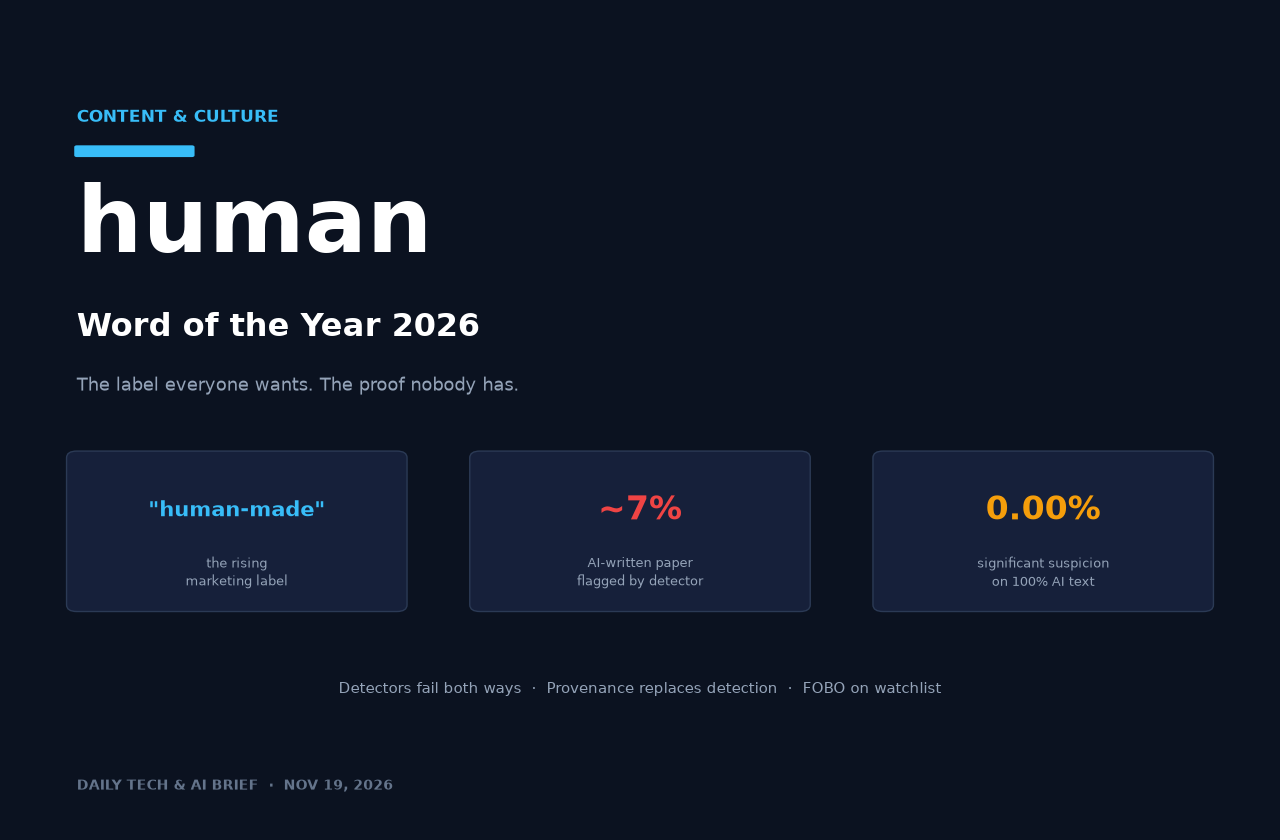
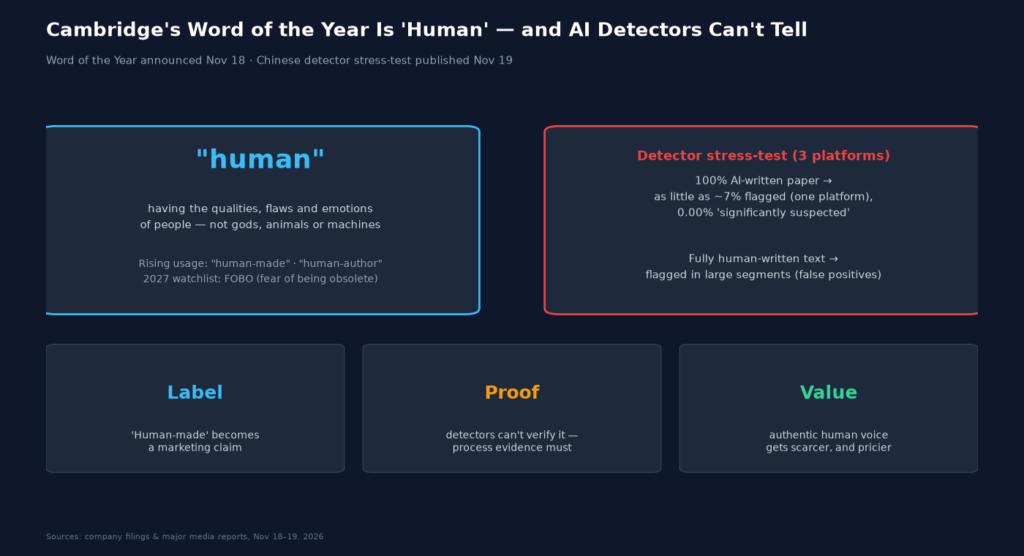
Two stories landed within 24 hours of each other this week, and read together they define the next phase of content marketing. On Tuesday, Cambridge Dictionary named “human” its 2026 Word of the Year — defined as having the qualities, flaws and emotions of people, as distinct from gods, animals or machines. The editors noted surging usage of distinguishing phrases like “human-made” and “human-author,” and flagged FOBO — fear of being obsolete — for next year’s watchlist. On Wednesday, Chinese researchers at The Paper’s testing lab published a stress-test of the country’s three dominant academic AI-detection platforms: a paper written 100% by AI was flagged as little as 7% suspected on one platform, with 0.00% “significantly suspected” text, while fully human-written passages were flagged in large red segments. The word of the year says people want human-made content. The stress-test says the machines cannot tell who made it. Everything interesting about content strategy in 2027 lives in that gap.
Why a dictionary choice is a market signal
Word-of-the-year selections are usually trivia. This one is a demand indicator. Cambridge’s editors chose “human” over a shortlist of AI-adjacent terms because usage data showed people reaching for the word specifically to mark boundaries — asserting what is human in contexts saturated with the synthetic. When a language’s speakers start needing adjectives to distinguish human-made from machine-made, a labeling market is being born. We have seen this movie before: “organic” was just a word until scarcity of trust made it a certification, then a price premium, then a regulatory regime. “Human-made” is at the beginning of that same arc, and the arc moved fast for organic once retailers got involved.
The commercial evidence is already accumulating. China’s regulator fined the operator of an AI virtual influencer this month for fabricated first-person product testimonials — the persona claimed contact lenses felt comfortable all day, an experience no synthetic character can have. State media’s editorial line was crisp: virtual persons may perform, but may not testify. Platforms are scanning for AI content at industrial scale while, as the detector test shows, the scanning technology produces results indistinguishable from a lottery. And in the creator economy, clients increasingly ask the question directly: did a person write this? The premium for a credible yes is rising precisely because the cheap no is everywhere.
The verification vacuum is the strategic fact
The detector results deserve precision. The test ran identical texts through CNKI, Wanfang and VIP — the three platforms Chinese universities rely on — and found wildly divergent verdicts: the same fully-AI paper scored from near-zero to substantial suspicion depending on platform, while genuinely human prose drew false positives. This matches the broader research literature: AI-text detectors trade false positives against false negatives along a curve no vendor has escaped, and paraphrasing or hybrid editing collapses their reliability further. The uncomfortable conclusion for institutions is that detection cannot carry the weight being placed on it — not for academic integrity, not for platform governance, not for brand-safety audits of vendor content.
What replaces detection is provenance: evidence of process rather than inference from output. Drafts with timestamps, version histories, recorded interviews, edit trails, signed workflows. The technical standards exist — content credentials and cryptographic provenance are shipping in cameras and creative software — but adoption is early, and no dominant “human-made” certification has emerged. That vacuum is an opportunity with a shelf life. The first credible certification brand in content — the one agencies, publishers or platforms rally around — will capture the organic-label position of the AI era.
A practical playbook for brands and creators
For marketing teams, four moves follow from this week’s two stories.
First, decide your disclosure posture before a platform or regulator decides it for you. The FTC’s endorsement principles already imply that fabricated experience claims are deceptive regardless of who — or what — voices them; the Chinese fine is the first enforcement proof. Audit every AI-persona script for first-person experiential claims and strip them.
Second, treat human authorship as a specifiable, provable deliverable. If you sell writing, creative or strategy, build process evidence into delivery — drafts, sources, revision logs — and price the proof, not just the prose. If you buy content, ask vendors for the same. “Trust us, it’s human” is now worth exactly what a detector says it’s worth: nothing reliable.
Third, use AI openly where it adds value and say so. The market is not anti-AI; it is anti-counterfeit. A brand that says “research synthesized with AI, judgment and final copy by named humans” converts the disclosure from confession into quality signal — and inoculates against the day someone runs your archive through a detector that gets it wrong in public.
Fourth, watch the certification space. When “human-made” labels standardize — and the dictionary’s data says demand is real — early adopters will set the terms. The brands that helped define “organic” earned decades of pricing power. The same seat is empty at this table.
The dictionary named the desire. The lab exposed the verification gap. Between them sits the entire business of trust in content — and it is, for now, unclaimed.






