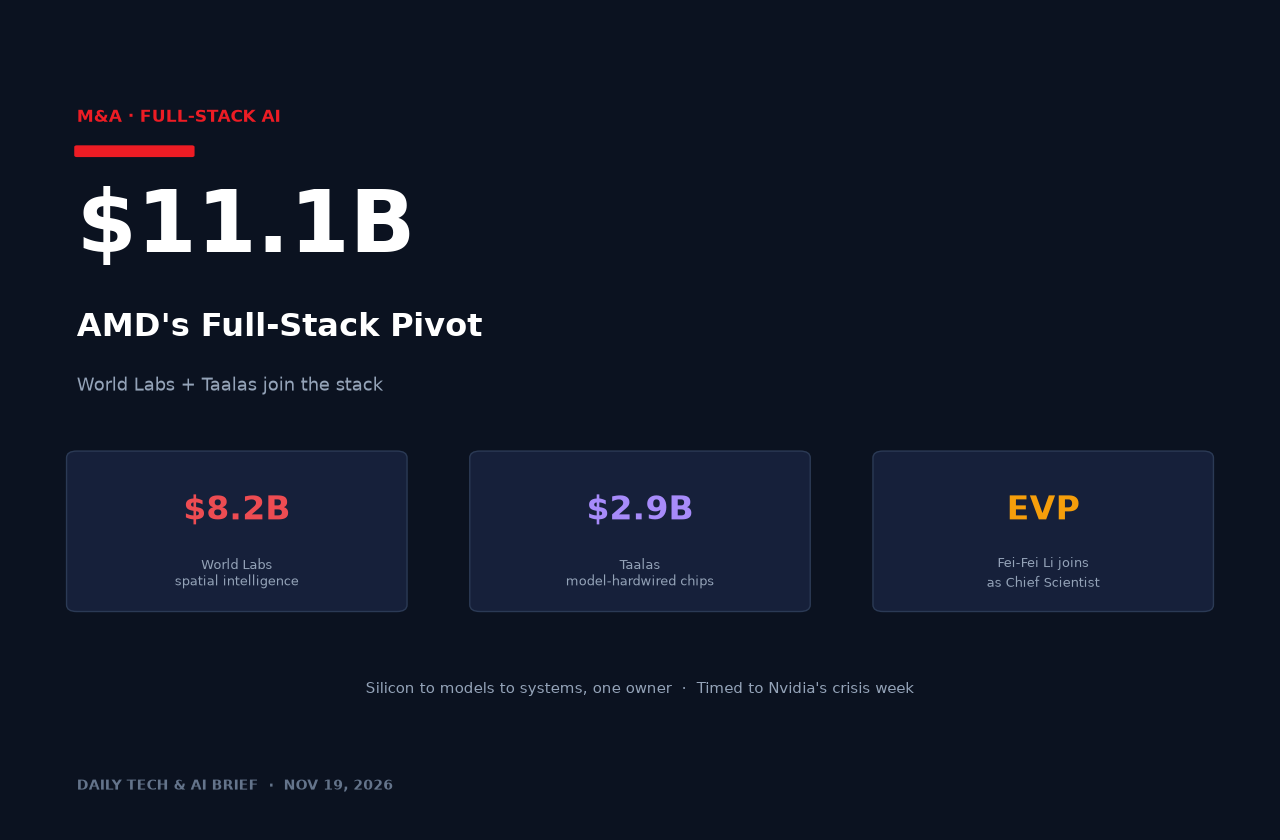
While Nvidia spent the week managing a governance crisis, AMD spent it completing a transformation. The company confirmed the close of its $8.2 billion all-stock acquisition of World Labs — the spatial-intelligence company founded by Stanford’s Fei-Fei Li — alongside a roughly $2.9 billion deal for Taalas, the Toronto startup that hardwires AI models directly into silicon. World Labs closed on November 13 and was announced November 16; Li joins as Executive Vice President and Chief Scientist, reporting directly to CEO Lisa Su. Combined, the two deals represent the largest strategic bet AMD has ever made, and their logic is not “catch Nvidia.” It is “stop playing Nvidia’s game.”
What AMD actually bought
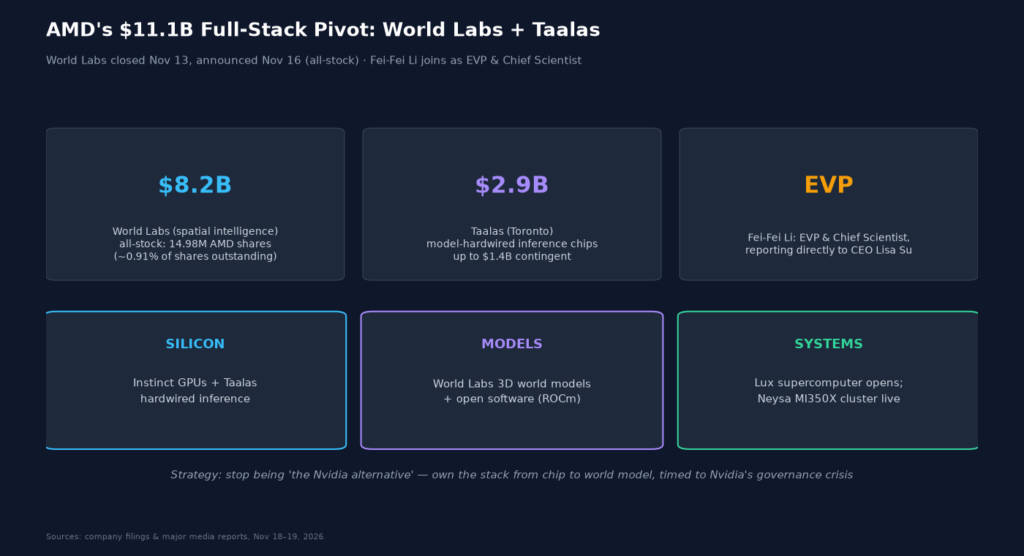
World Labs is the leading commercial expression of an idea Li has championed since her ImageNet days: that intelligence requires understanding space, not just language. Its models generate and reason about persistent 3D worlds from images and prompts — technology with direct paths into robotics simulation, game and film production, embodied AI training, and, closer to this publication’s readers, the next generation of marketing content: spatial product experiences, virtual environments, and 3D assets generated as casually as images are today. The $8.2 billion price, paid in 14.98 million AMD shares (about 0.91% dilution), is a striking multiple for a company with minimal revenue — it is a bet that world models become a foundational layer, and that owning one changes what a chip company is.
Taalas is the opposite kind of bet: tiny, concrete, and radical. The Toronto team etches trained models into purpose-built chips, trading flexibility for extreme inference efficiency — a “model-as-chip” approach that, if it scales, attacks the cost structure of serving AI at volume. At ~$2.9 billion, including up to $1.4 billion in contingent consideration, it ranks among the largest tech acquisitions in Canadian history. Set beside AMD’s existing assets — Instinct GPUs, the ROCm software stack, the Lux supercomputer now opening to scientists, and partner clusters like Neysa’s MI350X deployment going live — a structure emerges: silicon at the bottom, models in the middle, systems at the top, all owned or controlled. Nvidia has pieces of this; nobody has assembled it quite this deliberately, quite this fast.
The timing is the strategy
Context matters. AMD announced these closes in the same week Nvidia’s founder was forced out, its interim CEO faced an employee petition with nearly 200,000 signatures, its board publicly ruled out a return, and two banks downgraded the stock even after a blowout quarter. AMD shares rose while Nvidia fell for five straight sessions. That is not coincidence of calendar; it is the market repricing a duopoly’s risk. Every enterprise AI buyer with a concentration-risk clause in its procurement policy spent this week asking who the credible second source is. AMD answered with a full stack and the most respected scientist in computer vision on its org chart.
There is also a demand-side thesis underneath. OpenAI’s CEO argued publicly this week that chipmakers are double-counting AI demand; inference prices are falling across the industry; and independent spend data shows enterprise token usage tripling while budgets grow only modestly. In a world where usage explodes and unit prices deflate, the winners are whoever serves inference cheapest — which is precisely what Taalas attacks — and whoever owns differentiated workloads that resist commoditization, which is what world models offer. AMD bought both ends of that barbell.
What this means for marketing technology buyers
Three consequences are worth planning around. First, the 3D content pipeline is about to get an industrial sponsor. World Labs’ generative environments plus AMD’s compute puts spatial content — immersive product demos, virtual showrooms, synthetic video environments — on a cost curve similar to the one image generation rode in 2023–2025. Teams that found 3D prohibitively expensive should re-scope pilots for 2027. Second, inference deflation accelerates. If hardwired-model chips reach production, per-token costs for stable, high-volume workloads — classification, moderation, routine generation — could fall another order of magnitude, further pressuring vendors whose pricing assumes today’s GPU economics. Third, the second-source era is real. Procurement teams can now credibly threaten migration not just at the chip layer but across models and systems; use that leverage in enterprise AI negotiations, while discounting the integration risk — assembling acquired stacks takes years, and AMD’s software ecosystem still trails CUDA’s gravity.
The caveat deserves equal weight: $11.1 billion buys assets, not integration. World Labs’ research culture inside a chip giant, Taalas’ radical architecture against GPU incumbency, and ROCm’s persistent software gap are all unresolved. But strategy is about direction, and AMD’s direction this week was unmistakable — from alternative supplier to full-stack contender, with Fei-Fei Li as the flag. The AI race has a new shape, and it was drawn in Toronto and Palo Alto while everyone watched Manhattan.






