The why behind trends · discovery-driven · for a global marketing audience · Nov 2026
Two numbers from Hispanic marketing research look like separate findings. They are not. In LatiNation and ThinkNow’s 2025 study of bilingual Hispanic 18–34s (n=400, vendor-commissioned, self-reported), 87% said they notice culturally inauthentic advertising, and 32% spot it instantly. In iHeartMedia’s February 2026 survey with Collage Group (2,000 adults, including 1,200 Hispanic respondents), bicultural Latinos said they would pay more for brands that genuinely reflect them — 61% of them. Punishment and premium, measured by different firms, in different years. Same mechanism.
Economists call it signaling. A signal only carries information when it is costly to fake. A translated tagline costs a few weeks of agency time — anyone can send it, so it says nothing. Bilingual service lines, products built for 3.8-person households, creators the community trusted before you paid them: these cost real money to build and real money to fake. That is precisely why they work. The audience is not being sentimental. It is doing what any rational buyer does under information asymmetry: ignoring cheap talk and pricing the expensive evidence.
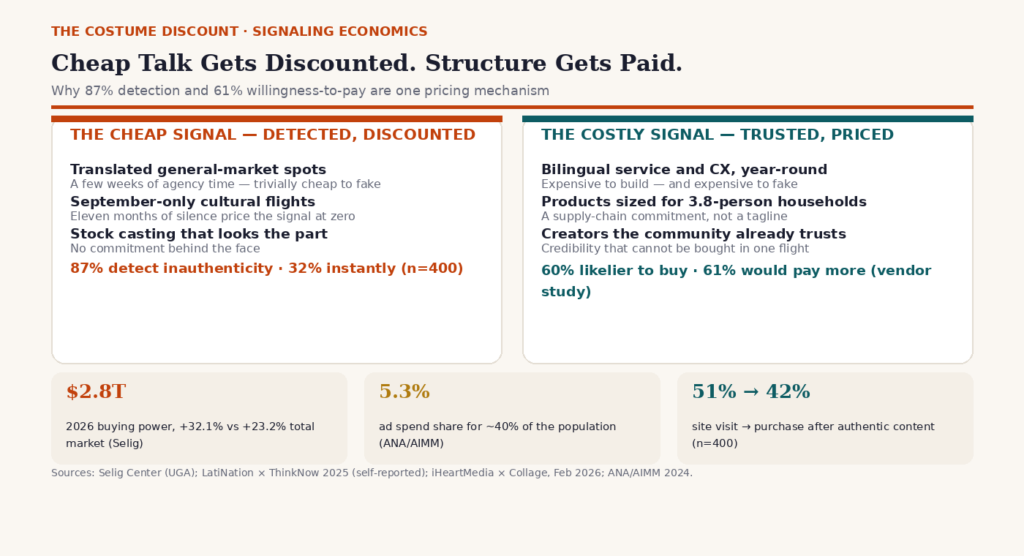
This reframes the “authenticity” conversation. Brands keep treating cultural fluency as a tone problem — hire Latino creatives, fix the casting, warm up the copy. But tone is the cheapest layer of the stack, which is why an audience with a 32% instant-detection rate discounts it fastest. The detection figure and the willingness-to-pay figure are two readings of one dial: how much did this brand actually spend to know me?
The market context makes the mispricing expensive. The Selig Center projects $2.8 trillion in US Hispanic buying power for 2026, growing roughly nine percentage points faster than the total market. Yet ANA/AIMM data shows multicultural audiences — about 40% of the population — drew roughly 5.3% of ad spend, and Hispanic-owned media received just $223 million in 2023. The industry is spending its minority budget on the signal layer the audience trusts least, while underfunding the layers it pays premiums for.
And the discount is not abstract. In the LatiNation data, authentic content pulled 51% of engaged respondents to a brand’s website, and 42% went on to purchase. Costly signals convert; costumes get scrolled past.
The uncomfortable implication: you cannot brief your way out of this. If the product, the service and the hiring do not carry the signal, more culturally fluent advertising just makes the cheap talk more articulate — and, to a third of this audience, detectable on sight. The premium is not paid for saying the right thing. It is paid for having spent the money to mean it.