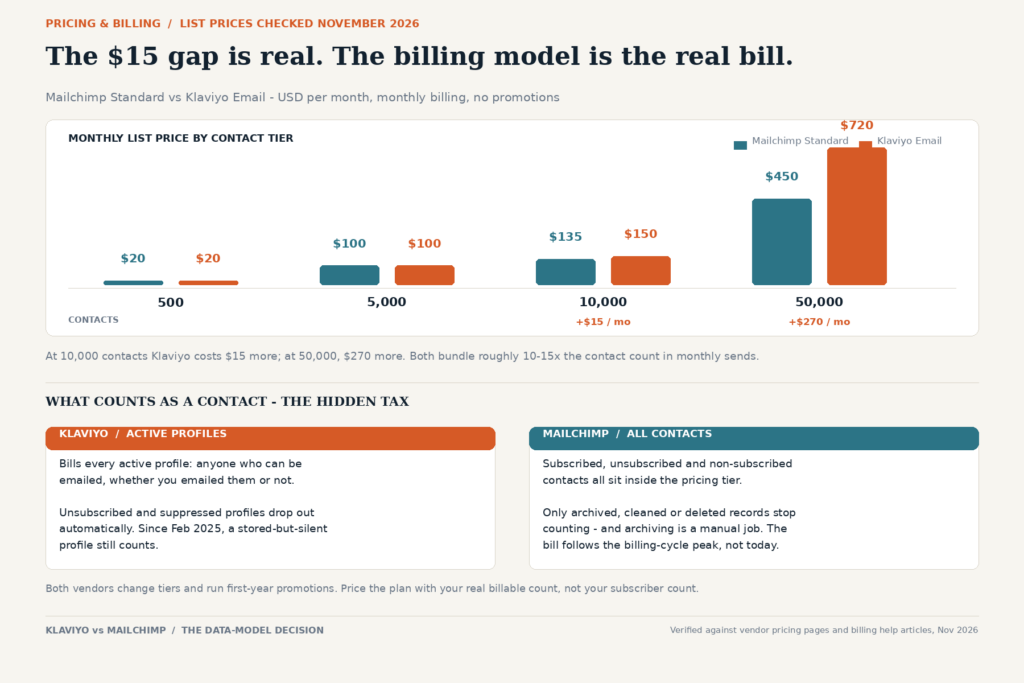
At 10,000 contacts the two platforms sit fifteen dollars apart — Mailchimp Standard at $135 a month, Klaviyo Email at $150, both checked on the vendors’ own pricing pages in November 2026. That is the number every comparison leads with. It is also the least interesting number in the comparison. What actually decides the purchase is what each product stores about a customer. Klaviyo keeps a running stream of store events; Mailchimp keeps a contact record. One was built to react to behaviour, the other to broadcast to a list. The pricing curve, the automation ceiling, the reporting, even the deliverability tooling all fall out of that single architectural choice. If email is already a revenue channel for you, depth pays. If email is a newsletter, breadth wins. And moving between them is a small construction project, not a subscription change.
1. The Fifteen-Dollar Question Nobody Asks
Type the two names into any search bar and you get the same ritual: a feature grid, a verdict, an affiliate link. Twelve rows of checkmarks. A winner declared. What you rarely get is the question that should come first — what does this thing believe a customer is?
Because here is the odd part. Two products that share a category label, a price point and a send button can be built on completely opposite assumptions. One assumes a customer is a sequence of things they did. The other assumes a customer is a row in a table you keep. Everything downstream — what you can trigger on, what you can predict, what you can prove to your CFO — is decided before you write a single subject line.
So let us not start with features. Let us start with plumbing.
2. Two Products Wearing One Category Label
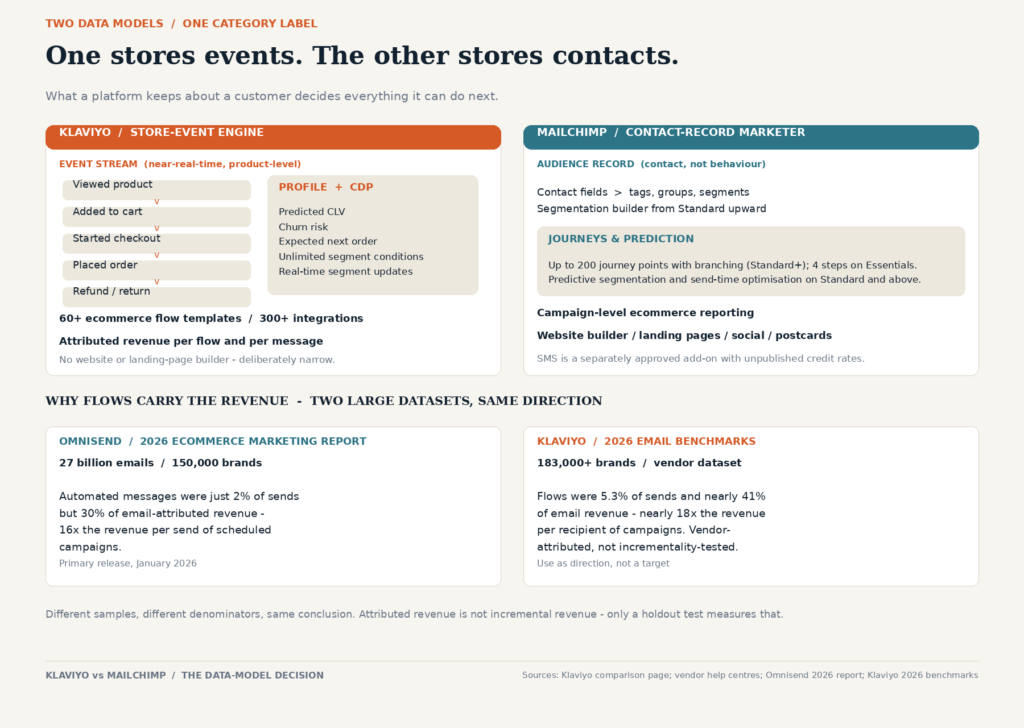
Klaviyo is, at heart, a store-event engine. Connect Shopify and the platform ingests a live feed: product viewed, added to cart, checkout started, order placed, refund issued, each with the product and the dollar amount attached. Those events land against a single profile, in near real time, and a built-in customer data platform holds them. Segments are just questions you ask of that event stream — show me everyone who bought from the skincare collection, spent over $80, has not ordered in 90 days and has not opened anything in a month — and they re-solve themselves as new events arrive. Klaviyo’s own comparison page puts the count at 60-plus ecommerce automation templates, 200-plus report templates and 300-plus pre-built integrations.
Mailchimp is a contact-record marketer. It begins with an audience: fields, tags, groups, signup source, location. Its automation starts when you tell it to, from a trigger you select, and walks a journey you drew. That is not a lesser design. It is a different one, aimed at a business that wants email, a website builder, landing pages, social scheduling and postcards behind the same login. On Standard and above the journey builder is genuinely capable — up to 200 journey points with branching — and the predictive layer (purchase likelihood, predicted demographics, send-time optimisation, multivariate testing) is real. It is simply built on a record, not an event stream.
Think of it this way. Klaviyo remembers what your customer did. Mailchimp remembers what your customer is. Which one you need depends entirely on whether behaviour or identity drives the money.
3. Verified Pricing, November 2026: The Bill Is Not the Sticker
Here is the part everyone photocopies. On monthly billing, in US dollars, read from the vendors’ pricing pages in November 2026:
| Contacts | Mailchimp Essentials | Mailchimp Standard | Klaviyo Email |
|---|---|---|---|
| 500 | $13 | $20 | $20 |
| 5,000 | $75 | $100 | $100 |
| 10,000 | $110 | $135 | $150 |
| 25,000 | $270 | $310 | $400 |
| 50,000 | $385 | $450 | $720 |
Mailchimp Standard tops out at $800 for 100,000 contacts; Premium starts at $350 for 10,000. Send allowances scale as a multiple of the contact tier — roughly 10x on Essentials, 12x on Standard, 15x on Premium — while Klaviyo bundles about 10x its profile count in email sends. At 10,000 that is 100,000 sends on either side. Klaviyo’s free tier is 250 profiles and 500 sends; Mailchimp’s free tier has shrunk in 2026 to a comparable 250 contacts and 500 sends in most markets, though the older 500-contact version still appears on some regional pages. Both run first-year promotions, including a 15%-off offer on 10,000-plus-contact plans. Budget on month thirteen, not month one.
Now the part nobody photocopies: what counts as a contact.
Mailchimp’s own help centre is blunt. Subscribed, unsubscribed and non-subscribed contacts all sit inside your pricing tier. A customer who bought once through a connected store but never opted in still counts. Only archived, cleaned or deleted records stop counting — and archiving is a manual chore you have to schedule. Worse, the monthly bill follows the peak contact count inside the billing cycle, so tidying the list on day twenty-nine does not undo the high-water mark on day three.
Klaviyo bills active profiles, and its definition changed on 18 February 2025. It used to charge for people you actually emailed; it now charges for every profile that can be emailed, regardless of consent status and regardless of whether you sent to them. A shopper who entered an email at checkout without opting in is billable. Unsubscribed and suppressed profiles drop out automatically, though the count can take up to 72 hours to refresh after a big cleanup.
So the folklore that a dirty list is a Mailchimp-only tax is out of date. Both platforms now charge you for dead weight. The difference is that Klaviyo evicts unsubscribes for you, while Mailchimp makes you carry them out yourself. A list with 8,000 subscribers and 4,000 lapsed unsubscribes prices as 12,000 contacts on Mailchimp and 8,000 profiles on Klaviyo — which can flip the apparent $15 gap on its head. Audit the list before you audit the price.
4. Automation Depth: 60+ Retail Flows vs 200-Step Journeys
Both will send a welcome series, an abandoned-cart reminder and a post-purchase thank-you. That is where the overlap ends.
Klaviyo ships more than 60 pre-built ecommerce flow templates — browse abandonment, back in stock, replenishment, price drop, win-back, VIP, review request — and each one can branch on any profile property or any event. Since the event data is already in the profile, a flow can show the exact item someone looked at without buying. Conditional splits, in-flow A/B tests, SMS stepping and smart-sending throttling are native. Segments have effectively unlimited conditions and update in real time. You do not need a developer; you need someone who understands the data.
Mailchimp’s journey builder is a fine piece of design software. Standard and Premium allow up to 200 journey points, multiple triggers, if/else branching and audience filters. Essentials caps a flow at four steps, which is enough for a two-email welcome and not much else — so the honest comparison is always Klaviyo versus Mailchimp Standard. The catch is what feeds the journey. Purchases and tags arrive via the store connection; the granular, product-level, moment-by-moment behavioural feed is thinner. You end up approximating. A replenishment reminder for a store that sells both coffee (reorder in 30 days) and a jacket (reorder never) becomes a fixed delay applied to everyone. Ask yourself which of those two messages you would rather receive.
5. The Predictive Layer: Forecasts That Need a Feed
Klaviyo’s predictive analytics add Historic CLV, Predicted CLV, Total CLV, churn-risk probability, average time between orders and an expected date of next order to each profile. The model retrains at least weekly. Segments can be built directly on those fields — predicted CLV above $500 and churn risk below 20% is a two-rule cohort that refreshes itself.
But read the eligibility fine print, because it is the whole story. Per Klaviyo’s help centre, predictions only appear when at least 500 customers have placed qualifying orders, an ecommerce integration or API is sending order events, there are 180 days of order history with an order in the last 30 days, and some customers have ordered three or more times. Klaviyo also says plainly that predictions are averages: reliable across a group, not a prophecy about one person. This is a feature that needs a data feed to exist.
Mailchimp’s predictive segmentation is gated to Standard and above, and it carries the same dependency: it needs a connected store, purchase history and at least one campaign already sent. Purchase-likelihood forecasts over 60, 90 and 365 days, predicted demographics and churn flags are genuinely useful once that data is present. On a pure newsletter list the fields are empty. Send-time optimisation has the identical catch — it needs engagement history per contact to optimise against, it does not apply to automated emails, and on a young list it quietly falls back to something close to your default send hour. Paying for Standard to get a prediction on a list that cannot produce one is the most common quiet overspend in this category.
6. Revenue Attribution: Why Revenue Per Recipient Is the Scoreboard
Here the data model turns into an accounting difference.
Klaviyo credits revenue down to the individual flow, campaign and message. Its default is a last-touch, cooperative multi-channel model with a configurable five-day window for email opens and clicks (shorter for SMS and push), and it reports Campaign Revenue, Flow Revenue and Klaviyo Share of Revenue side by side with your store’s total sales. Its API even lets you group placed-order metrics by flow. That is why Klaviyo dashboards get quoted in board decks.
Two honest caveats. First, attributed revenue is a claim, not a measurement of causality — it overlaps with whatever your ad platforms claim, and a five-day window happily credits orders that would have happened anyway. Klaviyo’s own documentation and independent analysts both say so. Second, only a holdout test — suppress 10% of a segment, mail the other 90% — measures true incrementality. Use revenue per recipient (RPR) as the operating metric, keep the attribution window fixed when you compare periods, and treat the dashboard as a compass, not a verdict.
Mailchimp reports ecommerce revenue at the campaign level and surfaces attributed revenue inside the Shopify admin. It is perfectly adequate for did this newsletter sell. It is not built to tell you that your third abandoned-cart email is worth $3.65 per recipient while your welcome sequence is worth $2.65. Fine-grained, per-message optimisation is the thing you are actually buying when you pay Klaviyo’s premium.
7. Deliverability: A 5.0 vs 3.0 Tooling Gap, Not a Destiny Gap
This is the section most comparisons get wrong, so slow down.
EmailToolTester used to publish biannual inbox-placement percentages from seed-list tests. In 2025 it retired them. Its stated reasons are worth knowing: seed lists grew inconsistent, some vendors appeared to optimise for test addresses, seeded lists of non-opted-in addresses violated anti-purchased-list policies, and after the Yahoogle changes of 2024 domain reputation and spam complaints mattered more than any platform’s IP reputation. So the current rating is feature-based, out of five, built from half-star credits across authentication compliance, complaint handling, dedicated deliverability support, list hygiene, and IP reputation and warmup.
On that scale Klaviyo scores 5.0, first among ten platforms: branded domain authentication, a Deliverability Hub with a daily account-level score based on the last 30 days that names the metrics dragging you down and recommends fixes, access to a deliverability team, strict list hygiene. Mailchimp scores 3.0, last: standard authentication, list policies, consultations, a $29.95-a-month dedicated IP for high-volume senders — but no dedicated dashboard, no health score, no built-in list validation, and no full SPF alignment.
Klaviyo was never in the old placement tests, so there is no percentage to set against Mailchimp’s retired numbers. Which is fine, because the percentage was the wrong question anyway. Your ESP is a courier, and after the handoff to Gmail or Yahoo the outcome is dominated by authentication, list hygiene, content and cadence — factors neither vendor controls for you. A domain with broken DKIM alignment will underperform on Klaviyo; a spotless DMARC-enforced domain will do well on Mailchimp. Neither platform issues Verified Mark Certificates or gets your logo into the inbox through BIMI. That sits a layer above both.
So read the 5.0 versus 3.0 correctly: Klaviyo gives you a daily read on sender health and tells you what to fix. Mailchimp leaves that monitoring to you or a third-party tool. Tooling is an advantage in visibility, not a guarantee of placement. Buying Klaviyo to solve a deliverability problem caused by a rotting list is like buying a faster courier for a package with the wrong address on it.
8. SMS and Channels: Unified Consent vs an Application-Gated Add-On
If text messaging is on your roadmap, this section may decide it for you.
Klaviyo runs email and SMS on one profile, with one consent record and one flow that can branch between channels. A cart sequence can send an email first and a text 24 hours later without a second tool, a second database or a second opt-in ledger. SMS is a separate metered spend on top of the email plan, but architecturally it is the same machine.
Mailchimp sells SMS as a paid add-on, not a switch. It is unavailable on Free, requires an application with business vetting and SMS-specific terms, and approval takes anywhere from one to seven business days depending on country. You buy a monthly credit subscription; unused credits expire at the end of each cycle and do not roll over. Credit prices vary by sending country and account currency, and the pricing page links out to rate details rather than publishing a flat number — so treat any quoted per-text price as provisional. Coverage is roughly 37 countries, with 10DLC two-way messaging in the US and Canada, virtual long numbers in the UK, Belgium and Australia, and one-way branded sender IDs across much of Europe. MMS needs Standard or Premium and works only for US and Canadian contacts.
Both have holes. Neither offers push or WhatsApp as a native unified channel in this comparison, and on Mailchimp transactional email is a separate product. Klaviyo, for its part, deliberately does not build websites or landing pages.
9. Ecommerce Integration Depth: What Actually Crosses the Pipe
Both have a Shopify app. The difference is what flows through it.
Klaviyo’s integration backfills roughly 90 days on connect and then the full order history, after which new data arrives in near real time: customers, orders, the product catalogue, and behaviour such as viewed products, searches and carts. It syncs bidirectionally, so Klaviyo segments can be pushed back into Shopify as customer tags. That bidirectional, event-level pipe is why so many Shopify-native apps and agencies build for Klaviyo first. The listing sits around 4.7 to 4.8 stars across several thousand reviews, depending on when you check.
Mailchimp’s Shopify app is well reviewed too — about 4.8 stars across more than a thousand reviews in late-2026 snapshots — and it syncs segments and supports welcome, abandoned-cart and back-in-stock emails, with attributed revenue shown in the Shopify dashboard. Its free Magento extension covers all plans. But the behavioural event history available for segmentation is shallower; a granular trigger often needs a connector or a workaround. It is worth remembering that Mailchimp left the Shopify App Store in 2019 after a data-sharing dispute and returned in 2022 — the integration works today, but that three-year gap is a large part of why the Shopify ecosystem standardised elsewhere.
App-store ratings are evidence of a smooth install, not of data depth. Do not confuse the two.
10. Breadth Versus Focus: The All-in-One Bet
Mailchimp’s case is not that it does ecommerce better. It is that you own one tool. A service business, a nonprofit, a membership organisation or an agency juggling several client accounts rarely needs predicted churn. It needs a newsletter, a donation page, a landing page for an event, a postcard, a social post, and a support line that picks up on a Sunday. Mailchimp gives 24/7 email and chat on every paid plan and phone support on Premium. The learning curve is gentler; a generalist marketer can be productive in an afternoon.
Klaviyo’s narrowness is a choice, not an omission. No website builder. No landing pages. Paid plans add a customer success manager, a dedicated onboarding expert and a dedicated deliverability expert, and the free tier gives email support for the first 60 days only. Weekend live chat on some plans sits behind a higher service package. The product assumes a store, a data feed and someone whose job is to tend the flows.
One useful sanity check from the research literature, with a warning attached. Litmus’s widely cited State of Email figure puts email ROI around $36 per dollar spent, higher in retail; the older $42 number is a 2019 UK DMA figure in pounds and is not a like-for-like comparison. Both are self-reported surveys. Treat them as confirmation of the channel’s economics, never as a forecast for your P&L. The leverage is real — near-zero marginal send cost against a list you own — but it is exactly why a deliverability problem hides in plain sight: the sends still report as delivered.
11. The Fit Matrix: Four Buyers, Four Answers
The early store. Under a few thousand contacts and under roughly $200K in annual revenue, both platforms are inexpensive and the free tiers are nearly identical. Promotions distort the first year. The binding constraint is not the invoice, it is whether anyone has time to build flows. If nobody does, the cheaper, simpler tool wins by default.
The newsletter, service business or nonprofit. Mailchimp, almost always. You are buying breadth and a gentle learning curve, and predictive CLV is a feature you will pay for and never populate.
The agency or multi-account operator. Mailchimp’s audiences, seats and all-in-one surface are easier to hand to a client. Klaviyo’s multi-account billing and SSO live higher up the ladder.
The team with no lifecycle owner. This is the uncomfortable one. A platform that bills every active profile punishes a list nobody prunes, and a 60-flow library nobody maintains is just shelfware. Budget 20 to 40 hours of relearning whether you switch or not. And if your stack is built on WeCom SCRM or Youzan rather than Shopify, ask the same question in that context: does the tool store events, or just contact records? The answer travels.
12. The Migration Playbook: You Are Rebuilding, Not Moving
Here is where the folk wisdom is most expensive. Contacts move easily. Everything valuable does not.
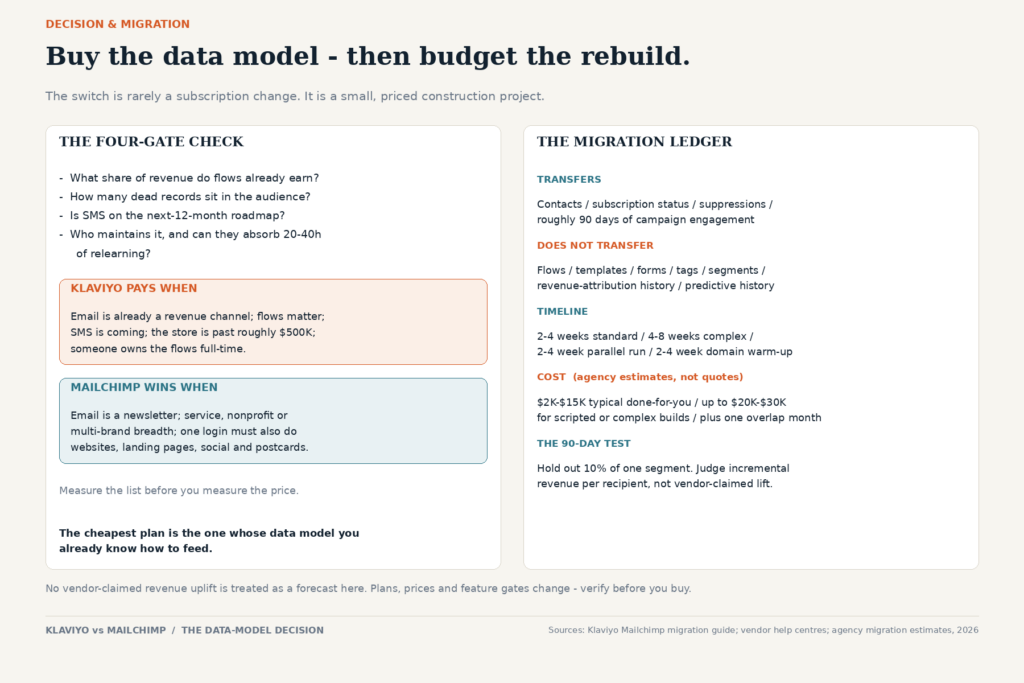
Klaviyo’s native Mailchimp integration pulls audiences, subscription status, unsubscribes and cleaned contacts, plus roughly the last 90 days of campaign engagement, syncing existing audiences about every 30 minutes while connected. What does not transfer: flows, templates, signup forms, tags, behavioural segments, revenue-attribution history and predictive history. There is no import path for automation logic. Drag-and-drop templates have to be rebuilt; custom HTML can be carried. Plan two to four weeks for a standard account, four to eight for a complex one, with a two-to-four-week parallel run and a two-to-four-week domain warm-up that starts with your most engaged 10 to 20% and widens from there. Re-authenticate SPF, DKIM and DMARC — new sending infrastructure means new DNS. Re-collect SMS consent from scratch; email opt-in is not SMS opt-in.
Now the money. Published agency estimates cluster at $2K to $15K for a done-for-you switch, rising to $20K–$30K for scripted builds with consent reconciliation and a first-party event layer; a DIY job is 40 to 100 hours of internal time. Add one overlap month of paying for both — at 10,000 contacts that is $285 at list price — and the opportunity cost of every week a revenue-producing flow is dark.
Which brings us to the number we deliberately removed. Migration guides love to promise a 40 to 100% lift in email revenue within 90 days. It is an agency marketing claim, not a verified benchmark, so it does not appear here as a forecast. Replace it with a test you control: hold out 10% of one segment, keep the attribution window fixed, and judge the switch on incremental revenue per recipient after 90 days. If the incremental gain clears the full switching cost, the move paid for itself. If it does not, you bought a nicer dashboard.
13. A Decision Checklist You Can Run on Monday
Pull four numbers before anyone opens a demo:
- Flow revenue share today. What percentage of email-attributed revenue comes from automated messages rather than campaigns? Two large 2026 datasets set the directional benchmark: Omnisend’s report on 27 billion emails from more than 150,000 brands found automated messages were 2% of sends but 30% of email-attributed revenue, at 16 times the revenue per send of scheduled campaigns (Shopify’s own statistics round-up reports the same 16x); Klaviyo’s benchmarks across 183,000-plus brands put flows at 5.3% of sends and nearly 41% of email revenue, nearly 18 times the revenue per recipient of campaigns. Different samples, different denominators, same direction. Some secondary write-ups quote 37% and 23 billion emails for the Omnisend figure — the primary January 2026 release says 30% and 27 billion, so use the primary. Both are vendor-attributed, not incrementality-tested.
- List dirtiness. Count unsubscribed, non-subscribed and long-inactive records. On Mailchimp they bill until archived; on Klaviyo they bill until suppressed. This number alone can move you a pricing tier.
- The SMS roadmap. If a second channel is coming within a year, unified consent is worth real money. If it is not, an application-gated add-on is harmless.
- Maintainer capacity. Who rebuilds, who prunes, who watches revenue per recipient? Name a person, or the more powerful tool is the wrong tool.
Then apply one rule: if email is already a revenue channel, with flows producing a meaningful share, SMS on the roadmap and a store past roughly $500K, Klaviyo’s depth pays for itself. If email is a newsletter, a service business, or one login has to do five jobs, Mailchimp’s breadth wins. A $200K store does not need predicted churn. A $5M store that sends four campaigns a month and nothing else does not need a cheaper plan — it needs more flows.
14. Conclusion: Buy the Model, Then Budget the Rebuild
The price gap is real but small at 10,000 and real but survivable at 50,000. The billing models now punish dirty lists on both sides, in slightly different ways. The deliverability scores measure tooling, not destiny. The automation counts — 60-plus flows against 200 journey points — are both big numbers that describe different capabilities. None of these is the decision.
The decision is whether your marketing runs on what customers do or on who they are. Pick the platform whose memory matches your economics, then price the list-cleaning, the flow rebuild, the parallel run and the holdout test before you sign anything. Most teams discover the honest answer is not which tool is better but which tool we will actually feed. That is a far less glamorous question, and it is the one that decides the invoice.
The Short Version, Again
Two data models share a category. Klaviyo stores product-level events and reacts in real time; Mailchimp stores contact records and walks them through designed journeys. At 10,000 contacts the sticker gap is $15; at 50,000 it is $270 — but what counts as a billable contact, and whether your list is clean, matters more. Klaviyo wins on event depth, predictive segmentation, per-message attribution and native unified SMS. Mailchimp wins on breadth, support, learning curve and price at scale. Deliverability’s 5.0-versus-3.0 is a feature gap, not a placement guarantee. Switching costs $2K–$30K and two to eight weeks, and nothing you have built transfers except the contacts. Decide with a four-number audit and a 90-day holdout test, not a feature grid.