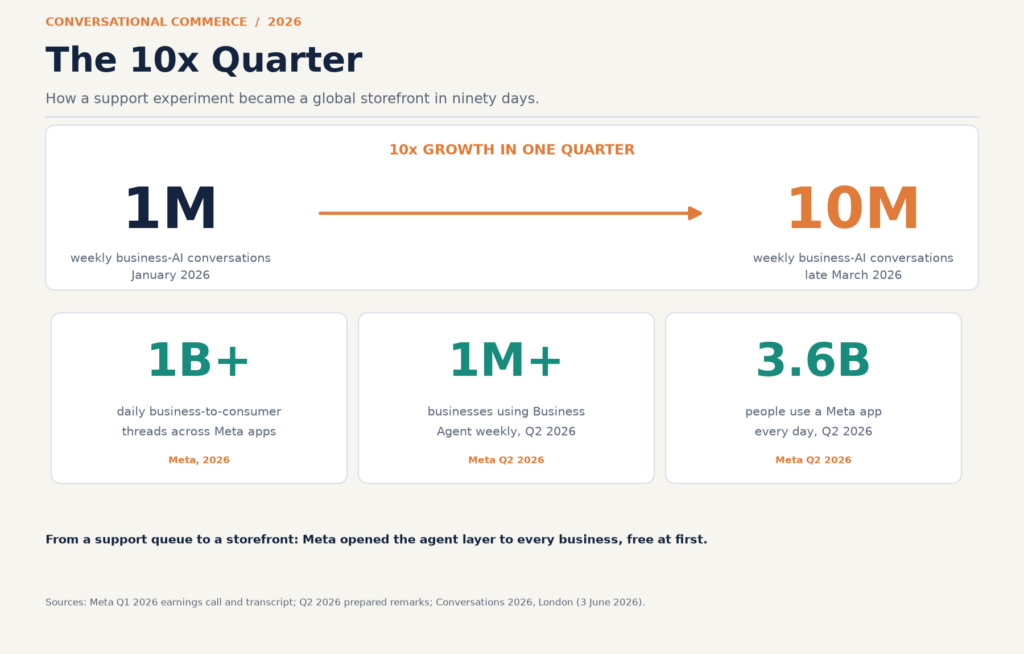
Something quiet happened between January and late March of 2026, and most marketing teams missed it because it did not look like a product launch. On Meta’s first-quarter earnings call, Susan Li mentioned that more than 10 million conversations a week were now being facilitated by business AIs on WhatsApp and Messenger, up from 1 million at the start of the year. Ten times in roughly ninety days. Mark Zuckerberg added a line that should have set off alarms in every ecommerce Slack channel: these tools were free for most businesses for now, but the company expected to work toward a longer-term monetization model.
Free is never a permanent price. It is a land grab with a timer on it.
By June, that experiment had a name and a global footprint. By July, it had a billing meter. And by the time the holiday forecasts landed in September, the demand side had already rearranged itself around the same idea: people were no longer starting with ten blue links. They were starting with a question, asked out loud, to a machine that answered in a thread. The chat window stopped being where you apologise for a late parcel and became where the parcel gets chosen, paid for, and tracked. If your funnel still treats messaging as a support queue that sits downstream of the funnel, you are solving the wrong problem. Let us work through what actually changed, what is still marketing folklore, and what to do about it on Monday morning.
1. The quarter that re-plumbed commerce
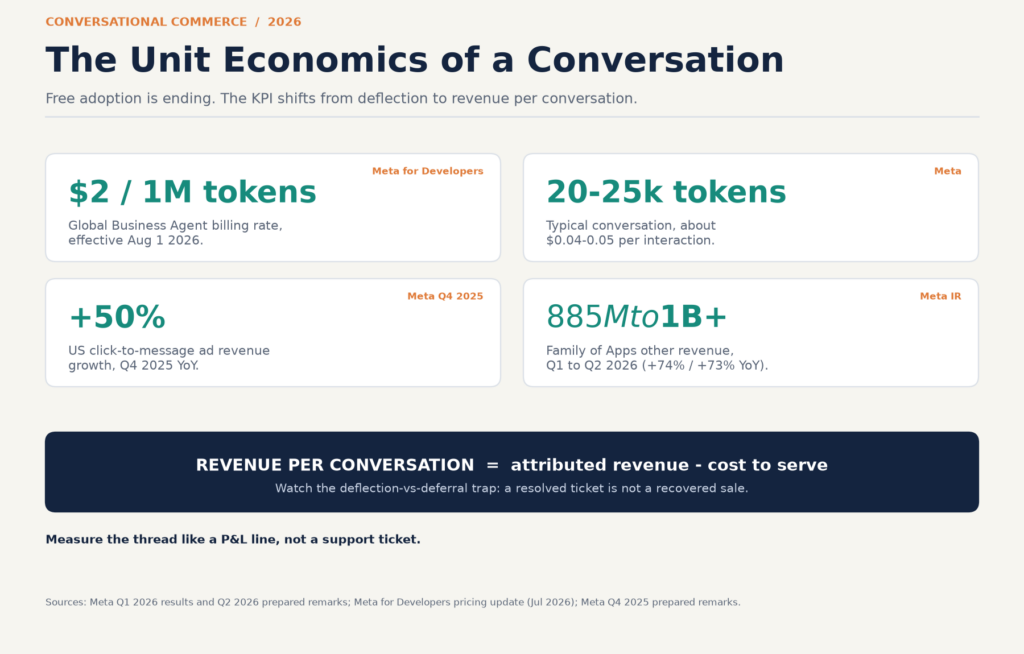
Start with the scale, because the scale is the argument. Meta reported 56.31 billion dollars in Q1 2026 revenue, up 33 percent year over year, with advertising at 55.02 billion. Buried inside that is a line item worth watching: Family of Apps other revenue of 885 million dollars, up 74 percent, driven primarily by WhatsApp paid messaging and subscriptions. One quarter later, that same line crossed 1 billion dollars for the first time, up 73 percent, again on WhatsApp paid messaging and subscriptions. In Q4 2025, paid business messaging had already passed a 2 billion dollar annual run rate, and US click-to-message ad revenue was growing more than 50 percent year over year.
Now put the product on top of the P&L. On 3 June 2026, at its Conversations conference in London, Meta made the Meta Business Agent global across WhatsApp, Messenger and Instagram after roughly two years of testing in markets including India, Mexico and Brazil. More than a million businesses were already using earlier versions; more than a billion business-to-consumer conversations flow through those apps every single day. On the Q2 call, Zuckerberg confirmed more than a million businesses were now using the agents weekly to talk to customers or complete sales, with Instagram rolling out next, and noted that 3.6 billion people use at least one Meta app each day.
Here is the part that reframes the whole thing. Zuckerberg did not describe a chatbot. He described an agent that learns from talking to your customers every day and brings the context back to you: overnight summaries, missed-conversation alerts, what people keep asking for, and eventually competitive intelligence and a kind of business-in-a-box service. The agent answers questions, recommends from a catalogue, books appointments, qualifies leads, closes sales, and hands off to a human at a moment the merchant defines. Read that list again. That is a storefront with the shelf, the till, the sales associate and the CRM collapsed into one thread.
2. Three agent layers, one customer
Once you see that, the real strategic question stops being whether to add a chatbot. It becomes: which agent owns the customer relationship? There are three contenders, and they are not interchangeable.
The first is the platform agent — Meta’s free-to-start Business Agent, and its cousins on other messaging surfaces. It lives where the customer already is, it costs nothing to switch on, and it will soon bill you by the token. The second is your own agent, the retrieval-augmented bot on your site and app that reads your inventory, order state, returns policy and pricing logic. It is slower to build and it will never match Meta’s distribution, but the data and the decision rules stay in your house. The third is the shopper’s own AI — ChatGPT, Gemini, Perplexity — which increasingly writes the shortlist before your brand is even in the room. That one you cannot buy; you can only be legible to it, which is the whole discipline of generative engine optimisation.
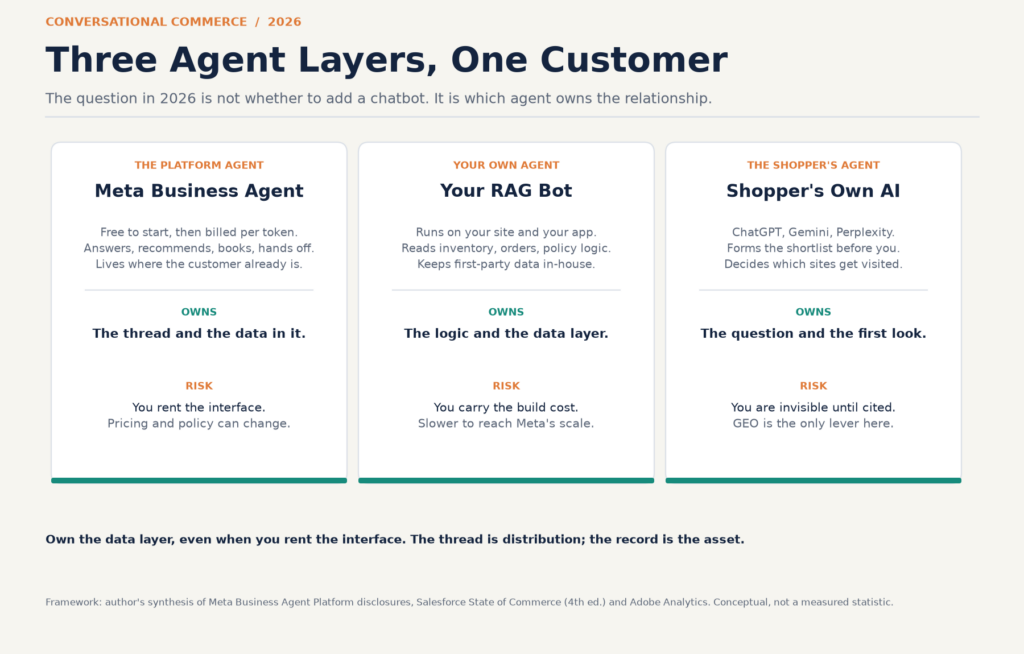
Notice the asymmetry. The platform agent owns the thread and the data inside it. Your own agent owns the logic. The shopper’s agent owns the question. Rent the interface if you like — most small businesses should — but do not rent the memory. The moment your product facts, price rules and customer history exist only inside someone else’s agent, you have built a store on land you do not own, at a rent that can be repriced. Which, as we will see, is exactly what happened in August.
3. The demand-side proof, read correctly
The supply side shipping an agent is one thing. The demand side voting for it is another, and here two independent datasets agree with each other, which is rarer than vendors would have you believe.
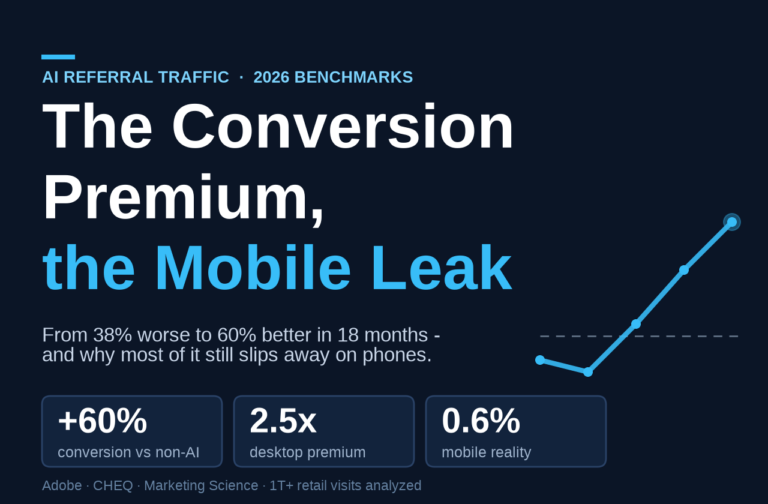
Adobe Analytics, tracking more than a trillion visits to US retail sites, 100 million SKUs and 18 product categories over the 2025 holiday season, found that AI-referred visitors converted 31 percent more than visitors from other sources. They spent 45 percent more time on site, viewed 13 percent more pages, and were 33 percent less likely to leave immediately. Retail generative-AI traffic grew 693.4 percent year over year. Adobe’s 2026 holiday forecast then called for AI-referred traffic to US retail sites to rise another 130 percent year over year, against total US online sales of 275.1 billion dollars growing 6.7 percent — with the candid caveat that the base is undisclosed and the channel remains modest in absolute volume.
Salesforce, drawing on the behaviour of 1.5 billion shoppers, reported that AI and agents influenced 20 percent of global holiday retail sales in 2025, or 262 billion dollars of a 1.29 trillion dollar season. Shoppers referred from AI search converted nine times more often than those from social media. Retailers that had deployed their own agents — Pandora, SharkNinja and Funko among them — grew sales 6.2 percent year over year versus 3.9 percent for those that had not. The fourth edition of Salesforce’s State of Commerce report, built on a survey of 3,450 commerce professionals plus behavioural data from 1.5 billion shoppers across 37 countries between Q1 2024 and Q1 2026, found traffic referred from AI chats growing between 150 and 428 percent year over year in every quarter measured, while overall traffic grew in the single to low double digits. Between August 2025 and May 2026, discovery through brand-owned properties fell 7 percent and traditional search fell 15 percent, while new channels — AI assistants, social AI, delivery apps — rose 38 percent.
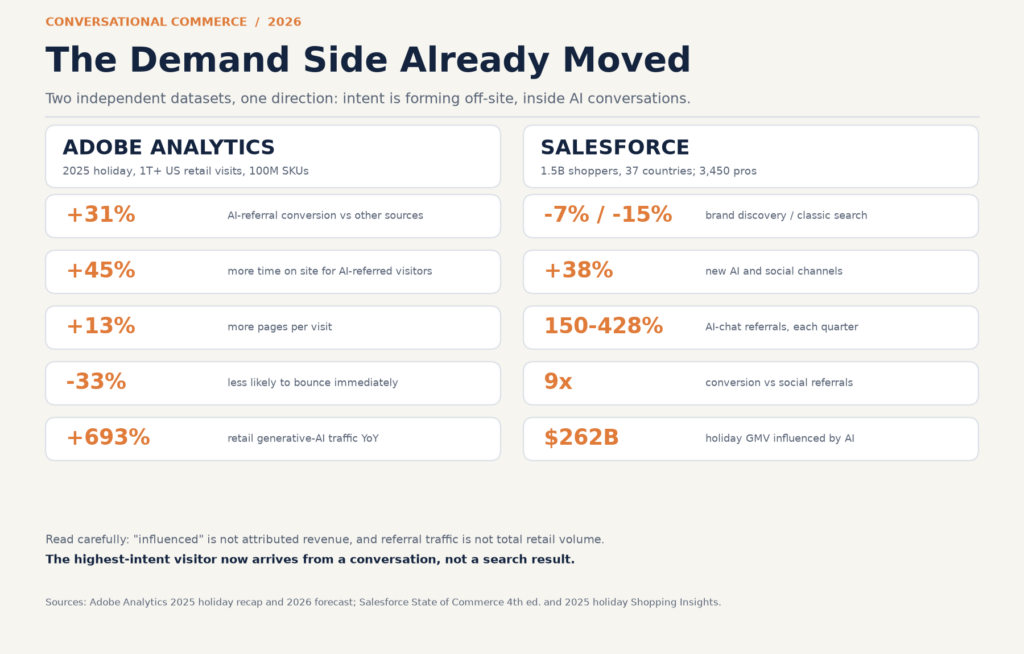
Two words of discipline, because this is where decks go wrong. First, influenced is not attributed: Salesforce’s 262 billion dollars describes sales where AI played a role in discovery or service, not sales the agent closed on its own. Second, a fast-growing referral channel is still a small referral channel. Adobe itself has said AI traffic remains modest in volume. There is even counter-evidence worth holding onto: Walmart products bought through an AI assistant’s instant checkout converted at roughly a third the rate of click-through traffic to Walmart’s own site, and a separate survey found only a tiny share of shoppers would still buy after an AI recommendation led them to a disappointing website. High intent is a gift, not a guarantee. The agent gets the shopper to your door; your product data and your site still have to close.
4. A channel economics map, and a warning about the numbers online
Ask a vendor for chat conversion benchmarks and you will get a confident spreadsheet: web chat at 8 to 15 percent, WhatsApp consumables at 12 to 25 percent, Instagram DM auto-replies around 7.4 percent, email at 2 to 5 percent. Those figures come from chatbot vendors synthesising their own customer data, with no shared methodology and no independent audit. Treat them as directional at best. The same goes for the famous 98 percent WhatsApp open rate, which traces back to a Mobilesquared estimate, not to anything Meta has published. Meta publishes no open or response rates for business messaging at all. The defensible version is plainer: WhatsApp messages are read far more reliably than email, and Meta’s own consumer research found about 73 percent of people prefer messaging a business over other channels. Ask any vendor quoting 98 percent to show you the study. Usually there is not one.
So build the map on anchors you can actually defend. Meta’s own Q4 2025 remarks give you a +50 percent US click-to-message growth rate and a 2 billion dollar paid-messaging run rate. Meta’s Q2 2026 call gives you a real operating case: Movida, a Brazilian car-rental company, ran its entire booking flow inside WhatsApp and reported a 44 percent increase in daily bookings year over year, with 85 percent of channel conversations resolved entirely by the AI and returning customers completing a reservation in as few as three messages. At Meta’s Mumbai summit in July 2026, a small retailer named Madhulika Enterprises reported a 25 to 30 percent lift in conversion with the agent handling 50 to 60 percent of repetitive inquiries. Those are self-reported merchant results, shared on the vendor’s stage, so discount them accordingly — but at least you know whose number it is and where it came from. That is more than you can say for most conversion benchmarks in circulation.
5. Inside the Meta Business Agent
Strip away the keynote and the product is fairly concrete. Setup takes minutes: a business feeds it product information, prices, policies and opening hours — PDFs work too — and the agent starts replying in the customer’s language, in a tone matched to the brand, around the clock. It discloses that it is an AI at the start of the conversation. It recommends from a catalogue, books appointments, qualifies leads, pushes a sale toward completion, and escalates to a human at a threshold the merchant sets. For managers it produces a daily digest of overnight conversations, surfaces recurring complaints and flags threads that need a person. Meta routes between smaller and larger models depending on the complexity of the question, which is a quiet hint that cost control was designed in from the start.
Alongside it sits the Meta Business Agent Platform for larger organisations: an infrastructure layer that connects the agent to Shopify, Zendesk, Shopee and similar systems, so it can take actions rather than just answer, with enterprise-grade controls, guardrails and measurement built in. That distinction matters more than the feature list. The standalone agent is a ready-made chat layer inside the app; the platform is the wiring underneath. If you are a 40-SKU shop, take the first. If you have an order-management system, a returns policy with exceptions and a CRM, you will need the second — or your own equivalent.
Then there is the price of free. On 1 August 2026, token-based billing went live for the Business Agent on the WhatsApp Business Platform at a global rate of 2 dollars per million tokens. Meta estimates a typical conversation consumes 20,000 to 25,000 tokens, roughly 4 to 5 cents per interaction; simpler threads cost less, longer multilingual troubleshooting costs more. From 1 October, service messages and utility messages inside the open 24-hour window become billable again, ending a waiver that had been in place since July 2025. Paid subscription tiers bundled under Meta One followed in September. In other words, the land grab ended on schedule.
6. Build versus adopt, and the decision that actually matters
The honest answer is that most small and mid-sized businesses should adopt before they build. If your use case is catalogue questions, opening hours, appointment booking and order status, the platform agent is better than anything you will ship this quarter, it is already where your customers are, and the setup cost is an afternoon. Adopt, instrument, learn what people actually ask, then decide.
You need your own retrieval stack when the answer depends on state the platform cannot see: live inventory across warehouses, a customer’s order history, a returns policy with edge cases, contractual pricing, regulated advice. That is the moment to connect the Business Agent Platform to your systems, or to run a separate RAG agent on your own properties and keep the messaging channel as a front door. One pragmatic rule: the more your answer depends on data that changes minute to minute, the more you should own the retrieval layer rather than rent it.
Either way, design the handoff before you design the greeting. The failure mode of the last generation of chatbots was an agent that kept talking when it should have stopped. Meta’s architecture explicitly avoids that by letting the merchant define the escalation moment. Pick yours deliberately: a refund dispute, a price exception, a complaint with a legal word in it, any thread where confidence drops. The agent should know when to raise its hand.
7. Five flows that do the work
Frameworks are cheap, so here are five that earn their keep, positioned as patterns to test rather than benchmarks to copy.
Pre-purchase guidance is the highest-value one, because it meets the shopper while intent is still forming: fit, compatibility, comparison, is this right for me. Proactive cart recovery inside a thread beats a generic email because the conversation already holds the objection — have the agent answer the actual question instead of sending a discount nobody asked for. A post-purchase sequence — confirmation, dispatch, delivery check, a review ask a few days later, a replenishment nudge for consumables — turns a one-off transaction into a reason to keep the thread open. Win-back should be triggered by behaviour, not by a calendar; Salesforce’s holiday data showed agents completing 142 percent more tasks such as returns and shipping updates, and those service moments are the natural place to earn a second order. Finally, DM intent capture: let click-to-message ads open a conversation, and have the agent qualify the lead and push a catalogue card rather than a landing-page form.
The common thread, if you will forgive the pun, is that each flow keeps the customer inside one continuous record. Every redirect to a page, an app or an inbox is a place where intent leaks out.
8. Revenue per conversation is the only honest KPI
Support teams optimise for deflection: how many tickets did the bot close without a human. Commerce teams cannot afford that metric, because a resolved ticket is not a recovered sale. The metric that survives contact with a CFO is revenue per conversation — attributed revenue from the thread minus the cost to serve it — alongside cost to serve, resolution quality, repeat-contact rate, and the share of conversations completed in-channel versus merely assisted.
Token billing makes this concrete rather than philosophical. At 4 to 5 cents a typical interaction, a thousand threads cost 40 to 50 dollars before you count WhatsApp message fees or the human escalations. That is cheap compared with a contact-centre minute and expensive compared with an email, and the gap between those two comparisons is exactly where your margin lives. Watch the deflection-versus-deferral trap: a bot that cheerfully closes a thread by saying someone will be in touch has deflected the ticket and deferred the revenue. Measure completed-in-chat transactions separately from assisted ones, and you will see which is happening.
One more reason to get this right: Salesforce’s State of Commerce report found only 32 percent of organisations have fully defined AI success metrics, and only about a quarter report fully unified customer data across sales, service, marketing and commerce. Most teams are already seeing results they cannot yet prove. Instrument the thread before the bill arrives, not after.
9. Click-to-message ads are the acquisition rail
An agent with no conversations is a very polite empty shop. Meta has been building the intake pipe for years, and it is now a mainstream format: click-to-message ad revenue in the US grew more than 50 percent year over year in Q4 2025, paid messaging passed a 2 billion dollar annual run rate, and click-to-WhatsApp ads were growing 60 percent year over year as far back as Q3 2025. Website-to-message ads, which let someone browse a site and then continue into a thread rather than a form, are the specific format to watch.
Design the funnel as one continuous object: ad, thread, catalogue card, checkout, post-purchase follow-up. The mistake is buying a messaging ad and then dumping the shopper onto a desktop product page, which breaks the very continuity that makes the channel convert. The creative promise in the ad should be the first thing the agent can actually answer. If the ad says ask us about sizing, the agent had better know the size chart.
10. Guardrails, trust, and who owns the data
Three risks deserve a real plan.
First, hallucinated facts. An agent that invents a price, a discount or a returns window creates a customer-service liability, and in some jurisdictions a regulatory one. Ground the agent in a versioned source of truth, constrain what it may say about price and policy, and log the answer alongside the source it used. The Business Agent Platform’s guardrails exist for precisely this reason; use them rather than assuming the model will behave.
Second, explainability. Zendesk’s 2026 CX Trends report, based on more than 11,000 respondents across 22 countries, found 95 percent of consumers expect an explanation for decisions AI makes about them, 79 percent want that reasoning in plain language, and 80 percent of CX leaders believe transparency will be mandatory for any customer-facing AI within two years. Yet only 37 percent of organisations currently give customers or agents the reasoning behind an automated decision. A crisp why we recommended this, or here is why your refund is pending, is not a compliance nicety. It is the difference between a decision that feels arbitrary and one that feels fair.
Third, data ownership. When Meta’s agent reads your conversations, the digest it hands back is useful and the underlying relationship is not fully yours. Decide now what you will export: thread-level outcomes, product questions, objections, resolution codes. If the only place your customer history lives is inside a platform you do not control, you have optimised this quarter’s conversion by mortgaging next year’s retention. Escalation design is part of this too — a human should be one deliberate step away from any high-stakes call.
11. The adoption gap is your window
Here is the genuinely encouraging number. In Salesforce’s fourth State of Commerce report, only 28 percent of commerce organisations globally were using agentic AI, while 44 percent planned to introduce it within six months; 86 percent said AI is raising customer expectations and 71 percent said scaling omnichannel operations is no longer viable without it. In other words, the majority of your competitors are still in the planning column.
That window closes quietly, not with an announcement. Early advantage here is not a better model — everyone rents similar models. It is cleaner product data, a defined handoff, a measured thread, and a team that has already learned what its customers actually ask at eleven at night. Those are boring, compounding assets, and they are much harder to copy than a chatbot demo. Measure first, adopt second, scale third. The 32 percent with defined success metrics will be the ones who can tell whether the whole thing worked.
12. Regional playbooks, not one global playbook
The channel mix is not uniform and pretending otherwise wastes budget. India is the showcase market: Meta launched the Business Agent and the enterprise Platform there at its third WhatsApp Business Summit in Mumbai on 7 July 2026, added in-app business discovery through WhatsApp Search and shareable business contacts, and named Swiggy, Madhulika Enterprises and Kaizen Adventours as early adopters. WhatsApp is the default commercial rail, so start there. Across Latin America, WhatsApp is similarly the default — Movida’s full booking flow in Brazil is the reference case — and the Q1 2026 expansion explicitly targeted SMBs in Latin America and Indonesia.
In the US and much of Europe, the mix is messier: Messenger and Instagram DMs for discovery, web chat on your own site for the data you want to keep, and click-to-message ads as the bridge between them. And for completeness, the mirror image exists in China, where Taobao’s Wangwang, Douyin’s Feige and WeCom’s customer-service layers have been agent-ised for years — same logic, different landlord. The strategic lesson travels even when the platforms do not: in every region, the winner is whoever owns the product data and the conversation record, not whoever picked the trendiest channel.
13. The measurement stack, and two numbers people keep confusing
Build the stack in three layers. At the thread level, capture intent category, agent-versus-human turns, resolution quality, token cost, and whether a transaction completed in-channel or was merely assisted. At the customer level, stitch that thread to the order, the return and the repeat purchase, so you can see repeat-contact rate rather than just first-contact deflection. At the channel level, compare AI-referred conversations against email, paid search and social on revenue per visit, not on raw conversion rate — the traffic is higher intent, so a naive comparison flatters it.
Then retire one persistent confusion. Analysts put the conversational commerce software market at roughly 11 to 14 billion dollars in 2026, depending on what the research firm counts: one January 2026 report estimated 14.11 billion dollars growing to 18.39 billion, another 12.64 billion dollars in 2026 reaching 22.57 billion by 2031. That is software and platform revenue. It is not the value of goods flowing through chat threads, which is a completely different and much larger measure that circulates in compilations but is rarely traceable to a primary source. I am deliberately not quoting one, because I could not verify it to a source worth citing. If a deck puts a GMV figure next to a software-market figure without saying which is which, it is not analysis. Keep the two ledgers separate and your forecasts will survive scrutiny.
Conclusion: own the record, rent the interface
The 2026 story is not that chatbots finally got good. It is that distribution moved. A billion daily business conversations now happen inside messaging apps, an agent answers most of them, and the shopper’s own AI decides which brands even enter the consideration set. Adobe and Salesforce agree that the traffic arriving from those conversations is unusually high intent. Meta agrees too, and has started metering it by the token.
So the practical agenda is short. Put a conversational channel in place somewhere your customers already are, even if it is the free platform agent. Decide, explicitly, which agent owns the customer relationship and which data you will keep regardless of who wins. Instrument revenue per conversation before the billing meter makes the question urgent. Design the human handoff and the explainability into the flow rather than retrofitting them after a complaint. And clean the product data, because every agent in this stack — Meta’s, yours, or the shopper’s — is only as good as the facts it can retrieve.
The brands without a conversational channel are already measurably behind, and the gap is compounding. The brands that treat the thread as a relationship rather than a ticket will own something the platform cannot reprice.