Here is the question that keeps growth teams awake: why does a visitor who arrives from a chat answer buy so much more readily than one who comes from a blue link? The easy answer is intent. The honest answer is stranger. That conversion premium is not a property of the channel. It is a temporary subsidy paid by interface design — and it can be withdrawn in the next product update.
Start with what AI search is actually built to do. An assistant is not trying to send you somewhere. Its job is to resolve your question inside the answer, and a click is often an admission that it could not. That is why, in Previsible’s tracking of 6.77 million LLM sessions, ChatGPT sends 92.4% of all trackable AI referrals — and 28.8% of those land not on a product page but on a site’s internal search results. The model trusted the domain but could not choose the page. The merchant receives a visitor whose decision was half-made by a system with no loyalty to that merchant at all.
That is the subsidy. Before the click, the assistant has done the comparative work a shopping site used to do: narrowing options, explaining trade-offs, absorbing doubt. By the time someone arrives, the persuasion has already happened elsewhere. Adobe’s trillion-visit dataset caught the effect by 2026: AI-referred retail shoppers converting 60% better than everyone else. But notice what this means. The premium belongs to the interface doing the deciding, not to the store receiving the click. It is rented, not owned.
And here is where the rent comes due. Follow the same shopper onto a phone — where, per CHEQ’s 14-retailer study, 86% of AI referrals arrive. On desktop, AI visitors buy at 3.9% against 1.6% for humans. On mobile, they buy at 0.6% against 1.7%. The pre-decided buyer does not disappear; the handover breaks. Pre-qualification loaded the intent, then a small screen, a slow login, and a clumsy checkout dumped it on the floor. Blend the two devices and the premium vanishes into a below-average number, which is why so many teams conclude — wrongly — that AI traffic is overhyped.
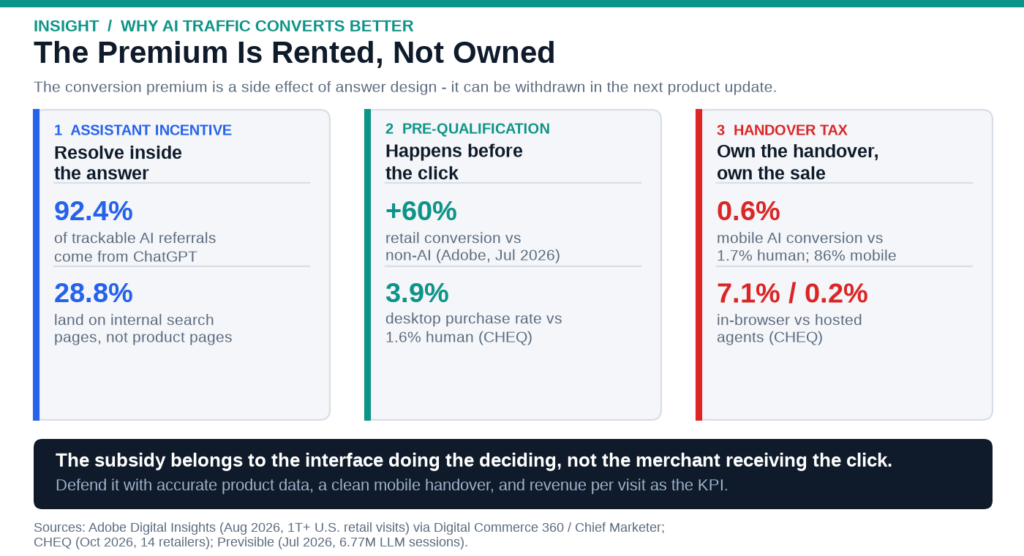
The agent data sharpens the point. In-browser agents, which help a shopper but leave the final decision with a human, converted at 7.1%. Hosted agents browsing on their own converted at 0.2%, despite generating most agent traffic. Same underlying intelligence; completely different economics. Value tracks who takes the keyboard at the decisive moment. Every industry rushing to build autonomous shopping agents is betting on the 0.2% column and ignoring who actually controls the handover.
The discovery, then, is uncomfortable but useful. Do not defend a premium you do not control. Defend the things that travel with you: accurate product data the models can quote correctly, a mobile checkout worthy of a pre-sold visitor, and a revenue-per-visit metric that tells you when the subsidy is real. Answer design will keep changing. The interface that wins the handover will keep the sale.






