
Two numbers arrived on the same desk last December, and together they explain almost everything that goes wrong when a foreign brand buys influencers in China.
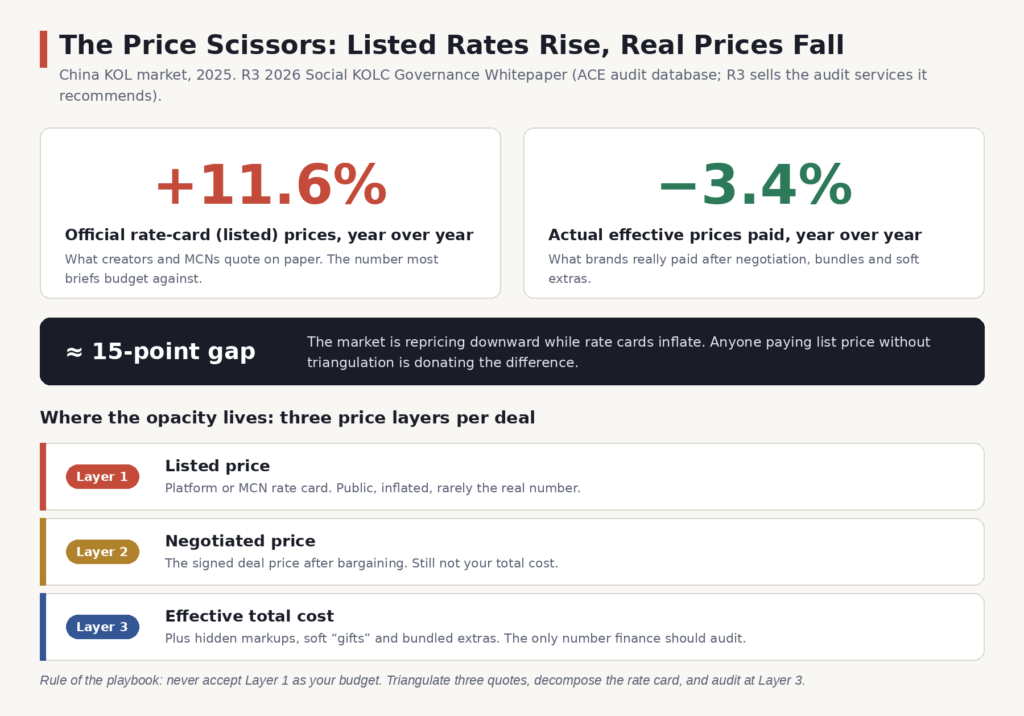
The first: in 2025, official KOL rate cards rose 11.6%. The second: the prices brands actually paid fell 3.4%. Same market, same year, a fifteen-point scissors gap. That gap comes from R3, the independent marketing consultancy, whose 2026 Social KOLC Governance Whitepaper draws on its ACE audit database — and yes, R3 sells precisely the audit services the whitepaper recommends, so read the direction, not the gospel. The direction is unambiguous: the market is quietly repricing downward while the sticker prices inflate. Brands that budget off the sticker are donating the difference to the opaque middle of the chain.
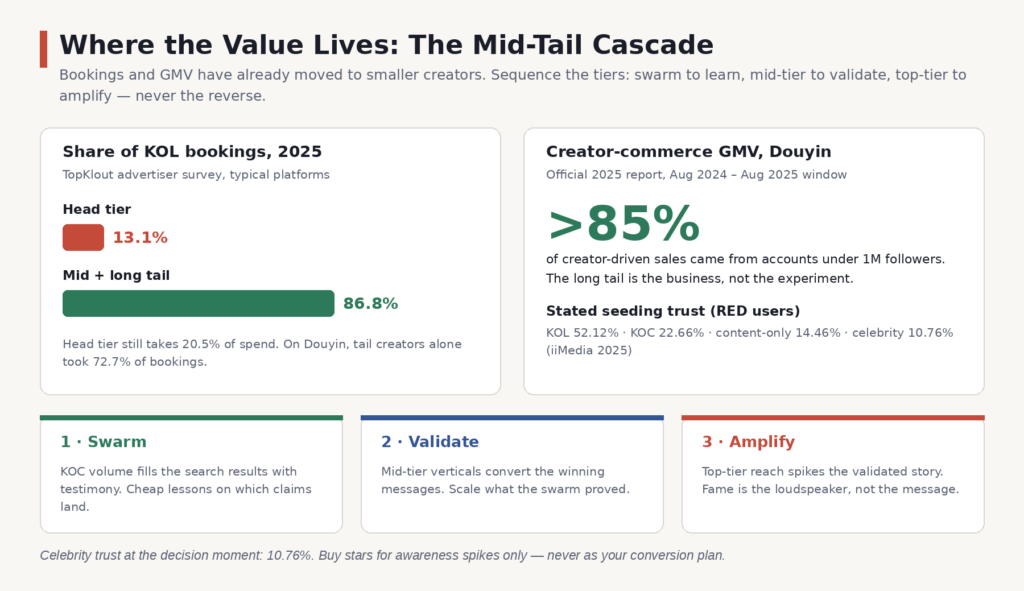
Now add a trust survey. When iiMedia Research asked Xiaohongshu users in 2025 whose recommendation they believe when a product gets “seeded” into their feed, professional creators — KOLs — won at 52.12%. Ordinary users, the KOCs, took 22.66%. Another 14.46% said they ignore the person and judge the content alone. Celebrities? 10.76%. (A caveat worth knowing: iiMedia’s own web page misprints that last figure as 0.76%, which leaves the percentages ten points short of 100; China Youth Daily’s printing of the same survey closes the set exactly. Fame is weak at the decision moment — but it is not a rounding error.)
So here is the situation you are buying into: an opaque price layer, a fame premium that trust data does not support, and a long tail that quietly does most of the selling. This playbook gives you the four-part system for navigating it — where to source, how to discover the real price, how to vet before you pay, and how to contract so the deal stays measurable.
The short version
- Source inside official marketplaces — Pugongying, Xingtu, Huahuo — and use third-party data tools to shortlist, never to transact.
- Never pay the listed price. Triangulate at least three quotes and audit the effective total cost, not the signed number.
- Run every creator through ten checks. One authenticity red flag is a walk-away, not a discount.
- The value sits in the mid-tail: 86.8% of bookings and over 85% of Douyin creator-commerce GMV already live there.
- Register every deal, label it, and buy the usage rights. Undocumented content is a liability wearing a discount.
1. Read the market before you source
Two research houses size this market, and their numbers disagree by tens of billions — which is itself a lesson. TopKlout, which counts content orders only, puts 2025 KOL spending at roughly ¥84 billion, down from ¥87.3 billion in 2024 and a ¥90 billion peak in 2023. R3, whose wider caliber captures more of the surrounding economy, estimates about ¥108.5 billion for 2025 and forecasts ¥117.2 billion — roughly US$16.8 billion — for 2026. Neither is “the” market size. Anyone who quotes one without the caliber is selling you certainty they do not have.
What both agree on is the shift underneath. Money is moving from buying exposure to buying relationships: co-created content, serialized placements, search-linked always-on programs. TopKlout’s 2026 outlook describes brands rebuilding selection around three questions — does this creator’s audience overlap our buyer, does the content style fit the product, and is the account stable and compliant over time. Notice what is missing from that list: follower count.
2. The sourcing map: four official marketplaces
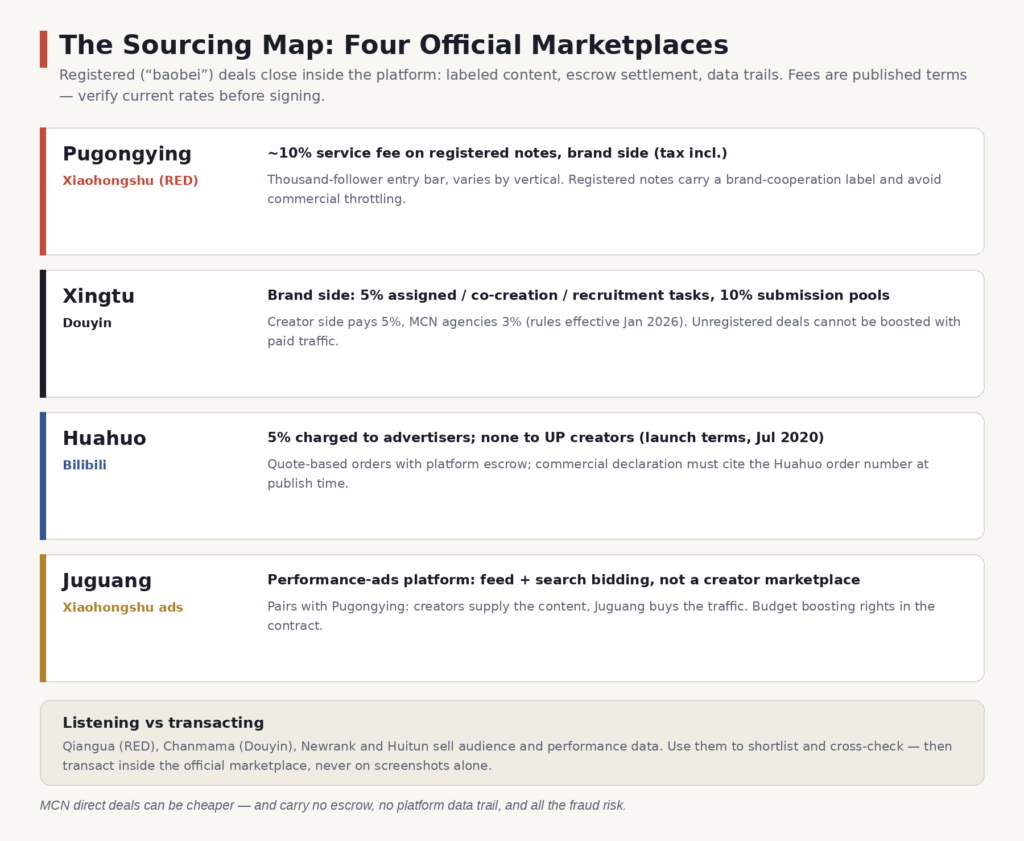
China industrialized creator sourcing years ago. Each major platform runs an official marketplace where deals are registered, content is labeled, money moves through escrow, and performance data accrues to your account. Buying outside these rails is possible — and it is where most of the horror stories live.
Pugongying (Xiaohongshu). The platform’s creator-brand marketplace. Registered notes — the industry calls them “baobei” notes — carry a brand-cooperation label and, crucially, do not get throttled as covert advertising. The platform charges roughly a 10% service fee on registered notes, brand side, tax included. Creator entry sits around a thousand-follower bar, varying by vertical; treat any precise threshold you read online as perishable and check the current rule. Pair it with Juguang, Xiaohongshu’s performance-ads platform: Pugongying borrows the creator, Juguang buys the traffic. They are different products, and your contract needs to know which is which.
Xingtu (Douyin). The settlement rules effective January 2026 charge brands 5% on assigned, co-creation and recruitment tasks, 10% on submission-pool tasks, with joint content-and-ads tasks temporarily waived; the creator side pays 5%, or 3% through an MCN agency. These are published rules as compiled from the platform’s help center — verify on the task page before signing, because the platform adjusts them. Here is the practical point most guides get wrong: there is no single official clause saying every commercial deal must go through Xingtu. What the mechanics do say is that unregistered content cannot be boosted with paid traffic and risks throttling as undisclosed advertising. In a market where you will almost certainly want to amplify winners, that is compulsion by architecture.
Huahuo (Bilibili). Launched in July 2020 with terms charging advertisers 5% and creators nothing — the launch-time official pricing, so confirm the current schedule. Orders run on quote-based pricing with platform settlement, and the commercial declaration must cite the Huahuo order number when the video publishes. Bilibili’s culture rewards depth; budget for longer relationships here, not drive-by placements.
Weibo’s task marketplace and MCN direct deals. Weibo maintains its own commercial-task system for hot-topic amplification. And MCN agencies — the talent-management firms — will happily sell you creators directly, off-platform. Sometimes that is cheaper. It also means no escrow, no platform data trail, weaker disclosure enforcement, and every fraud risk sitting on your side of the table. If you go direct, the vetting section below stops being advice and becomes survival.
3. The price-discovery method: closing the opacity gap
R3’s whitepaper describes three price layers in every deal: the platform or MCN rate card, the negotiated deal price, and the brand’s effective total cost — which absorbs hidden markups and soft “gifts” that never appear on an invoice line. The scissors gap lives between those layers. Your job is to budget at layer three.
The method is unglamorous and it works. First, triangulate: get at least three quotes for the same tier, vertical and deliverable — one through the platform marketplace, two through different agencies or MCNs. Spread matters more than volume; three quotes from the same agency are one quote with extra steps. Second, decompose the rate card. A quote is followers × engagement quality × vertical trust × exclusivity window × usage rights, whether the seller admits it or not. Ask what each component costs. A creator who cannot explain their own price is quoting a vibe. Third, anchor to observable performance: cost per engagement and cost per thousand impressions on past registered campaigns, which the marketplaces surface in their dashboards. Xingtu even publishes suggested price bands per creator based on growth, engagement and conversion history — use the platform’s own anchor against an inflated quote.
And remember the direction of the scissors: with real prices falling, a seller citing “market rates are up 11.6%” is quoting the layer you are trying to escape. The negotiation leverage is on your side this year. Use it.
4. The 10-point vetting checklist
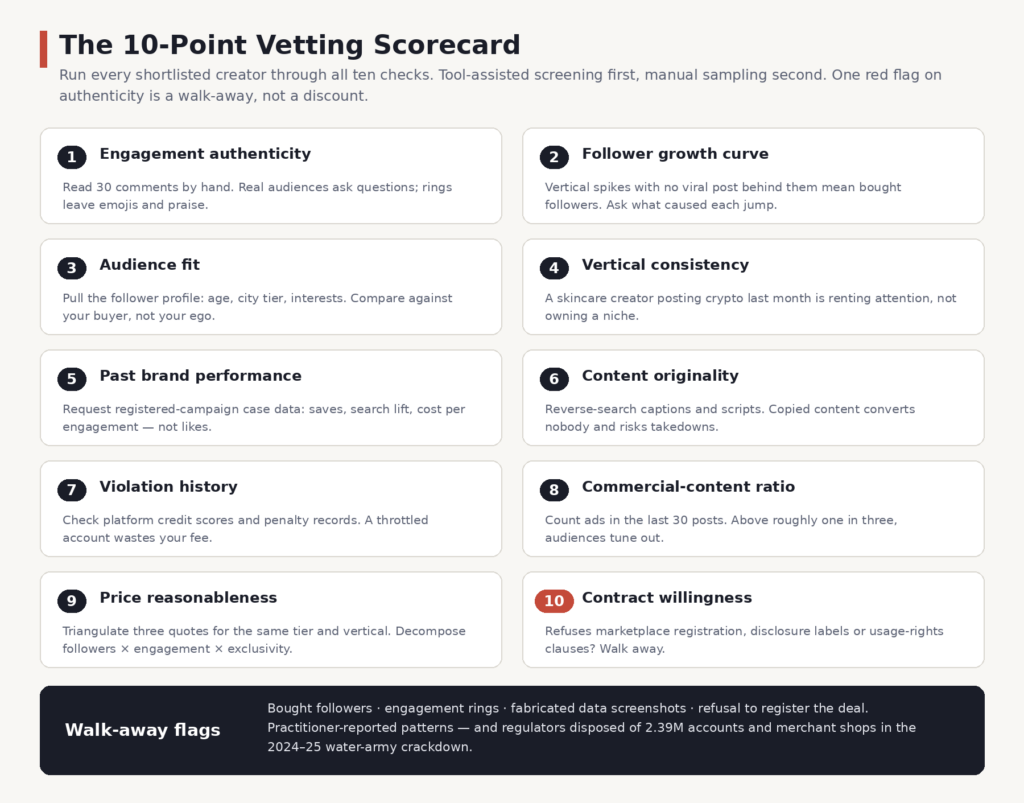
This is the core of the playbook. Shortlist with data tools, then run every finalist through all ten checks — tool-assisted screening first, manual sampling second. Screenshots are claims. You are here to convert claims into evidence.
- Engagement authenticity. Read thirty comments by hand. Real audiences ask questions — sizing, price, where to buy. Engagement rings leave emojis and generic praise. The comment section is the cheapest lie detector in the market.
- Follower growth curve. Pull the history. Vertical spikes with no viral post behind them mean purchased followers. Ask the creator what caused each jump; the answer should match a piece of content you can watch.
- Audience fit. Request the follower profile — age, city tier, interests — and compare it against your buyer persona, not your aspirations. A million followers in the wrong province are worth less than ten thousand in the right one.
- Vertical consistency. A skincare creator who posted crypto content last month is renting attention, not owning a niche. Vertical trust is the premium you are actually paying for; verify it exists.
- Past brand performance. Ask for registered-campaign data: saves, search lift, cost per engagement. Registered deals leave platform-verifiable trails; a creator with only screenshots has either never run a clean campaign or does not want you to see one.
- Content originality. Reverse-search captions and scripts. Copied content converts nobody, and platforms punish it.
- Violation history. Check platform credit levels and penalty records. Pugongying’s credit system gates commercial permissions; a throttled or penalized account burns your fee quietly.
- Commercial-content ratio. Count the ads in the last thirty posts. Past roughly one in three, audiences start scrolling past the sell — you are buying fatigue.
- Price reasonableness. Apply the triangulation from section 3. A quote far above the peer band needs a documented reason: exclusivity, proven conversion, production complexity. “I have a million followers” is not a reason.
- Contract and registration willingness. Will they transact through the marketplace, accept disclosure labels, sign usage-rights terms? Resistance here predicts every problem downstream. Walk away.
The fraud patterns behind these checks — bought followers, engagement rings, fabricated data screenshots — are practitioner-reported, not academically censused. But the scale of the underlying industry is official: China’s cyberspace regulator reports that since 2024 its water-army crackdown has closed or removed more than 400 websites and platforms, cleaned 4.82 million illegal posts, and disposed of 2.39 million accounts and merchant shops plus 52,000 groups, with fake engagement and comment manipulation among the named targets. When the state is deleting accounts by the million, “but their engagement looks great” is not due diligence.
5. The tier strategy: where the value actually lives
The market has already voted. TopKlout’s 2026 report shows head-tier creators took just 13.1% of KOL bookings in 2025; mid- and long-tail accounts took 86.8%. On Douyin, tail creators alone accounted for 72.7% of bookings. The money still skews slightly glamorous — the head takes 20.5% of spend — but nearly 80% of budgets now flow to the tail.
The commerce data says the same thing louder. Douyin’s official 2025 e-commerce report, covering August 2024 to August 2025, found that creators with under one million followers drove more than 85% of creator-commerce sales — and over 5.11 million new creators earned stable income in that window. Note the caliber: that is creator-driven commerce, not the platform’s total GMV. Note the source: company-reported, not independently audited. The shape is still unmistakable. The long tail is not the experiment. It is the business.
So sequence your tiers rather than betting on one. Start with a KOC swarm to fill search results with testimony and learn cheaply which claims land. Promote the winning messages to mid-tier vertical creators who convert. Then, and only then, rent top-tier reach to amplify a validated story. Celebrities close the loop at the awareness end only — remember, 10.76% decision-moment trust — and a mega-deal signed before the swarm has taught you anything is just an expensive guess with a famous face.
One warning before you industrialize the swarm. A peer-reviewed study by University of Michigan researchers Huiran Yi and Lu Xian, published in the Proceedings of the ACM on Human-Computer Interaction (CSCW 2025), followed Xiaohongshu KOCs through nine months of online ethnography and found that their commercial labor is deliberately dressed up as spontaneous ordinary-user posting — and routinely underpaid and under-recognized in the paperwork. The format your buyers want is peer evidence; the production method decides whether it is legitimate. Real sampling, honest briefs and disclosure labels are the durable version. Scripted fake experiences are the version platforms purge and regulators fine.
6. Brief to contract: the workflow that keeps you measurable
A vetted creator at a fair price can still deliver an unmeasurable campaign if the paperwork is lazy. Run every deal through the same seven gates.
Brief. One page: the buyer question you are answering, the claim you can substantiate, the format, the deadline, the red lines. Give the creator the boundaries and let them own the voice — TopKlout’s data shows co-created native content outperforming scripted brand theater, and audiences spot the script instantly.
Registered deal. Transact through the marketplace so the content carries its cooperation label and your account receives the data. This is also your compliance backbone: under China’s Internet Advertising Measures, in force since May 2023, content that promotes goods through knowledge-sharing, experience-sharing or reviews and attaches a purchase link must be conspicuously marked as advertising. Article 9 was written for exactly the seeding format you are buying. And if your plan involves livestream selling, Article 19 makes a host recommending goods in their own name an advertising endorser with endorser liability. Disclosure is not a favor to the regulator; it is the line between marketing and a penalty notice.
Claim library. Supply substantiated claims and forbid the rest — no scripted fake experiences, no medical claims, no superlatives the ad law bans. The creator’s credibility is your asset; do not let a brief torch it.
Deliverables and approval. Script or outline review, one revision round, publication window, takedown terms. Put the acceptance standard in writing before money moves.
Usage rights. The clause everyone forgets: the right to boost the post with paid traffic and to reuse the content in ads, for a defined term. Without it, your best-performing note is a firework you watched once. With it, winners become always-on assets — the difference between buying a post and buying a content library.
Payment milestones. Marketplace escrow handles most of this; off-platform deals need explicit milestones tied to acceptance, never full prepayment to a stranger.
Performance readout. Agree the metrics before launch, per tier: search lift and return-search rate for seeding, cost per engagement for mid-tier, attributed sales for commerce. A metric negotiated after the campaign is an argument, not a measurement.
7. Run the roster like a portfolio
One campaign teaches you little; a roster compounds. Score every creator after each cycle and sort them into three buckets: test again, scale, or kill. Keep a living library — audience profile, verified rates, past performance, usage-rights status, compliance record — so the next brief starts from evidence instead of a fresh search. TopKlout’s 2026 outlook describes exactly this shift among Chinese advertisers: from one-off content buying to owned creator pools with tagging systems and deepening relationships. The brands that treat creators as recurring partners get better rates, first call on formats, and content that improves because the creator actually understands the product. The brands that treat every campaign as a cold start pay the opacity tax forever.
8. Six failure modes to avoid
Paying the listed price without triangulation — the scissors gap becomes your donation. Buying follower counts — you are renting a number, and the number may not even be real. Unregistered deals — no boosting, throttling risk, disclosure exposure, no data. No usage rights — your winner expires on publication day. Screenshot-only vetting — claims masquerading as evidence. And the one-shot mega-deal — most of the budget on one famous face before the swarm has validated anything. Each of these is common. None of them is necessary.
9. Honest boundaries
The fee schedules here are published terms with as-of dates; platforms revise them, so verify before signing. Market sizes differ by research caliber — R3 and TopKlout are not measuring the same thing, and neither is audited. Douyin’s GMV share and creator-income counts are company-reported. The iiMedia survey is a commercial research product with limited methodological disclosure, and its celebrity figure needed a cross-source correction. The fraud patterns are practitioner-reported. What is solid: the regulatory text, the enforcement statistics, and the direction every independent source agrees on — opaque pricing, overpriced fame, undervalued tail.
The bottom line
The China influencer market rewards buyers who act like auditors and punishes buyers who act like fans. Source inside the rails. Triangulate every price. Vet all ten points. Sequence swarm, then mid, then star. Register, label, and buy the rights. Do that, and the fifteen-point scissors gap stops being a tax on your budget and becomes the discount you negotiated — while everyone else is still paying sticker price for a famous guess.





