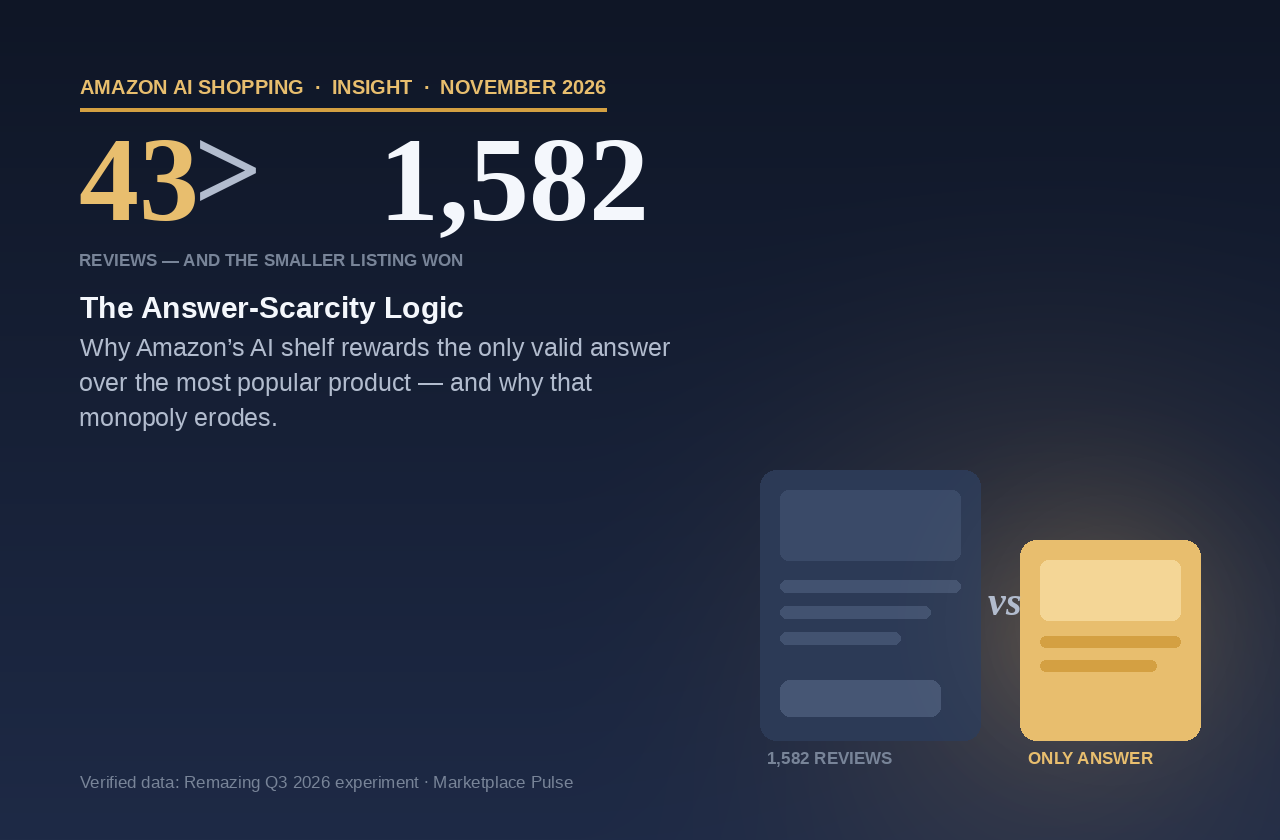
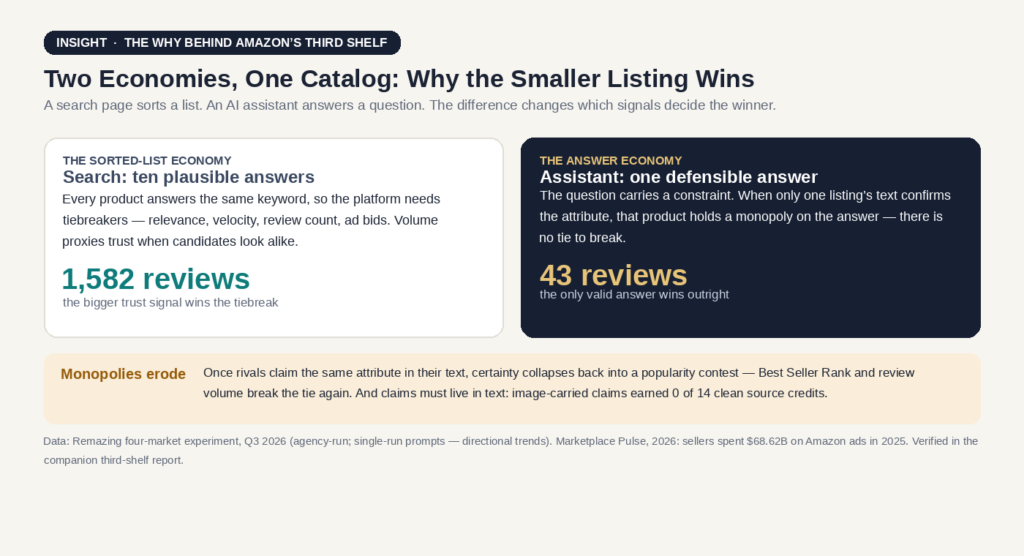
Here’s a result that shouldn’t happen under the old rules. A German shopper asked Amazon’s AI assistant for a product with a specific attribute. The assistant recommended a listing with 43 reviews — ahead of a rival carrying 1,582. That’s from Remazing’s four-market experiment in Q3 2026, and it looks like a glitch until you see what actually changed: not the products, but the shape of the question.
Two economies hiding in one catalog
A search page runs a sorted-list economy. Type “queen mattress” and every candidate answers the same vague keyword. Since dozens of products are equally plausible, the platform needs tiebreakers, and tiebreakers favor volume: sales velocity, review count, ad bids. Sellers spent $68.62 billion on Amazon ads in 2025, by Marketplace Pulse’s count, largely to win those tiebreaks. Popularity is a proxy for trust when all candidates look alike.
An assistant runs an answer economy. The shopper’s question carries a constraint — an attribute, a use case, a compatibility requirement. Now the machine isn’t sorting a list; it’s defending a single recommendation. And when only one listing’s text confirms the requested attribute, that product holds a temporary monopoly on the answer. There is no tie to break, so the tiebreakers never fire. Forty-three reviews don’t beat 1,582 — they become irrelevant.
Why the monopoly erodes — and what that means for you
Scarcity here is informational, not physical. The moment a competitor writes the same attribute into its own bullets or structured fields, the assistant has two defensible answers, certainty collapses, and the tiebreakers return — Remazing observed Best Seller Rank and review volume deciding exactly those contested cases. The 43-review winner isn’t protected by a moat; it’s protected by a gap in everyone else’s text.
Two consequences follow. First, the leverage is claim placement, not claim volume: in the same experiment, text carried inside images earned zero of fourteen clean source credits, so an unclaimed attribute written only on a JPEG doesn’t create the monopoly at all. Second, the window is competitive, not permanent — attribute gaps close as rivals audit their listings, which is why this favors fast catalog hygiene over slow brand building.
The deeper why: assistants optimize for defensibility, and search optimizes for plausibility. Budget follows the second logic; the third shelf rewards the first. That mismatch — not any algorithm secret — is why small, precise listings keep surprising big, popular ones.