Here’s a puzzle worth sitting with. Two brands sell similar software. One has three times the backlinks, twice the content, and a heavier ad budget. The other has a fraction of all three — but AI assistants name it constantly and skip the bigger player. If visibility were bought with link equity, that outcome shouldn’t exist.
It exists because the machine isn’t pricing your links. It’s pricing your identity. And identity it can’t verify gets discounted.
The Buyer Who Can’t Inspect the Goods
Economists have seen this movie before. In Akerlof’s famous lemons market, buyers who can’t cheaply verify quality discount everything they can’t resolve — so honest sellers with legible reputations win against bigger, murkier ones. An LLM answering “what’s the best tool for X” is exactly that kind of buyer. It cannot interview your customers or audit your product. It can only triangulate: does this name resolve to one entity, one category, one consistent story across the sources I’ve read?
When the answer is yes, the brand is cheap to recommend. When your website says “analytics platform,” LinkedIn says “CRM,” and Crunchbase says “data intelligence,” recommending you is expensive — the model must hedge, qualify, or simply reach for a name it can state without risk. Practitioners call the failure mode entity drift. I’d call the consequence an identity discount: not a penalty anyone coded, but the emergent price of being ambiguous to a machine that earns trust by being confidently right.
Why the Discount Compounds
The correlation evidence points the same way. In Ahrefs’ 75,000-brand study — vendor-produced, and correlational, so hold it loosely — plain web mentions of a brand correlated with AI Overview visibility at 0.664, while backlink count managed 0.218. Roughly three to one. The follow-up wave put YouTube mentions on top at about 0.737 across ChatGPT, AI Mode and AI Overviews, while site page count sat near the floor at ~0.194. The cliff between quartiles was stark: 169 average mentions for the top quartile of mentioned brands, 14 for the next.
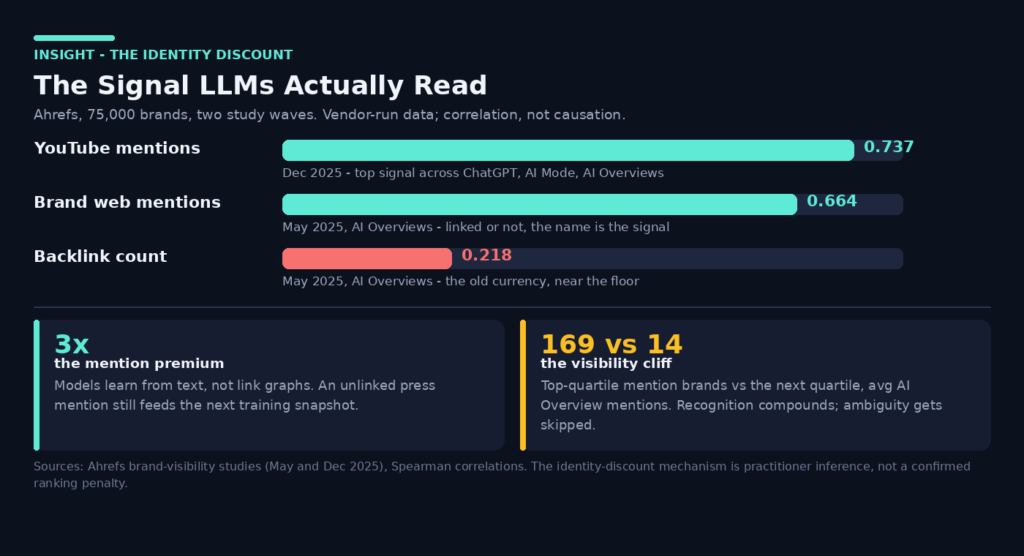
Read those numbers as a loop, not a leaderboard. Mentions put your name in text; models learn from text — the GPT-3 paper showed curated sources like Wikipedia getting several times the training exposure per token of raw crawl, and no lab has published anything since to suggest the bias vanished. Known names get recommended; recommendations generate mentions; mentions feed the next snapshot. The loop runs on identity legibility. A drifting brand leaks value at every turn of it: each inconsistent description taxes the next mention’s ability to consolidate.
The Discount Is Payable in Editing Time
Here’s the part that should change your Monday. Big brands earn mentions because they’re big — the causality genuinely runs both ways, and nobody can hand you a clean causal number. But the discount itself has a cheap cure that doesn’t require winning the mention arms race: one name, one category, one two-sentence description, repeated everywhere you control, with your profiles and structured data pointing at each other. That’s editing time, not media budget.
You can’t buy your way into the model’s memory. You can stop charging yourself a tax on every mention you already have. The brands winning AI recommendations aren’t always the loudest. They’re the ones the machine can say with a straight face.





