Here is a puzzle worth sitting with. Western CRM spent twenty years automating the message: drip sequences, lead scores, trigger emails. Chinese CRM spent the same years automating the person: chat SOPs, task lists for store associates, scripts for service reps, inheritance rules for when a rep quits. Same industry label, opposite reflexes. Why?
The standard answer is cultural — China is relational, the West is transactional. That answer is lazy, and it hides the actual mechanism. The real driver is a price. Specifically, the price of sending one more message to one customer.
Two branches of one tree
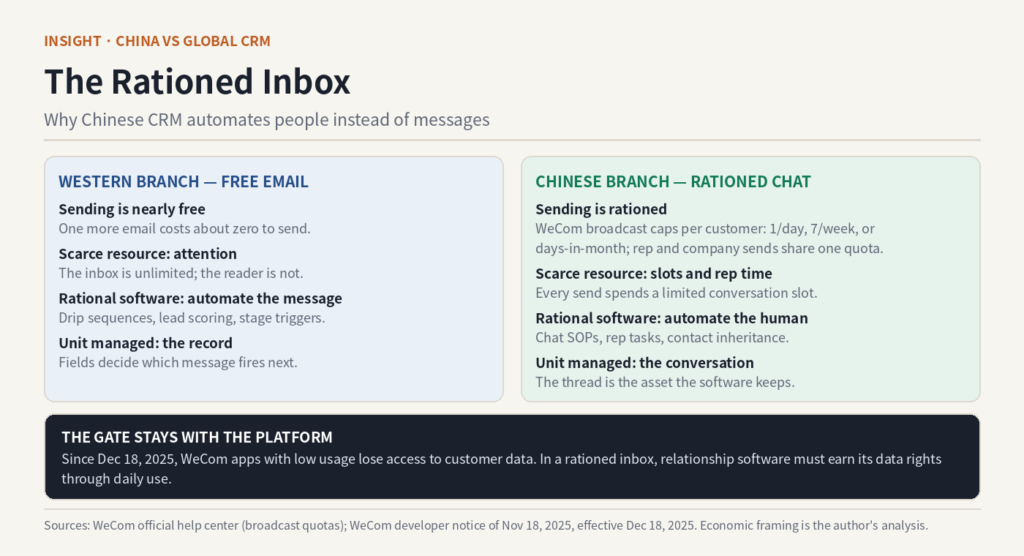
In the Western stack, the marginal cost of an email approaches zero. Your ESP charges by volume, but the ceiling is your budget, not the channel. When sending is nearly free, the scarce resource is customer attention — so the rational software automates throughput. More sequences, better scoring, finer segmentation. The record tells the machine which message to fire next, and the machine never gets tired.
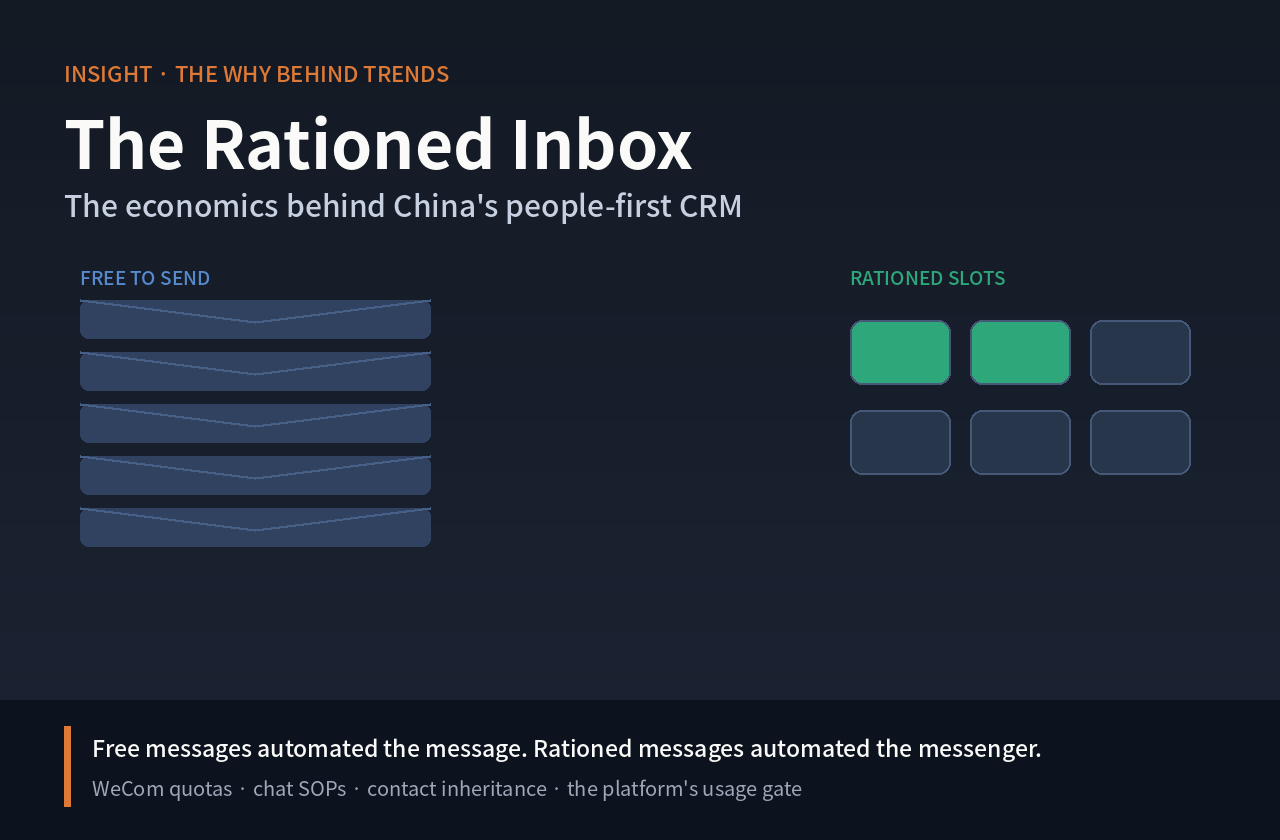
In WeChat, sending is not free. It is rationed. WeCom’s official rules cap how many broadcast messages a single customer can receive, with admin-configurable quotas — one per day, seven per week, or the number of days in the month — and rep-initiated and company-initiated sends draw from the same allowance. Your marketing department and your store associate are spending one shared budget of interruptions.
Sit with that constraint and the entire SCRM feature list suddenly reads like a rational response. When each slot is scarce, the scarce resource flips from attention-in-general to the quality of each human touch. You cannot win by sending more. You can only win by making each send count — which means upgrading the human doing the sending. Hence chat SOPs instead of drip campaigns. Hence rep task queues instead of trigger emails. Hence quality inspection of archived conversations: if every message is expensive, management will absolutely audit how the budget was spent.
The inheritance clue
The strongest evidence is contact inheritance. When a rep leaves, WeCom lets the company hand the customer — the same chat thread, the same relationship — to a successor. Western analysts file this under “data hygiene.” Look again through the scarcity lens: in a rationed inbox, the relationship itself is the capital asset. The slots you have earned, the trust you have built, the history that makes the next message welcome — none of that can be rebuilt by a new email address. So the software protects the thread the way a Western CRM protects the account record. Each system defends whatever is expensive to replace.
The platform keeps the gate
And the landlord knows it. Since December 2025, WeCom’s API rules tie customer-data access to actual app usage: dormant integrations lose their data rights. Read economically, this is rent collection on the rationed channel — relationship software must prove it serves daily conversations, or the platform reclaims the pipe. Vendors cannot warehouse the relationship; they must operate it.
So the next time someone tells you Chinese CRM is “social CRM,” correct them gently. It is scarcity engineering. Free messages bred automation of the message; rationed messages bred automation of the messenger. Change the price of a send, and you change the species of software that grows around it.