Every citation map in AI search has a home bias — except this one. Grok is built into X, promoted inside X, and used by roughly 117 million people a month according to SpaceX’s SEC prospectus. Yet when Ahrefs tallied the domains Grok actually cites across 1.9 million-plus US queries in June 2026, X ranked twelfth, at 1.4% mention share. Reddit, YouTube and Facebook together took 45.3%. The engine that lives on a social network behaves as if it distrusts the neighborhood.
That is not a bug. It is a rational response to three economic forces, and understanding them changes where you invest.
Force one: posts are claims; communities produce records. A post asserts something. A Reddit thread contests it, a YouTube comment section pressures it, a Facebook group argues it into shape. What survives that process is not just content — it is a claim that has already been cross-examined by strangers with no stake in your brand. For a retrieval system trying to answer cheaply and safely, a survived argument is a pre-paid verification service. X’s velocity optimizes for assertion; the community web optimizes for survival. Grok cites the survivors.
Force two: citing your own feed concentrates liability. When an assistant quotes third parties, errors are attributable to sources — the citation is a paper trail that distributes blame. When it quotes its host platform, every platform failure becomes an answer failure with the same logo on both. The July 2025 incident, when a code update made the @grok reply bot produce antisemitic posts for roughly 16 hours, showed how fast a feed can turn toxic. SpaceX’s own IPO prospectus now lists misinformation among the risks tied to X and Grok. An engineering team reading that risk section has every incentive to keep the answer layer’s evidence at arm’s length from the feed. The 1.4% is, in part, a liability shield.
Force three: correction labor cannot be bought at platform scale. xAI tried to own its reference layer. Grokipedia launched in October 2025 as an AI-written Wikipedia rival, then quietly froze: a Lawfare analysis found no edits after April 24, 2026, with more than 13,000 suggested corrections stuck “in review.” Meanwhile the sources Grok actually leans on — Reddit, YouTube, Wikipedia — run on armies of unpaid moderators, commenters and editors who keep correcting the record every day. Verification is a labor-intensive public good. Communities subsidize it with volunteer attention; a company must schedule and fund it, and at Grokipedia the review pipeline simply stopped. The frozen encyclopedia is the natural experiment that proves the rule.
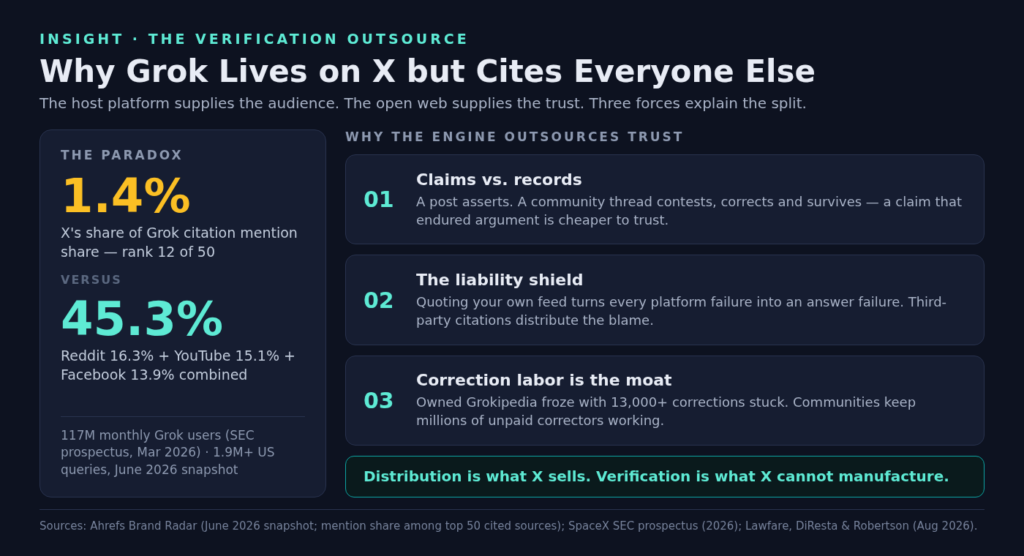
So the strategic read is almost the opposite of the platform’s branding. X sells distribution — 117 million monthly users you can reach with a findable bio and quotable threads. What X cannot sell you is verification, and verification is what the citation layer runs on. Brands should treat their X presence as the trigger and their community footprint as the trust balance sheet: the Reddit answers that survived challenge, the videos whose comment sections stayed honest, the third-party coverage nobody can accuse you of writing. The engine outsourced its verification to the crowd. Your credibility has to live where the crowd can check it.