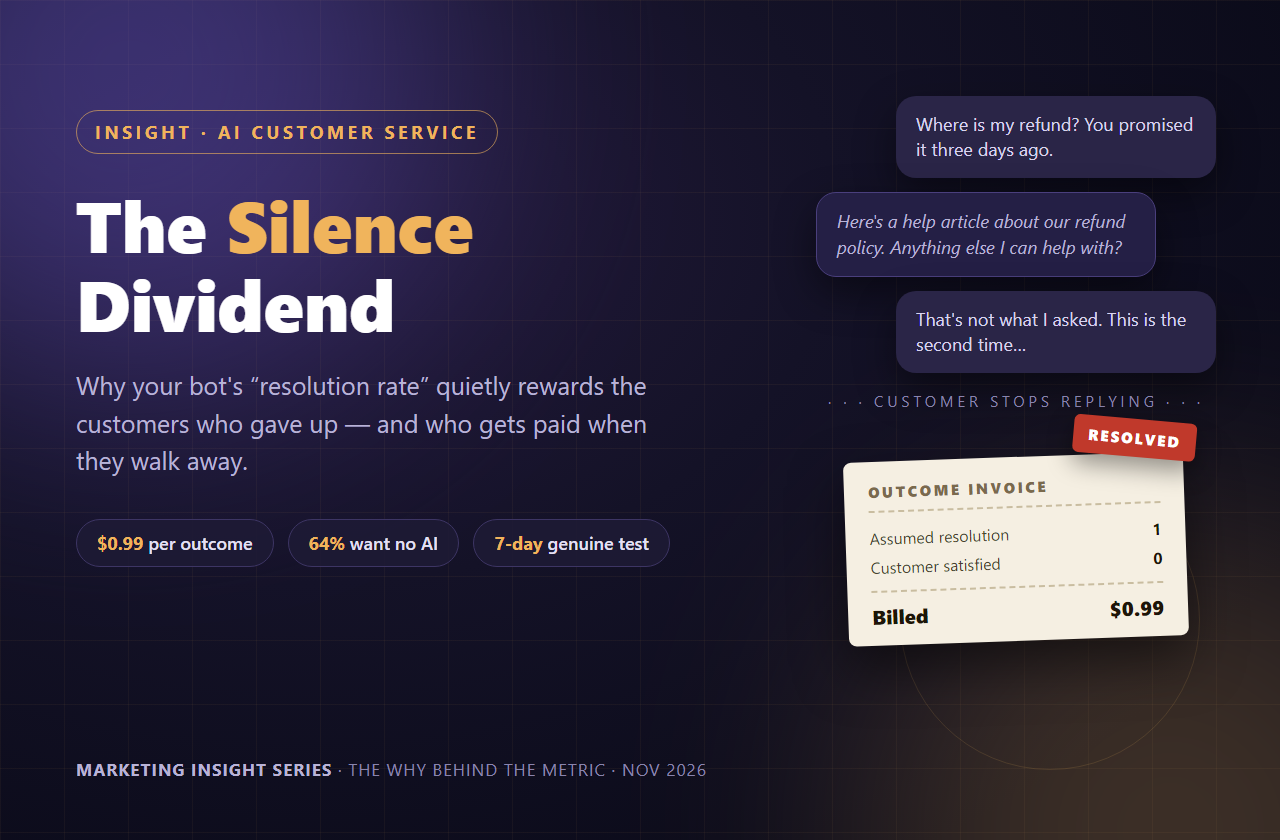
Here is a small scene that repeats thousands of times a day. A customer asks where her refund is. The bot links a policy article. She asks again, more sharply. The bot links the same article. She stops typing — not because the problem is solved, but because she has given up and moved her complaint to a review site. The conversation goes quiet. And the system, obeying its definition, logs a resolution.
Somebody gets paid for that silence. That’s the mechanism worth understanding.
Two ledgers, one event
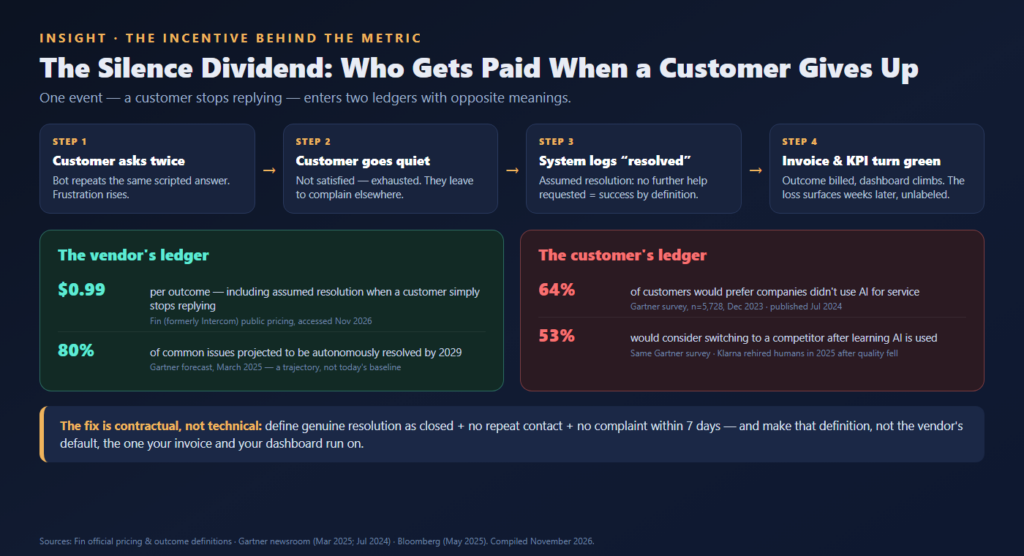
The cleanest evidence sits in public pricing. Fin — the company formerly called Intercom, now being acquired by Salesforce — charges $0.99 per outcome. Read the fine print and you find that an outcome includes “assumed resolution”: the customer received an answer and requested no further help. Silence counts. One conversation, one billable success, even if the customer’s next action is a one-star review.
To be fair, this isn’t villainy; it’s measurement economics. Vendors need a billable unit that can be computed automatically at scale, and “did the customer stop asking” is the only signal available inside the chat window. What happens outside it — the complaint, the chargeback, the churn — lives in systems the vendor never sees. So the metric optimizes the observable proxy, and the proxy drifts from the outcome. Your invoice rewards closure. Your business needs resolution. Those are different products.
Why the drift is getting more expensive
Three verified facts turn this quirk into a strategic risk. First, Gartner’s consumer survey (5,728 respondents, December 2023) found 64% of customers would prefer companies didn’t use AI for service, and 53% would consider switching providers after learning they do. The tolerance for a bad bot loop is structurally low. Second, Klarna — the loudest AI-service success story of 2024 — told Bloomberg in May 2025 that its cost focus had driven quality down, and began rehiring humans. The averages had looked excellent while the tail experiences collapsed. Third, Gartner’s March 2025 forecast of 80% autonomous resolution by 2029 guarantees more volume flowing through exactly this metric. Scale amplifies whatever the definition rewards.
The fix is contractual, not technical
You cannot make a vendor see your churn. You can refuse to buy their definition. Write “genuine resolution” into the contract and the dashboard: ticket closed, no repeat contact on the same issue within seven days, no complaint filed. Ask vendors to price against it, or at minimum to report it alongside their default. Then audit the gap monthly — the spread between assumed and genuine resolution is your silence dividend, paid out of your own customer base.
The bots will keep getting smarter. The incentive won’t fix itself. Whoever defines “resolved” decides who the machine works for — and right now, in most contracts, it isn’t you.






