Japanese retail spent the past week discovering how much of its customer data lives in one place. Plaid Inc. — the Tokyo-listed company (TSE: 4165) behind the KARTE customer-engagement platform, and no relation to the American fintech of the same name — disclosed that an intruder accessed its systems on November 13. The platform has been down ever since, and the damage keeps getting counted downstream.
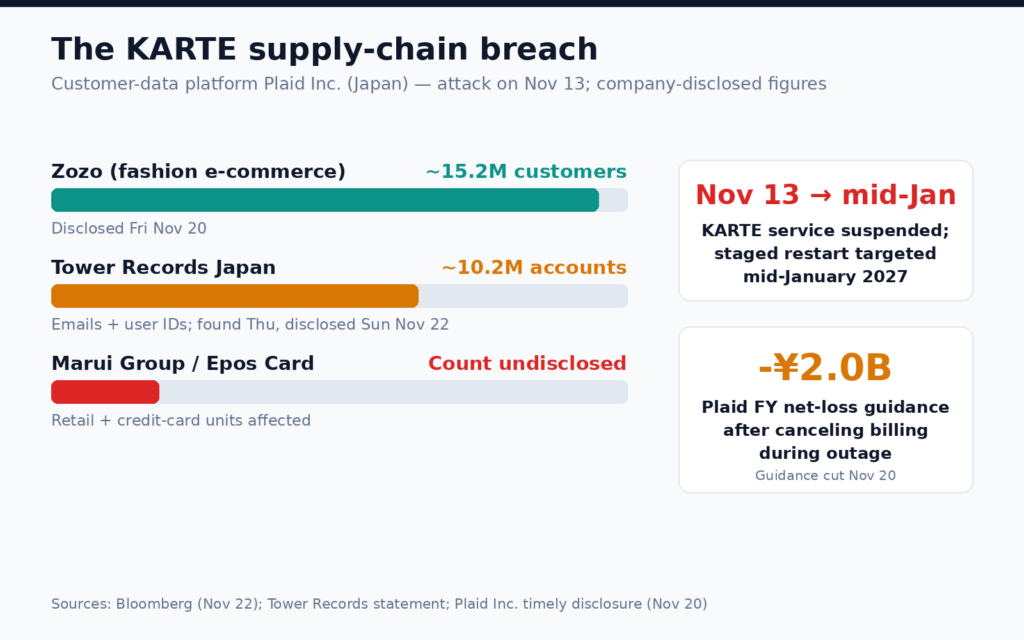
The numbers are stark. Fashion e-commerce giant Zozo said on November 20 that data on roughly 15.2 million customers may have been exposed. Tower Records confirmed about 10.2 million accounts affected — the issue surfaced on Thursday and the company’s statement followed on Sunday, per Bloomberg’s reporting. Department-store operator Marui, whose Epos card business also runs on the platform, acknowledged exposure without publishing a count. Together, the disclosed figures already exceed 25.4 million customer records, and the true total may grow as the forensic work continues.
Plaid’s own situation is arguably worse than a typical breach. KARTE remains offline with no full restoration date; the company says a phased restart will begin in mid-January 2027 — two months of downtime for a service that sits inside retailers’ daily marketing operations. It is waiving fees for November and the outage period, and on November 20 its timely disclosure cut the full-year net profit outlook to a loss of roughly 2 billion yen. For a SaaS vendor, that combination — prolonged outage, fee waivers, guidance reset — is what concentration risk looks like when it detonates.
The uncomfortable lesson is architectural, not incidental. Over the past decade, retailers moved customer data out of scattered spreadsheets into customer data platforms and engagement suites precisely to make marketing more effective: unified profiles, cross-channel journeys, automated campaigns. KARTE was good at that job, which is why so many major brands plugged into it. But every CDP is also a single point of failure — one vendor compromise becomes a multi-brand data incident overnight, and one vendor outage becomes a multi-brand marketing blackout.
For marketing and CRM teams, three actions follow directly. First, inventory your processors: most teams cannot name every vendor that holds identifiable customer data, which is exactly the gap this incident exploited. Second, contract for exit: two months without your engagement platform should be a scenario in your business-continuity plan, with a fallback channel (email service provider, owned app push) that can run independent of the CDP. Third, rehearse disclosure: Zozo communicated within days; downstream brands that waited on the vendor’s forensic timeline inherited the reputational damage without controlling the narrative.
None of this argues against customer data platforms. It argues for treating them like payment processors or cloud regions: powerful infrastructure that deserves vendor due diligence, redundancy planning and a tested incident playbook — before the breach, not during it.