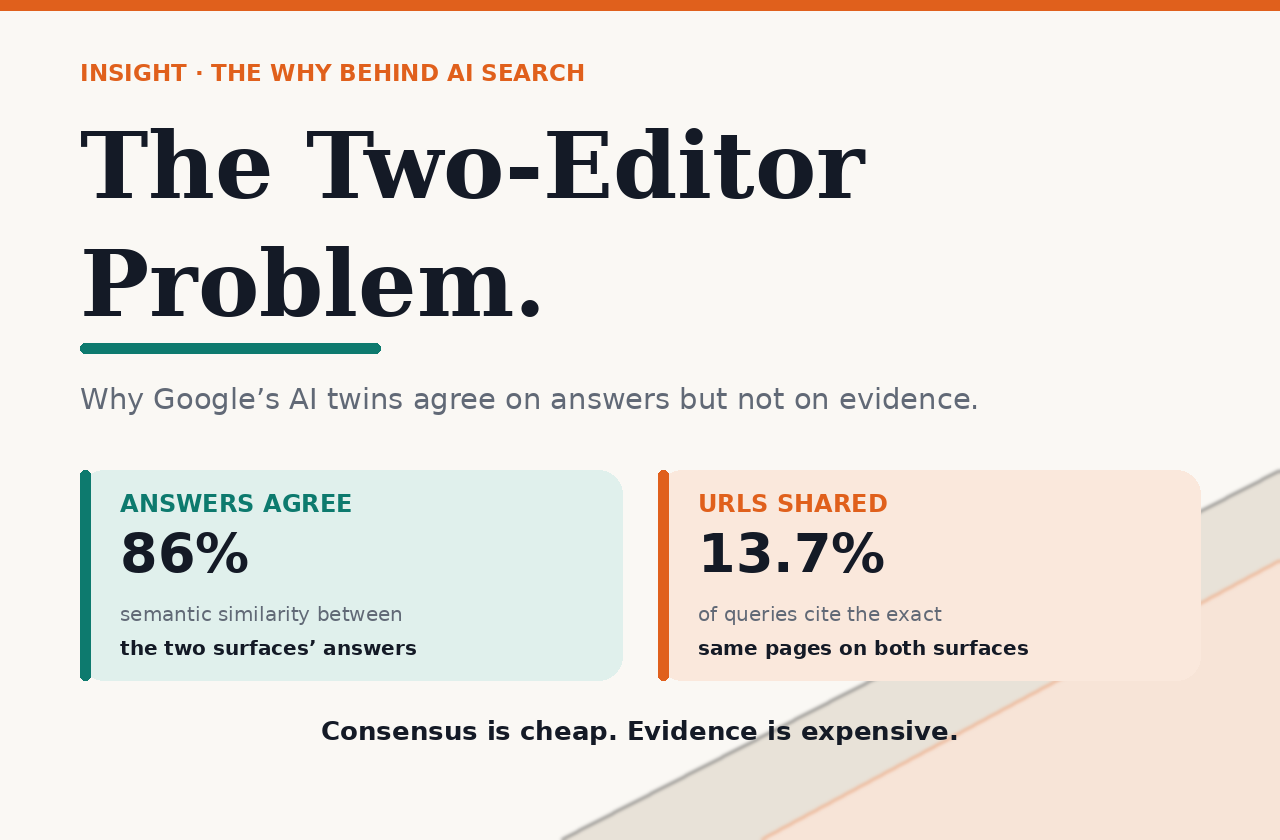
Here is a finding that should bother every SEO team: Google’s two AI surfaces agree on what to tell you 86% of the time, but point at the same evidence only 13.7% of the time. Ahrefs measured this across 540,000 matched query pairs. Same conclusion, different witnesses — nine times out of ten.
Most coverage treats this as a quirk. It isn’t. It’s the predictable output of two machines doing two different jobs. Once you see the jobs, the numbers stop being surprising — and your strategy stops being one-size-fits-all.
Two Editors, One Newsroom
Think of AI Overviews as a fact-checker and AI Mode as a research assistant. Both work in the same newsroom — Google’s index, Google’s knowledge base — so they reach the same verdicts. But their briefs differ, and the citation patterns follow the briefs with almost embarrassing fidelity.
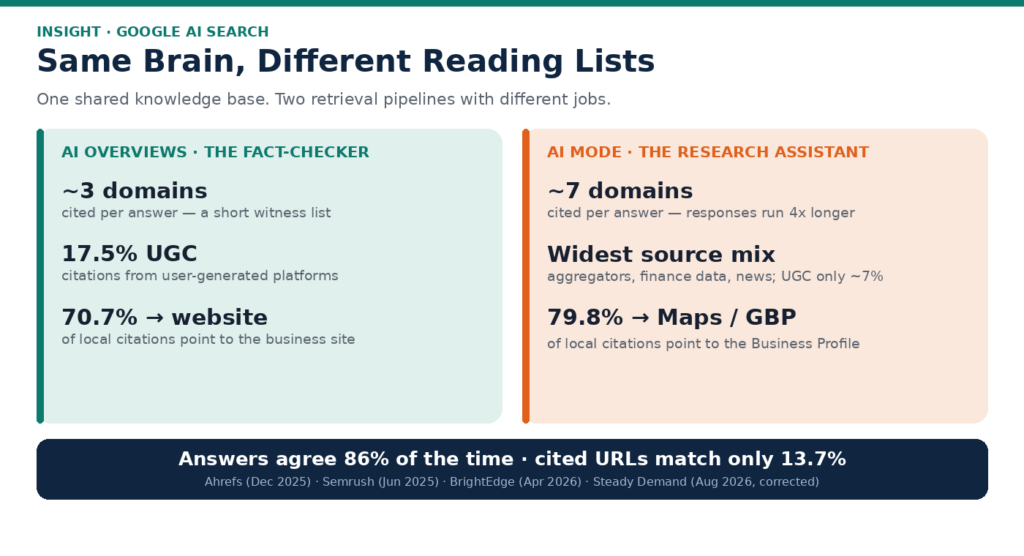
The fact-checker needs a short witness list. Semrush counted roughly three cited domains per Overview answer. It needs claims that are quick to verify and safe to summarize above ten blue links. BrightEdge found its sourcing tilts toward user-generated platforms — 17.5% of citations, about 2.5 times AI Mode’s share — with one video platform supplying 10.6% alone. Why UGC? Because a Reddit thread or a YouTube demo is pre-digested consensus: real users already compressed the answer into a form the machine can lift. The fact-checker isn’t lazy; it’s economizing on verification.
The research assistant has the opposite brief: be thorough. AI Mode answers run about four times longer, cite roughly seven domains, and spread references across the widest source catalog of any engine BrightEdge studied — review aggregators, finance data, news, with a top-10 concentration of just 19.4%. A longer answer needs more scaffolding, and scaffolding comes from everywhere. Length isn’t a stylistic choice; it’s a retrieval budget.
The Local Mirror Is the Tell
The cleanest proof of the two-briefs theory is local search, where Steady Demand classified 86,645 citations across 50 US metros. On local-intent queries, AI Mode sent 79.8% of citations to Maps or the Business Profile; AI Overviews sent 70.7% to the business’s own website. Nearly inverted.
Why would siblings disagree this sharply? Because they trust different kinds of truth. The research assistant wants structured, maintained facts — hours, categories, services — and the Profile is a database Google itself keeps fresh. The fact-checker wants narrative claims it can quote — prices, service descriptions, licensing — and those live on your site. Each surface routes to the source format its job rewards. (The usual caveats apply: agency-run study, corrected figures, residual classifier category, pre-November-12 data. The mirror is directional, not decreed.)
What This Means for You
The 13.7% overlap is not noise to average away — it’s a division of labor to exploit. Stop asking “how do I rank in Google AI?” Ask instead: which of my assets is shaped like a witness the fact-checker can lift, and which is shaped like scaffolding the researcher can lean on? Community corroboration and crisp passages serve the first. Comparison depth, commercial facts and a maintained Profile serve the second.
One newsroom, two editors. You don’t need two publications. You need one archive that satisfies both briefs — and the humility to measure each desk separately.