Somewhere in your company, someone flipped a switch labeled “block AI crawlers” and felt responsible about it. A week later, your brand stopped showing up in ChatGPT answers. Nobody connected the two events, because the dashboard that would have shown it was quietly filing those lost visitors under “Direct.”
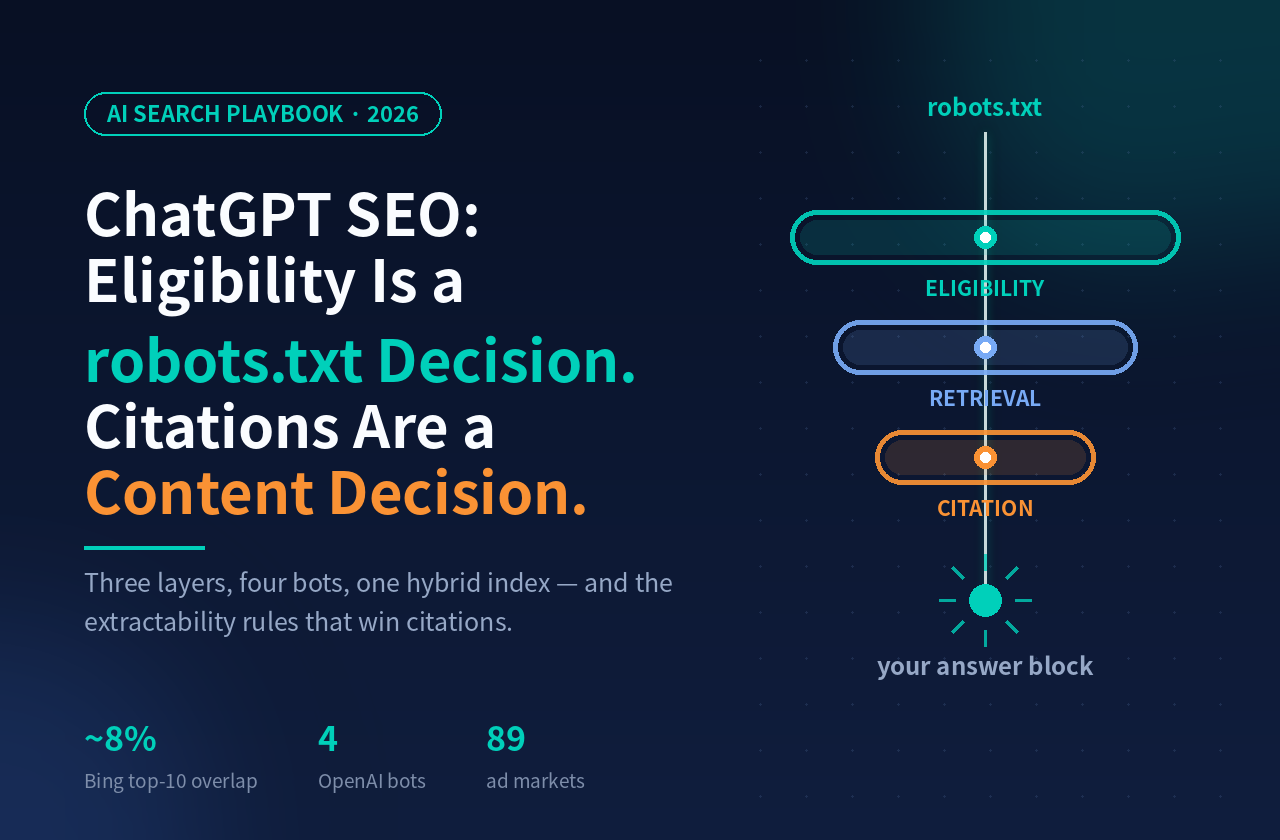
That is the state of ChatGPT SEO in 2026: most teams are fighting the wrong battle. They chase rankings when they have an access problem, or rewrite robots.txt when they have a content problem. The fix starts with accepting one structural fact — getting cited by ChatGPT is not one decision. It is three, made by different parties, under different rules.
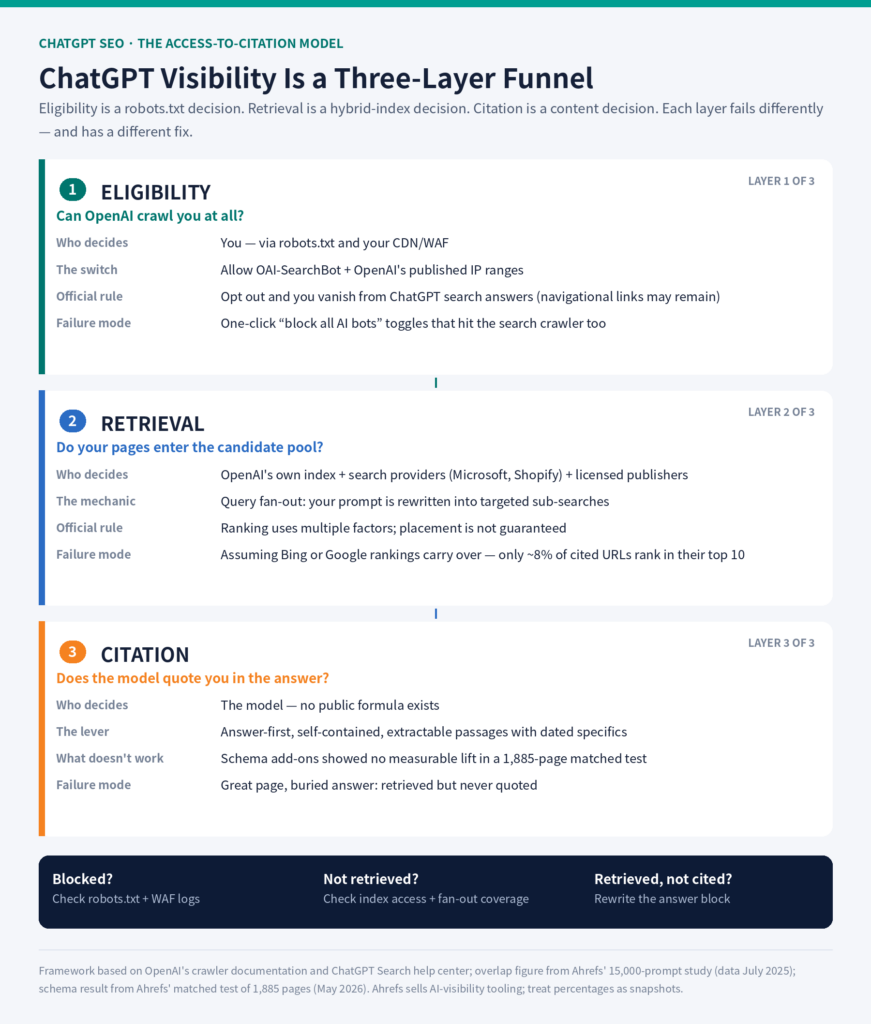
The Three-Layer Funnel: Eligibility → Retrieval → Citation
Think of ChatGPT visibility as airport security. First you need a valid ticket (eligibility). Then you need to reach the right gate (retrieval). Then the gate agent has to actually call your name (citation). Plenty of sites hold a perfect ticket and still never board.
Layer one is a permission you grant. Layer two is a pool you enter. Layer three is a choice the model makes, and OpenAI has never published the formula. Confuse the layers and you will spend a quarter optimizing the wrong one.
Eligibility Layer: What Each of OpenAI’s Four Bots Actually Does
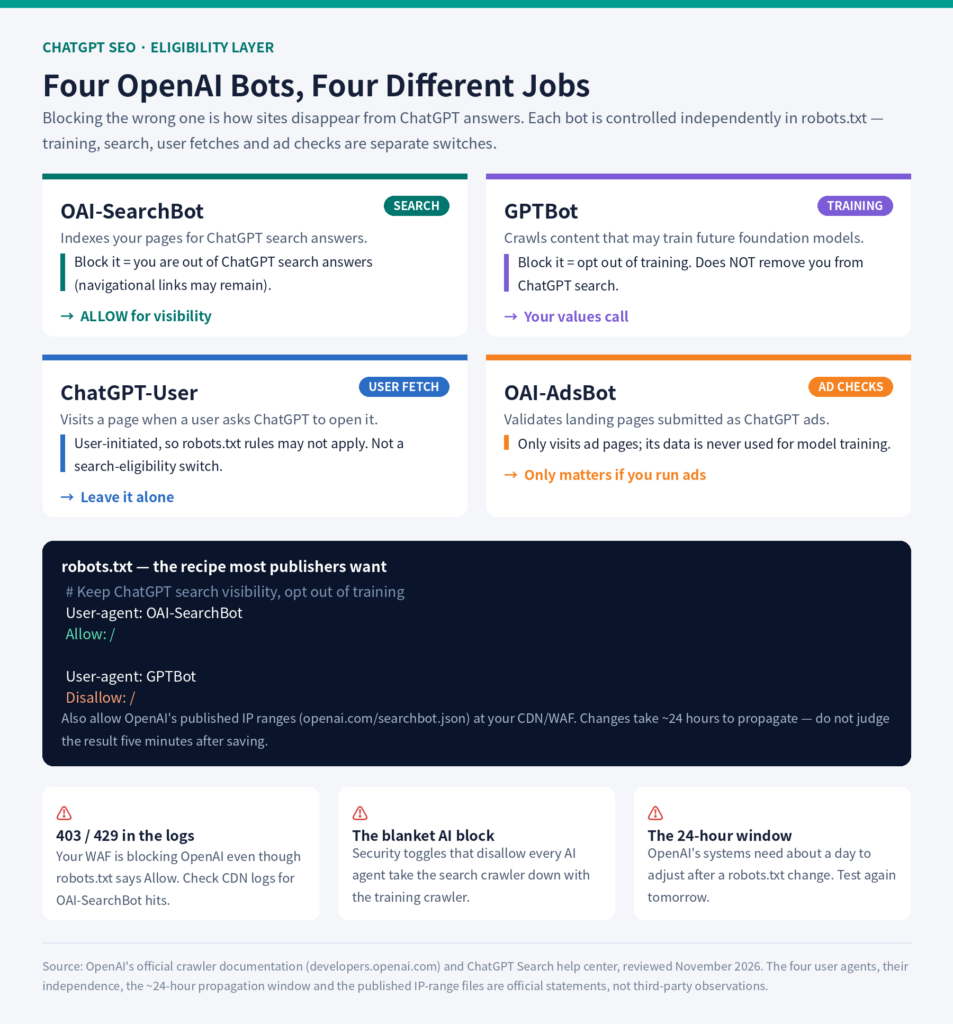
OpenAI’s crawler documentation is refreshingly blunt. Four user agents, four jobs, four independent switches:
| Bot | Job | What blocking it costs you |
|---|---|---|
| OAI-SearchBot | Indexes pages for ChatGPT search answers | You disappear from search answers (navigational links may remain) |
| GPTBot | Crawls content that may train foundation models | Nothing in search — it is a training opt-out only |
| ChatGPT-User | Fetches pages when a user asks ChatGPT to open them | User-initiated; robots.txt rules may not apply anyway |
| OAI-AdsBot | Validates landing pages submitted as ads | Nothing editorial — it only visits ad pages, never trains models |
The official line matters here: sites opted out of OAI-SearchBot “will not be shown in ChatGPT search answers.” Not demoted. Removed. Meanwhile GPTBot — the one everybody argues about — has no bearing on search visibility at all. You can block training and keep citations. The recipe most publishers want:
User-agent: OAI-SearchBot
Allow: /User-agent: GPTBot
Disallow: /
The CDN/WAF Trap: Audit Your 403s and 429s
Robots.txt is a polite request; your firewall is a bouncer with orders. OpenAI asks you to allow requests from its published IP ranges (openai.com/searchbot.json), and this is where “we allow all bots” sites silently fail. Pull your CDN logs and filter for the OAI-SearchBot user agent. If you see 403s or 429s, your security layer is overruling your SEO layer. One-click “block AI agents” toggles on hosting platforms are notorious for exactly this friendly fire.
The 24-Hour Window: Don’t Judge a Change After Five Minutes
OpenAI states it can take roughly 24 hours for its systems to adjust after a robots.txt update. So no, your fix did not fail because ChatGPT still ignores you at lunchtime. Change, wait a day, then test — and keep testing on a schedule, not on vibes.
Retrieval Layer: A Hybrid of OpenAI’s Own Index, Bing and Shopify
The old map said “ChatGPT search = Bing.” Throw it away. Here is what is confirmed versus what merely circulates:
| Confirmed (official sources) | Not confirmed |
|---|---|
| OpenAI’s help center names search partners via Microsoft and Shopify privacy policies | Any claim that Bing alone powers retrieval |
| ChatGPT rewrites your prompt into targeted sub-queries (query fan-out) | Internal index codenames and architecture rumors |
| OpenAI runs its own crawler and index; a 2026 Cloudflare pilot helped it discover and index hundreds of millions of new pages, which OpenAI then independently evaluates and ranks | Reports of Google results pulled via third-party scraping APIs |
| Shopping answers use structured product metadata; restaurant availability comes from OpenTable, Resy and Yelp | Any public “ranking factor” list — OpenAI publishes none |
An academic probe makes the hybrid picture concrete: researchers at NUS and Xi’an Jiaotong University ran 80 questions twenty times each through ChatGPT’s instant models in 2026 and found the system never searches your exact wording — it rewrites everything. Combining Google results with OpenAI’s own web-search API recovered only about 26–28% of the URLs ChatGPT actually cited. Most of the answer’s source list comes from somewhere you cannot directly query.
The 8% Lesson: Bing Rankings Don’t Buy ChatGPT Citations
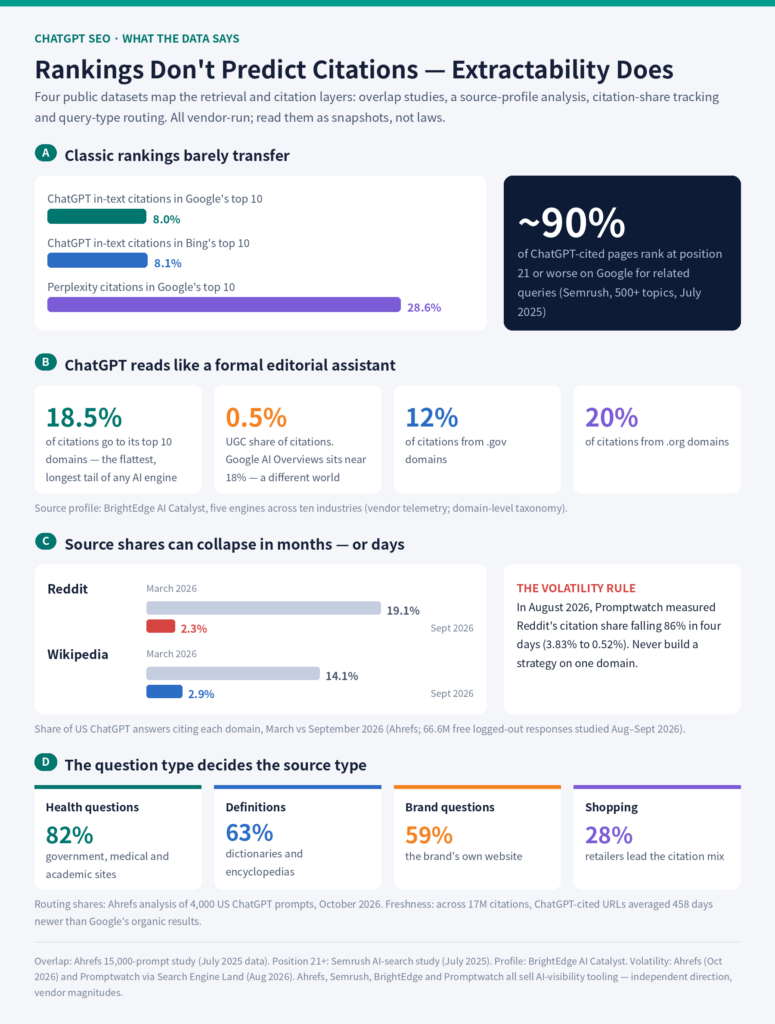
Ahrefs ran 15,000 long-tail prompts through the major assistants in July 2025 and matched citations against classic rankings. ChatGPT’s in-text citations sat in Bing’s top 10 just 8.1% of the time — and Google’s top 10 only 8.0%. Perplexity, for contrast, overlapped 28.6%. Ahrefs sells AI-visibility tooling, so treat the decimals as a vendor snapshot; the direction has since been replicated by independent teams. The lesson stands: ranking is a lottery ticket for retrieval, not a reservation for citation. Fan-out means a page can win on a sub-query you never tracked — Ahrefs’ analysis of 66.6 million free responses found searching answers average 1.6 sub-queries, 6.8% use the site: operator, and three-quarters of those go straight to brand websites.
Citation Layer: No Formula, Just Extractability
OpenAI says it “ranks search results using multiple factors” and that placement is not guaranteed. That is the entire public documentation of the citation decision. Everything else is observation — useful, but observation.
What the observations agree on: the model quotes text it can lift cleanly. In Ahrefs’ 1.4-million-prompt study, pages retrieved through ordinary web search got cited 88% of the time versus under 2% for the Reddit feed, and cited pages had titles measurably closer to the question (0.60 similarity versus 0.48 for retrieved-but-ignored pages). Translation: answer the actual question, near the top, in words the questioner used.
Before: “Our platform leverages a robust suite of solutions designed to empower modern teams across a variety of workflows.”
After: “Acme invoicing supports recurring bills in 14 currencies. Setup takes about ten minutes: connect your bank, import clients, schedule the first run. As of November 2026, pricing starts at $19 per month.”
The second paragraph is self-contained, dated, specific and quotable. The first is a brochure. Which one would you cite?
The Freshness Dividend — and Why 90% of Cited Pages Rank 21+
Two numbers should rearrange your content calendar. Semrush’s 2025 study of 500+ topics found that when ChatGPT cites pages, they rank at position 21 or worse on Google for related queries almost 90% of the time. And across 17 million citations, Ahrefs measured ChatGPT-cited URLs as 458 days newer than Google’s organic results — the strongest recency tilt of any major engine. (You may see a “3.2× lift for 30-day updates” stat circulating; we traced it and could not find an original study behind it, so we left it out.) The actionable version: refresh your money pages with real changes — new data, new dates, new sections — on a quarterly rhythm, and stop assuming page-one rankings do the work for you. Meanwhile, a matched Ahrefs test of 1,885 pages that added schema markup found ChatGPT citations moved +2.2%, indistinguishable from noise. Write the answer block before you decorate the metadata.
Source Profiles: Encyclopedias, Editorial Long Tails and Vertical Data
BrightEdge’s cross-engine analysis gives ChatGPT a personality: the formal editorial assistant. Its top 10 domains account for just 18.5% of citations — the flattest distribution of any engine — with UGC at a mere 0.5%, .gov around 12% and .org around 20%. Compare Google AI Overviews, where UGC hovers near 18%. Same web, different appetites.
But appetites change fast. Ahrefs tracked the share of US answers citing Reddit falling from 19.1% in March 2026 to 2.3% in September; Wikipedia slid from 14.1% to 2.9%, while PubMed climbed from the 64th most-cited domain to the 4th. Tracking firm Promptwatch separately measured Reddit’s citation share dropping 86% in four days in August 2026. If your entire GEO plan was “get on Reddit,” you built a house on a fault line.
Your Yelp and Shopify Listings Are Also Battlegrounds
Question type routes to source type. In Ahrefs’ October 2026 sample of 4,000 US prompts, health questions sent 82% of citations to government, medical and academic sites; definitions went 63% to dictionaries and encyclopedias; brand questions went 59% to the brand’s own website; shopping leaned to retailers. And the structured pipes matter: restaurant availability in ChatGPT comes from OpenTable, Resy and Yelp, while shopping answers draw on product metadata from providers including Shopify. If you run a restaurant or a store, your listing in those systems is your ChatGPT visibility. Audit them like landing pages, because they are.
Measurement: Clicks and Mentions Are Two Different Reports
Click layer: filter analytics for utm_source=chatgpt.com — it remains the primary signal, since most ChatGPT clicks still arrive without a referrer. Mention layer: build a fixed panel of ten prompts (six unbranded category questions, four branded), run each three times in fresh sessions on a fixed model and login state, and log three rates — mentioned, cited, recommended. Compare monthly; treat one-off swings as noise, because citation lists genuinely churn day to day.
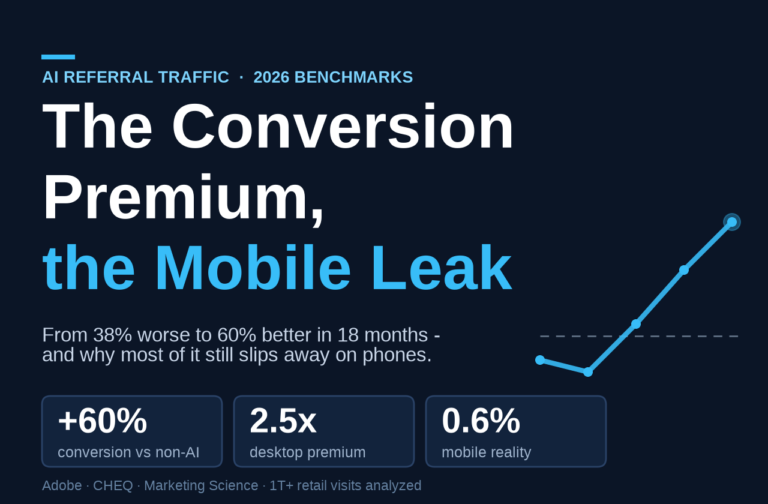
One honest caveat on ROI math: Semrush’s widely quoted claim that AI visitors convert 4.4× better is a vendor observation, not an audited benchmark. The peer-reviewed counterweight — Kaiser and Schulze in Marketing Science (2026), covering 973 e-commerce sites and $20 billion in revenue — found ChatGPT referral traffic converting below organic search overall, but outperforming in complex, information-heavy categories, with conversion improving over time. Sell GEO internally on qualified visibility, not on a magic multiplier.
The Direct-Traffic Trap: October’s Eight-Day Blackout
From October 8–15, 2026, the GPT-6 rollout shipped a bug: outbound links lost their UTM tags and referrer, so GA4 filed ChatGPT visits under Direct. Adobe’s telemetry across roughly 500 pages showed ChatGPT traffic “falling” by 31,000 visits a day while Direct “rose” by 26,000. OpenAI confirmed the bug on October 14 and fixed it on the 15th. Annotate that week in every report — and whenever ChatGPT numbers crater, check Direct on the same landing pages before you touch the content strategy.
Diagnosis: Six Reasons Your Page Never Shows Up
- OAI-SearchBot is disallowed (often by a blanket AI block). Fix robots.txt.
- Your WAF blocks OpenAI’s IP ranges. Allowlist searchbot.json; verify 200s in logs.
- Content hides behind JavaScript rendering or logins. Serve crawlers real HTML.
- You are eligible but never retrieved. Cover the fan-out variants: comparisons, pricing, “official” spec pages.
- You are retrieved but never quoted. Rewrite the opening block: direct answer, dated specifics, question-matching headings.
- Your vertical data is missing or stale. Fix the OpenTable/Yelp/Shopify/product-feed entries the answers actually read.
Work top to bottom. Every layer you skip invalidates the work below it.
Ads Are Not Answers: 89 Countries and Counting
As of OpenAI’s October 21, 2026 announcement, ChatGPT Ads runs in 89 countries with over 100,000 advertisers, shown only on Free and Go plans. The official position is unambiguous: ads are labeled, run on separate systems, and do not influence answers; advertisers cannot shape or rank responses. Shopping results are likewise declared “not ads, nor influenced by any OpenAI partnerships.” So report paid placements and organic citations in separate columns. You cannot buy the answer — you can only earn it, then optionally advertise next to it.
The Bottom Line
ChatGPT SEO in 2026 rewards teams that diagnose before they optimize. Access is a config file. Retrieval is a hybrid pool you enter through fan-out coverage and clean listings. Citation is an editorial choice you influence with extractable, fresh, specific answers. Three layers, three toolkits, one order of operations. Get the ticket, reach the gate, then give the agent a reason to call your name.