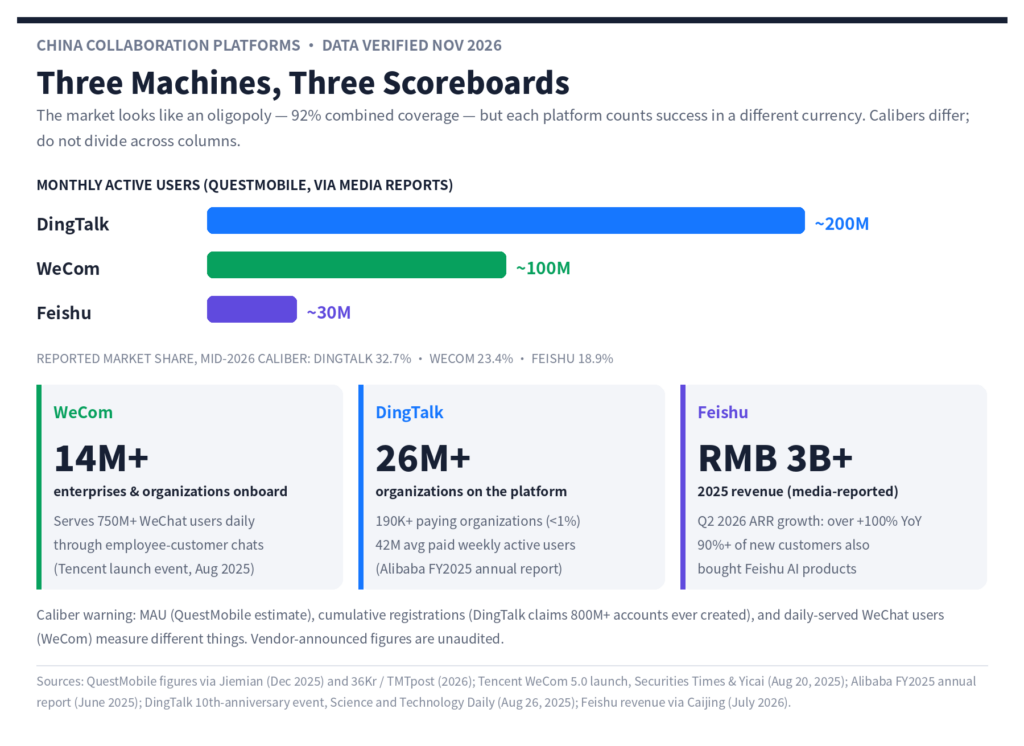
Here’s a number that should end every platform debate before it starts: 92%. That’s the combined market coverage of DingTalk, WeCom and Feishu in China’s collaboration software market, according to QuestMobile data reported by Jiemian in late 2025. Microsoft Teams and everyone else split the crumbs.
So the market is settled, right? Pick the biggest one and move on?
Not quite. Because the strangest thing about this oligopoly is that the three winners barely compete with each other. They look like substitutes on a feature-comparison spreadsheet — all three do chat, docs, meetings, approvals — but underneath, they are three different machines built to do three different jobs. WeCom is a customer-connection machine wired into the WeChat social graph. DingTalk is a management-control machine built on approvals, attendance and read receipts. Feishu is a knowledge-creation machine organized around documents, multidimensional tables and shared context.
Marketing teams pick wrong when they compare feature lists. The feature lists converge every year. The DNA never does.
This guide gives you what a feature list can’t: a job-based decision matrix, an honest read of the 2026 AI shake-up, the real cost structure behind the “free” labels, and the multi-platform patterns that most mature teams actually run.
Three Machines, Not Three Apps
WeCom: The Customer-Connection Machine
WeCom (Tencent’s enterprise app) has one asset nobody else can copy: it talks to personal WeChat. Your staff add customers as contacts, and the customer on the other end just sees a chat inside the WeChat app they already open dozens of times a day. No download. No new account. No friction.
At its 5.0 launch in August 2025, Tencent VP Huang Tieming put numbers on that bridge: over 14 million real enterprises and organizations onboard, and more than 750 million WeChat users served daily through it. Read that second figure carefully — it’s not WeCom’s user count. It’s the consumer end of the pipe. That’s the whole point. WeCom’s value isn’t its own app; it’s what the app connects to.
DingTalk: The Management-Control Machine
DingTalk grew out of Alibaba’s own management obsession: did the message land, did the task move, who approved what. The famous DING notification — which can escalate to an actual phone call — and read receipts weren’t accidents. They were the product.
At its tenth-anniversary event in August 2025, DingTalk announced over 26 million organizations on the platform, with 190,000-plus paying organizations, and claimed 79% of China’s 5,191 A-share listed companies use it. Alibaba’s FY2025 annual report adds the sharpest commercial figure: 42 million average paid weekly active users as of March 2025. This is the deepest process-and-organization stack in the market.
Feishu: The Knowledge-Creation Machine
Feishu (internationally, Lark) came out of ByteDance’s internal experiment in running a company on shared documents instead of meetings and email. Its center of gravity is creation: collaborative docs, a wiki, and Base — the multidimensional table product that behaves like a build-your-own business system. Base crossed 10 million monthly active users in 2025, per its product lead’s conference announcement and same-day Jiemian coverage; a single table now holds 10 million live rows.
Smaller than its rivals by an order of magnitude, but denser: Caijing reported Feishu’s 2025 revenue exceeded RMB 3 billion, with ARR growth above 100% year-on-year in Q2 2026 — on roughly 30 million MAU versus DingTalk’s 200 million.
The Customer Test That Ends Most Arguments
Ask one question: will your customer install an app to talk to you?
A retail bank’s branch head quoted in a 2026 industry piece put it bluntly — they tried building customer groups on other platforms three times, and customers simply wouldn’t join. “Can we just chat on WeChat? Don’t make me install another app.”
DingTalk and Feishu are both fine products that fail this test by design. WeCom passes it without trying. If your marketing job involves consumers on WeChat, the external-connection decision is already made. Everything else in this guide is about the inside of your team.
Reading the Numbers Without Getting Fooled
Before the matrix, a warning about the data itself, because this market’s numbers are a minefield.
The calibers don’t match. DingTalk’s headline “800 million users” is cumulative accounts ever registered — including hundreds of millions of pandemic-era school accounts. Its MAU is around 200 million (QuestMobile). WeCom’s “750 million” is WeChat consumers served, not enterprise seats. Feishu’s 30 million is app MAU. Line these up in one bar chart without labels and you’ve built a lie.
The revenue figures are reported, not audited. DingTalk’s FY2025 subscription revenue passed RMB 3 billion per multiple outlets including 36Kr; Feishu’s RMB 3 billion-plus comes from Caijing, and the company declined to comment. Treat both as credible media reporting, not filings — except Alibaba’s 42 million paid weekly users, which is in the annual report.
One viral number died in verification. A “58.3% share / 280 million MAU” claim for DingTalk circulates in aggregator posts. We traced it to a single low-quality self-media source with no QuestMobile report behind it. It doesn’t appear here, and you shouldn’t repeat it.
The honest summary: DingTalk wins scale, WeCom wins connection, Feishu wins revenue-per-user. None of these is “best platform.” They’re different scoreboard victories.
The Job-Based Decision Matrix
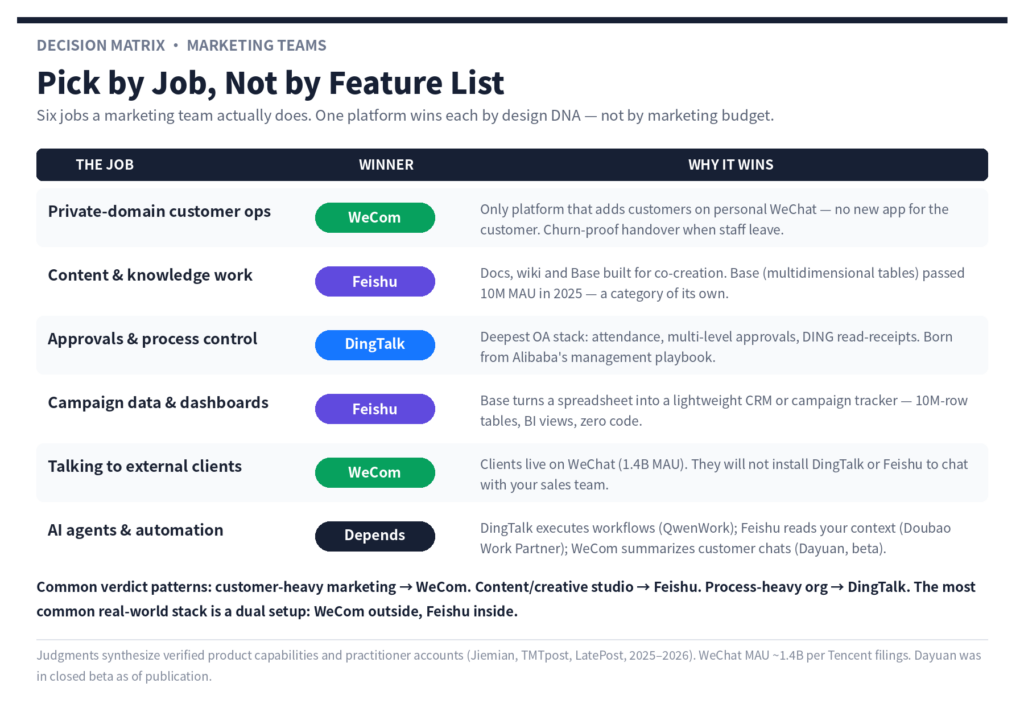
This is the core of the guide. Six jobs a marketing team actually does, and the platform that wins each — by design, not by slogan.
Job 1: Private-Domain Customer Operations → WeCom
Adding customers on WeChat, tagging them, running customer groups, posting to customer-facing Moments, handing accounts over when staff leave — this is WeCom’s home turf and nobody else’s turf at all. Customer relationships belong to the company account, not the employee’s phone. When your top sales rep resigns, the customers stay. Try doing that with personal WeChat.
Job 2: Content Collaboration and Knowledge Management → Feishu
Briefs, campaign wikis, review threads, asset libraries. Feishu’s docs-plus-wiki combination is the most mature co-creation environment of the three, and it’s not close. Teams that live in documents feel the difference in week one.
Job 3: Project Approvals and Process Control → DingTalk
Multi-level budget approvals, attendance for field teams, procurement flows, the audit trail your finance department demands. DingTalk’s OA depth — template library, flow engine, payroll integration — remains the benchmark. If your marketing org is process-heavy (retail chains, manufacturing, anything with regional hierarchies), this job dominates your daily pain.
Job 4: Campaign Data and Marketing Dashboards → Feishu
Base deserves its own row because it changed category. A campaign tracker, a content calendar with automation, a lightweight lead CRM — you build these in Base without code, with BI-style dashboards sliced by channel or owner. DingTalk shipped a competing AI table in 2025 and made basic usage free; the race is real. But Feishu’s head start is measured in years, and its CEO Xie Xin claimed in a July 2025 LatePost interview that Base leads DingTalk by “at least 12 months.” Vendor trash talk, yes — but the product gap is visible to anyone who uses both.
Job 5: External Client Communication → WeCom
Agencies, this row is yours. Your clients are on WeChat. Full stop. The dual realities of Chinese business communication — consumers on WeChat, and most B2B contacts reachable there too — mean the external channel decision defaults to WeCom unless your clients are themselves DingTalk or Feishu organizations.
Job 6: AI Assistants and Automation → It Depends on Your Base
The only genuinely contested job in 2026, and the next section explains why “depends” is the honest answer.
The Verdict Patterns
Customer-heavy marketing (retail, education, local services, consumer brands): WeCom, non-negotiable for the external layer.
Content and creative studios (internet companies, agencies, design-led brands): Feishu for the internal layer.
Process-heavy organizations (manufacturing, chains, regulated industries): DingTalk as the internal backbone.
And the pattern you’ll see most in practice: the dual stack — WeCom outside, Feishu inside. It’s not indecision. It’s the correct answer to having two different jobs.
The 2026 AI Shake-Up: Same Summer, Three Bets
July 2026 reorganized this entire market in thirty days. If you evaluated these platforms’ AI in 2025, your notes are obsolete.
What Actually Happened in July
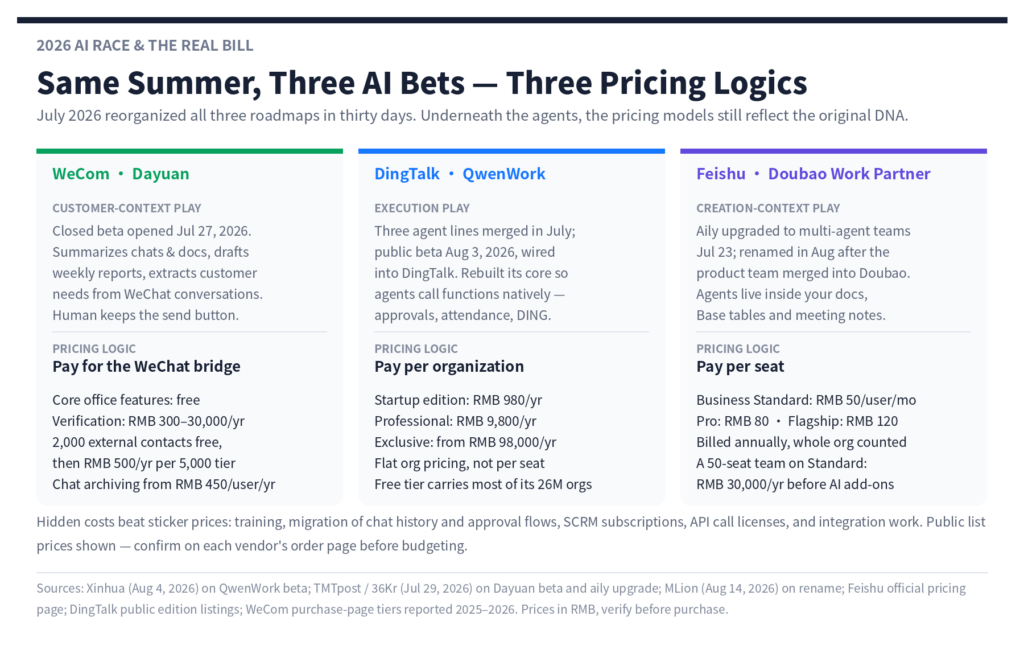
On July 2, DingTalk merged three internal agent product lines under new CEO Chen Yusen. The consolidated product, QwenWork, entered public beta on August 3 — Xinhua covered the launch — wired into DingTalk’s organization graph, running on the Qwen model family. The bet: agents that execute. DingTalk spent a year rewriting its core so agents call functions natively — submit approvals, query attendance, push DING messages — instead of simulating clicks.
On July 23, Feishu upgraded aily to multi-agent collaboration: cloud agents working 24/7, teams of specialized agents dividing tasks. Then came the organizational earthquake. On July 30, ByteDance merged Feishu’s product team into the Doubao team; Xie Xin now reports to Doubao’s lead. By mid-August, aily had been renamed Doubao Work Partner. The bet: agents that understand your context — your docs, tables, meeting notes — because Feishu is where that context lives.
On July 27, WeCom opened closed beta for Dayuan, its first native AI assistant. Swipe left, and it summarizes chat history, drafts weekly reports, and — the differentiating piece — extracts customer needs and follow-up blockers from your WeChat customer conversations into structured tables. The bet: agents that know your customers. Note the restraint reported by beta users: Dayuan drafts replies but doesn’t send them, and can’t submit approvals on your behalf. The human keeps the trigger.
The March Prelude: All Three Open-Sourced Their CLIs
One layer down, something quieter and arguably more durable happened. Between March 27 and 29, 2026, all three platforms open-sourced command-line tools on GitHub — dingtalk-workspace-cli (Apache-2.0), lark-cli (MIT, exposing 2,500-plus APIs across 11 business domains), and wecom-cli (MIT). These let external AI agents — Claude Code, Cursor, and the OpenClaw-style agent frameworks that went viral in early 2026 — operate the platforms directly from a terminal.
For marketing ops, the practical read: whichever platform your team lives on is becoming programmable by whatever AI tools you already use. Feishu opened widest; WeCom’s CLI initially restricted full features to organizations of ten people or fewer, a genuinely material limit for larger teams. The platform war is becoming an agent-infrastructure war, and your switching costs are being quietly rewritten.
How to Choose the AI, Honestly
Match the agent to the context you already own. DingTalk org with years of approval history: QwenWork’s execution layer has something to execute. Feishu shop with a rich doc-and-Base corpus: Doubao Work Partner reads it natively. WeCom operation with customer chats as your core asset: Dayuan structures what the other two can’t see. And keep the shipped-versus-announced distinction in mind — Dayuan was still in beta as of this writing, and beta summaries are not production workflows.
The Real Bill: Three Pricing Logics, Not Three Prices
Comparing sticker prices across these platforms is a category error, because they don’t even charge for the same thing.
DingTalk charges the organization. Public editions run RMB 980/year (Startup), RMB 9,800/year (Professional), and from RMB 98,000/year (Exclusive). A 200-person company and a 50-person company can pay the same Professional fee. That’s why fewer than 1% of its 26 million organizations pay — simple division of the vendor’s own two numbers — while 42 million individuals sit inside paid enterprise accounts. Free-riding is the design, not a bug.
Feishu charges the seat. Business Standard is RMB 50 per user per month, Pro RMB 80, Flagship RMB 120, billed annually — and the purchase must cover your whole organization, not just the enthusiasts. Fifty people on Standard is RMB 30,000 a year before AI add-ons. This is standard international SaaS logic, and it’s why Feishu earns near-DingTalk revenue on one-seventh the users.
WeCom charges for the bridge. Core office features are free. You pay for verification (RMB 300 to 30,000 a year by company size), for external-contact capacity beyond the free 2,000 (RMB 500/year for the 5,000 tier, scaling to RMB 100,000/year for a million), for chat archiving if compliance demands it (from RMB 450 per user per year), and — the big one — for the SCRM layer from third-party vendors that turns raw customer connections into segmented, automated operations.
The hidden costs beat all three stickers: training, migration, integration, API licenses. Budget the first year as software plus implementation, or the spreadsheet lies to you.
Integration, Data and the Boring Stuff That Bites
A few structural facts worth knowing before you commit.
WeCom’s SCRM ecosystem is the deepest third-party marketing layer in China — customer data can sync through official APIs into systems you control, which matters enormously under PIPL, China’s personal information protection law. Customer chat archiving is a regulated-industry requirement, not a nice-to-have, and it’s a paid feature with per-seat economics.
DingTalk’s integration strength points inward: ERP, supply chain, manufacturing systems, plus the Alibaba ecosystem. Feishu’s openness points toward developers — the widest CLI, the most complete API exposure, and Base itself now runs inside DingTalk and WeCom as a third-party app, a 2025 move that quietly conceded the customer-connection war while winning the tool war.
And whichever you choose, ask the exit question before signing: what exports, in what format, at what cost? Chat history, approval records, document trees. The platform you can leave is the platform you can safely join.
Migration and the Dual-Stack Operating Rules
Switching costs here are not download-and-reinstall costs. They’re organizational: approval flows rebuilt, historical chats stranded, document permissions remapped, and several weeks of your team quietly working in two systems at once. Practitioner accounts in 2025–2026 coverage describe real migrations in both directions — consumer brands moving DingTalk-to-Feishu for the docs, logistics and hardware companies moving Feishu-to-DingTalk for the process depth. Neither direction is a verdict on quality. It’s jobs changing.
If you run the dual stack (and you probably should), three rules keep it sane:
One system of record per data type. Customers live in WeCom/SCRM. Documents live in Feishu. Approvals live wherever finance says they live. Never let the same record exist authoritatively in two places.
Bridge the seam deliberately. A closed deal in a WeCom chat must land in the internal tracker — through Base’s WeCom integration, an API job, or at minimum a human ritual. The seam is where dual stacks die.
Name an owner for each platform. Two admins, two permission models, two renewal calendars. Unowned software rots.
When does consolidation pay? When one job clearly dominates — when 80% of your collaboration pain is one category, paying the migration cost to unify beats paying the seam tax forever. Below that threshold, run both and stop feeling guilty about it.
Honest Boundaries
Everything above has edges. All market-share and MAU figures are QuestMobile estimates reported secondhand; vendor scale claims are unaudited; revenue figures are media-reported with companies declining comment. Dayuan’s capabilities come from beta coverage and may change at general availability. Prices are public list prices checked in November 2026 — enterprise deals deviate. And there is no universal winner here, which is not a cop-out but the finding: the question “which is best” is malformed, and this entire guide is the argument for replacing it with “best for which job.”
The Verdict
WeCom for customers. DingTalk for control. Feishu for creation. Audit your team’s actual week — count the hours spent on customer chats, approval flows, and document co-creation — and let the biggest bucket pick your backbone. Then add the second platform only where a job structurally demands it, wire the seam, and revisit when the AI layer matures enough to change the math. It might, soon. That’s the one prediction this guide will make.