You have already paid for this customer once. The ad did its job, the parcel arrived, the payment cleared. And yet next month, when you want to tell that same person about a restock or a member price, the platform quotes you a fresh fee to reach them again — your own buyer, rented back to you at auction.
That is the loop private domain exists to break. Not with a cleverer ad, but with a transfer: move the customer, once, onto a rail where the next message costs labour instead of media budget. In China that rail is almost always WeCom, Tencent’s business counterpart to WeChat, plus the groups, mini programs and memberships around it.
This playbook covers the build: four stages, ninety days, and the platform rules you must design around. It also covers the failure mode, because silent pools are common, well documented, and almost entirely avoidable.
Start with the arithmetic, not the group chat
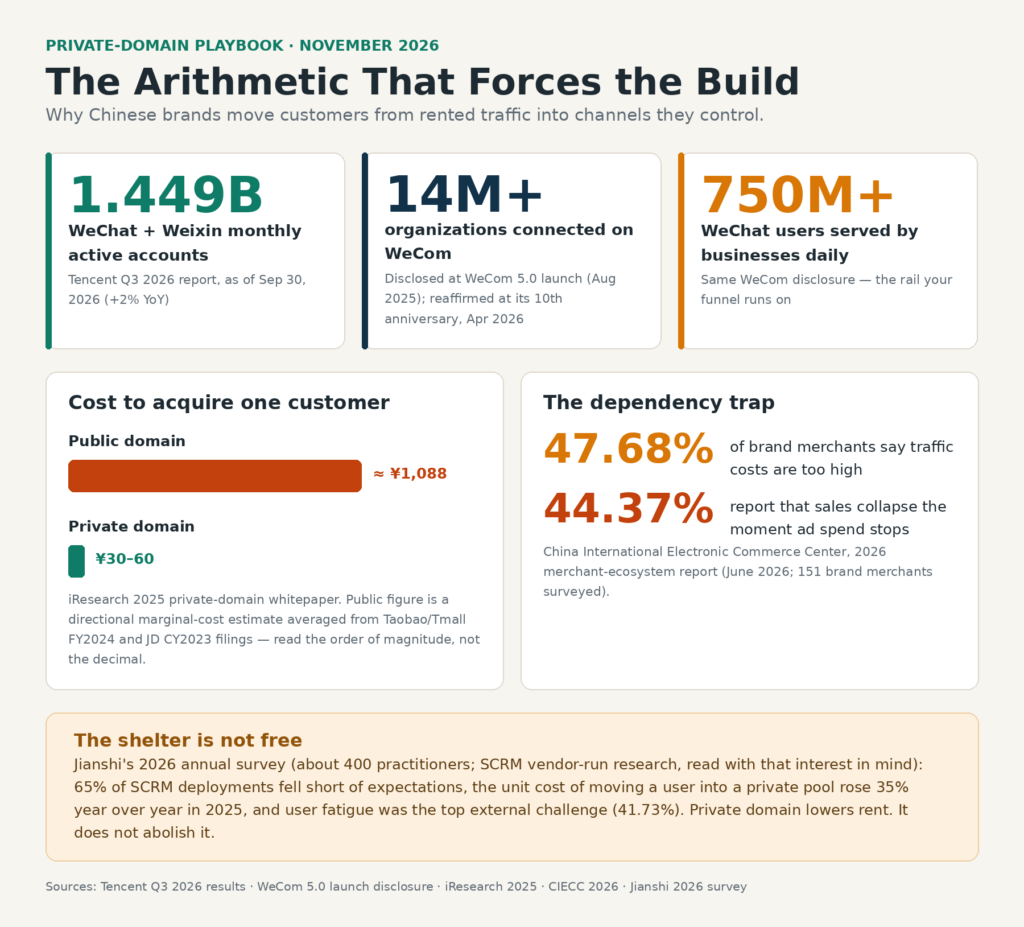
The business case is a price gap. iResearch’s 2025 private-domain e-commerce whitepaper estimates public-domain acquisition at roughly ¥1,088 per new customer, against ¥30–60 to re-engage someone already inside a private pool. Conversion follows the same logic: about 0.37% in public traffic versus 6–10% in private channels. Read those figures honestly — the public number is a directional marginal-cost estimate averaged from Taobao/Tmall and JD annual filings, not a precise invoice. The decimal is soft; the order of magnitude is the argument.
Merchants feel the squeeze from the other direction. In a June 2026 report by the China International Electronic Commerce Center, a state-affiliated research body, 47.68% of 151 surveyed brand merchants said traffic costs were too high, and 44.37% described the same trap: stop spending, and sales collapse. Public reach is not an asset you buy. It is a subscription you cannot cancel without losing the customers.
The infrastructure for the alternative already exists at national scale. Tencent’s Q3 2026 report puts combined WeChat and Weixin monthly active accounts at 1.449 billion as of September 30, 2026. WeCom, per Tencent’s own disclosure at the product’s 5.0 launch in August 2025 (reaffirmed at its tenth anniversary in April 2026), connects more than 14 million enterprises and organizations and serves over 750 million WeChat users every day. Your customers are already in the app. You are not building an audience; you are building a doorway.
And this is a mainstream channel, not a fringe tactic: the 100EC e-commerce research center sized China’s private-domain commerce at ¥6.4 trillion in 2025, with roughly 680 million users. Nearly ninety percent of merchants surveyed by iResearch already run some private-domain program. The question stopped being whether to build. It is whether yours works.
The architecture: four stages, one loop
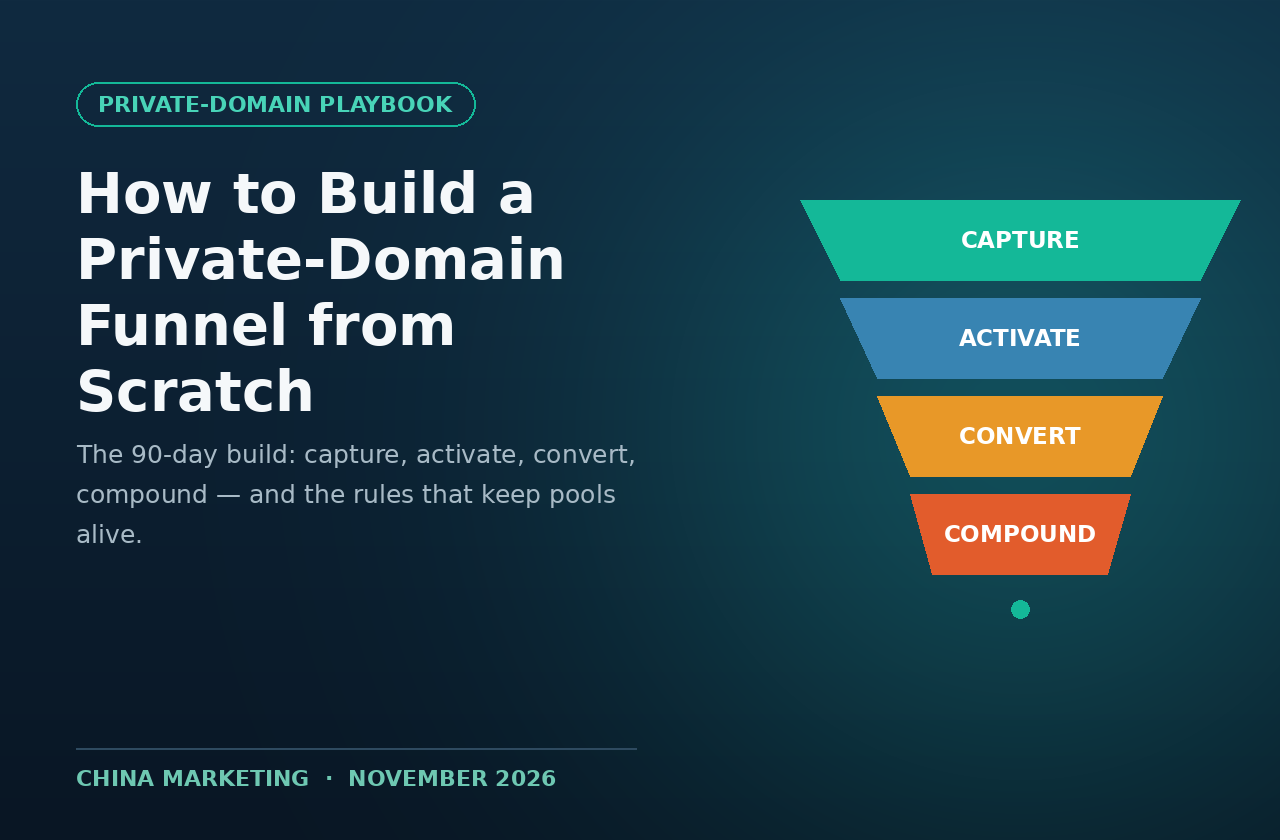
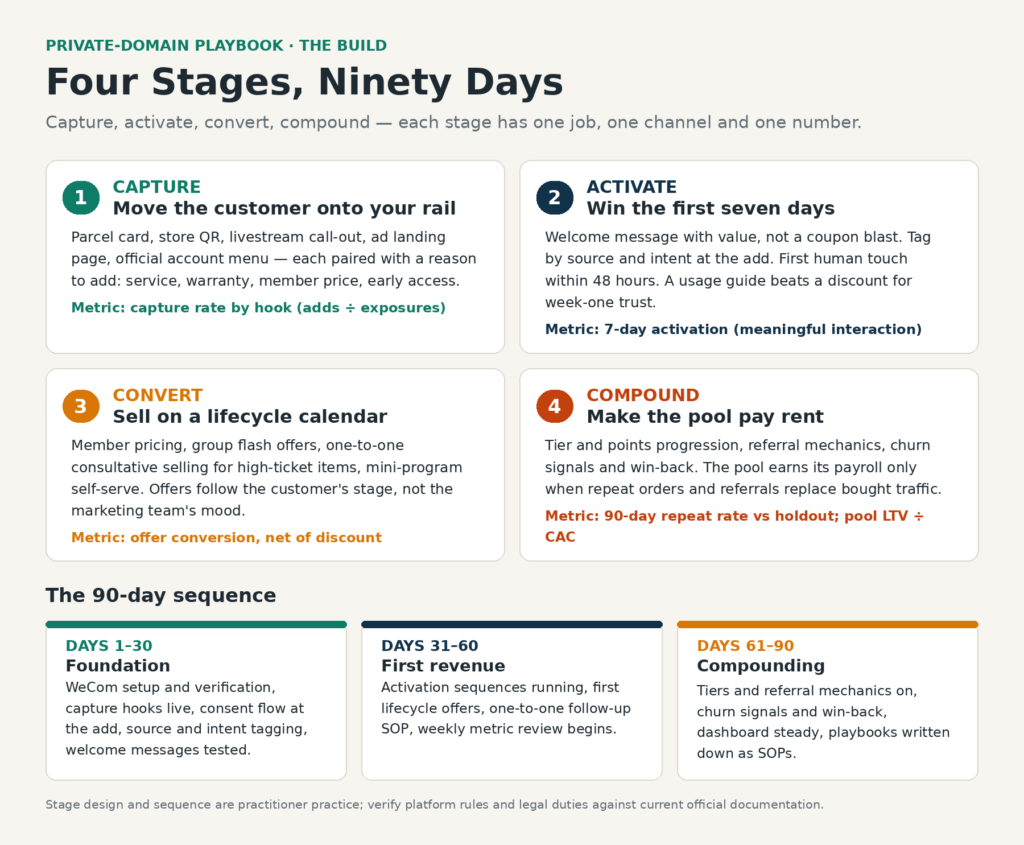
A private-domain funnel is not a page with a button. It is an operating loop with four stages, and each stage has one job, one primary channel, and one number that tells you the truth.
| Stage | Job | Primary channel | Content | Truth metric | Owner |
|---|---|---|---|---|---|
| Capture | Move the customer onto your rail | WeCom add, group join, mini-program membership | Hook + reason to add | Capture rate by hook | Growth / store ops |
| Activate | Earn the right to message again | 1:1 chat, welcome sequence | Value-first onboarding | 7-day activation | Operator |
| Convert | Turn trust into orders | Member offers, group flash, 1:1 consult | Lifecycle offer calendar | Offer conversion, net of discount | Operator + sales |
| Compound | Replace bought traffic with repeat and referral | Tiers, points, referral mechanics | Retention and win-back | 90-day repeat vs holdout | CRM lead |
Notice what is missing: pool size. A pool of 50,000 silent contacts is a liability with a payroll attached. Every design decision below optimizes for activity, not accumulation.
Stage 1 — Capture: design a transfer worth accepting
The hook inventory
Capture happens where public attention already touches you. Five surfaces do most of the work: a card inside the parcel, a QR code at the store counter, a spoken call-out during a livestream, an ad landing page, and the menu of your official account. WeCom also offers official acquisition links that let a customer add a staff member in one tap from an ad or an off-WeChat page; note that this capability is billed per successful add, with rates varying by industry — check current pricing in your admin console before you model it.
Each surface needs an exchange, not a plea. “Add us for updates” converts strangers into nobody. What works is a concrete reason: extended warranty registration, a fitting or usage consultation, member pricing on the next order, early access to a drop. Service-shaped hooks attract customers who intend to stay; coupon-only hooks attract people who intend to extract. Both add contacts. Only one builds a funnel.
A discipline point on benchmarks: you will find “package-card scan rates” quoted across vendor blogs, but there is no authoritative public benchmark series for capture rates. Treat every circulated percentage as folklore. Instrument your own hooks from day one — adds divided by exposures, per surface — and let your week-two baseline be the benchmark you beat.
Consent is part of capture, not paperwork
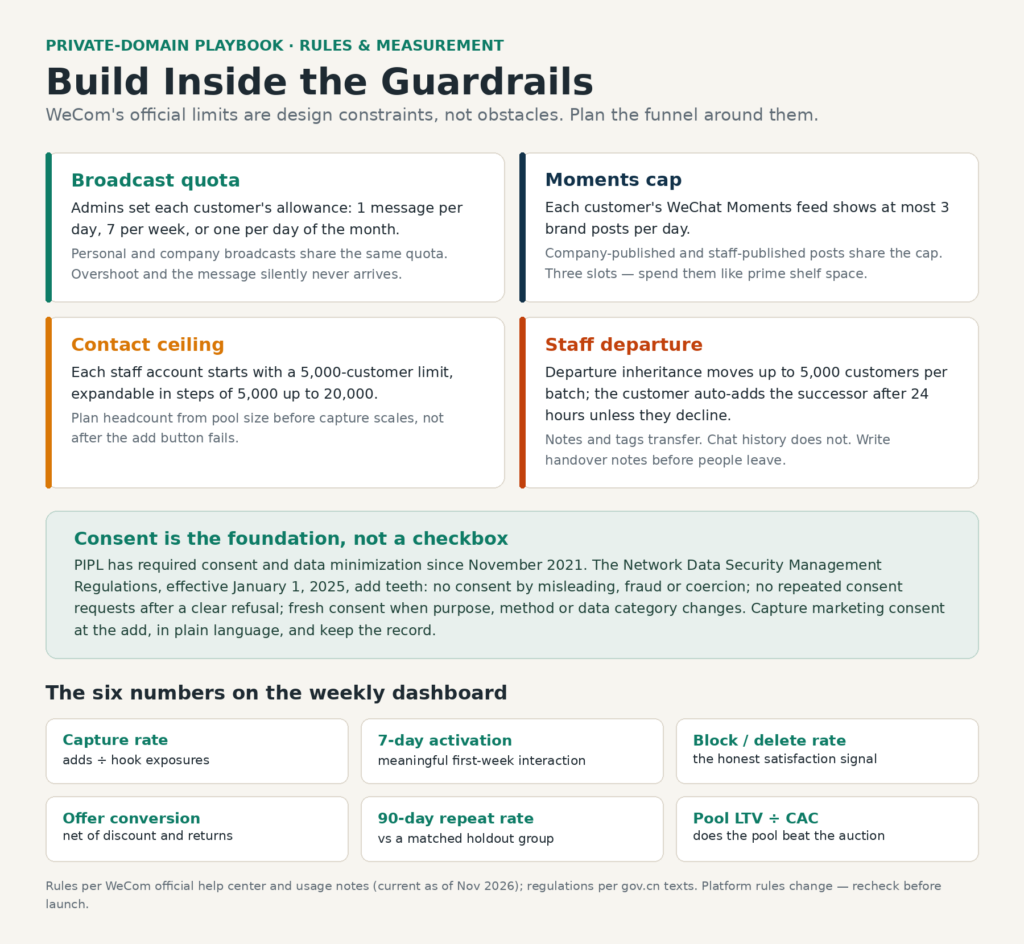
China’s Personal Information Protection Law, in force since November 2021, requires a lawful basis — for marketing, that means consent — and data minimization. The Network Data Security Management Regulations, effective January 1, 2025, sharpen the mechanics: consent may not be obtained through misleading, fraud or coercion; you may not keep asking after a clear refusal; and a change in processing purpose, method or data category requires fresh consent.
Practically: state at the add what you will send and how often, keep the record, and collect only what the relationship needs. Use official WeCom channels rather than staff members’ personal WeChat accounts — the personal route is a compliance grey zone and an asset-risk trap, because a personal friend list walks out the door with the employee.
Stage 2 — Activate: win the first seven days
The value-first welcome
WeCom ships an official welcome-message feature: when a customer adds a staff member, a configured message fires automatically, with text, images, links or mini-program cards. Most teams waste it on a coupon blast. The better sequence front-loads usefulness — a usage guide for what they just bought, the service menu, the answer to the question they were about to ask — and tags the contact by source and intent at the moment of the add, while the context is fresh.
Then a human touches the thread. Our house rule, and a common practitioner convention rather than a measured law: first personal response within 48 hours of the add, referencing why they came. A contact who added you from a warranty card should hear about their warranty, not about a flash sale.
Cadence inside the platform’s caps
WeCom enforces frequency limits, and they are stricter than most decks assume. Under current official rules, administrators configure each customer’s broadcast allowance — one message per day, seven per week, or one per day of the month — and personal and company broadcasts share that same quota. A customer’s Moments feed shows at most three brand posts per day, company-published and staff-published combined. Overshoot the broadcast cap and the message simply never arrives.
Design implication: scarcity forces quality. If a customer can receive one broadcast a day at most, every send competes with every other team that wants the slot. Run one content calendar for the whole pool — 1:1 messages, group posts and Moments included — and give the slot to the message with the clearest customer benefit. Block and delete rates are your feedback loop; treat them as a product metric, not an annoyance.
Stage 3 — Convert: offers on a calendar, not on a whim
Conversion in a private pool runs on four mechanisms: member pricing inside a mini program, time-boxed group offers, one-to-one consultative selling for high-ticket items, and self-serve reorder flows. None of them is exotic. What separates working funnels from dead ones is the calendar.
Tie every offer to a lifecycle moment: replenishment when the usage cycle predicts it, an upgrade after a service milestone, a win-back when activity flags decay. Random blasts train customers to mute you; lifecycle offers feel like service because they are. Wire deep events — order placed, membership activated, coupon redeemed — so conversion is measured on transactions inside the mini program, not on replies in a chat. A conversation is intent; an order is revenue. Your dashboard needs the second one.
Stage 4 — Compound: make the pool pay its own rent
The pool earns its payroll only when repeat orders and referrals start replacing bought traffic. Three mechanisms carry the load.
Tiers and points, run on two tracks: points as currency (earn and burn on real value) and tiers as identity (status, early access, service priority). Currency drives the next order; identity drives the next year. Referral mechanics, kept simple enough to explain in one sentence, rewarded on both sides, and measured on referred customers who actually buy — not on shares. And churn signals with a win-back path: in a chat-native channel, a delete or a block is a visible, honest defection event. Log it, learn from the cohort, and win back with service rather than deeper discounts.
The math that governs all of it: pool lifetime value against acquisition cost, and 90-day repeat rate against a matched holdout group that gets no private-domain touches. Without the holdout you are measuring enthusiasm, not incrementality.
The 90-day build sequence
Days 1–30: foundation
Verify the WeCom entity, configure staff scopes, and switch on contact archiving where your industry requires it. Launch two or three capture hooks — not all five — each with its consent wording and source tags. Test welcome messages with a real test account. Build the tag taxonomy before the pool grows: source, intent, lifecycle stage. Nothing else.
Days 31–60: first revenue
Run the activation sequence properly: value-first welcome, 48-hour human touch, tagged follow-ups. Ship the first lifecycle offers — one member price, one group flash, one consultative flow — and wire order events into reporting. Start the weekly metric review now, while the numbers are small enough to argue about honestly.
Days 61–90: compounding
Turn on tiers and referral mechanics. Add churn flags and the win-back path. Steady the dashboard, then write everything down: welcome scripts, offer calendar rules, tagging conventions, handover procedure. The playbook you document in week twelve is the asset; the pool is just its first output.
Team and tooling minimums
One operator plus content support can run the first ninety days. Scale headcount from official limits, not vibes: each WeCom staff account starts at a 5,000-customer ceiling, expandable in steps of 5,000 to a maximum of 20,000. A 60,000-contact pool therefore needs at least three seats by arithmetic, and more by service bandwidth — plan the roster before capture scales, not after adds start failing.
Start on WeCom’s native tooling; it covers welcome messages, tags, broadcasts and group management for free. Upgrade to a paid SCRM when you hit real triggers: multiple stores, journey automation, or attribution joins to your order system. Buy skeptically. Jianshi’s 2026 annual survey — about 400 practitioners, and note that Jianshi is itself an SCRM-industry research vendor, so read the finding with that interest in mind — found 65% of SCRM deployments fell short of expectations, with the unit cost of moving a user into a private pool up 35% year over year in 2025 and user fatigue the top external challenge (41.73%). The tool is not the strategy. Demand a cohort repeat-purchase curve from any vendor before you sign; a vendor who can only show you a percentage is selling a slide.
Measure six numbers, not pool size
Capture rate by hook. Seven-day activation, defined as a meaningful interaction, not a delivered message. Block and delete rate — the most honest satisfaction signal a chat channel produces. Offer conversion, net of discounts and returns. Ninety-day repeat rate against a holdout. And pool LTV over CAC, which answers the only question your CFO actually asked.
Review them weekly, same day, same sheet. The ritual matters more than the dashboard software: a number nobody argues about on a fixed cadence is decoration.
Seven ways pools become graveyards
The failure patterns repeat across industries, so here is the prevention list. Broadcast-only pools with no conversation. No value calendar, so every message is an ask. Over-messaging until the block rate spikes. No tagging, so every customer gets the same blast. Staff departure without inheritance — WeCom transfers the contact relationship, notes and tags (up to 5,000 customers per batch, with the customer auto-adding the successor after 24 hours unless they decline), but not the chat history, so written handover notes are the difference between continuity and amnesia. Buying adds to inflate the pool. And measuring size instead of activity, which rewards every mistake above.
If you recognize three or more of these in your current program, pause capture and fix activation first. Pouring traffic into a leaky pool is the most expensive way to learn this lesson.
The build checklist
Days 1–30: entity verified; scopes and archiving set; two hooks live with consent wording; source and intent tags tested; welcome messages verified with a test account. Days 31–60: 48-hour touch rule running; first three lifecycle offers shipped; order events wired; weekly review started. Days 61–90: tiers and referrals on; churn flags and win-back live; holdout group defined; SOPs written; vendor decision made against a cohort curve, not a demo.
The bottom line
Private domain is not a growth hack and not free traffic. It is an infrastructure choice: pay once to acquire, then earn the right to stay in touch through usefulness, cadence discipline and honest measurement. The economics force the move — ¥1,088 to rent versus ¥30–60 to keep is not a gap you can out-optimize with better creatives. But the shelter has a maintenance bill, and the operators who pay it in service and restraint are the ones whose pools still answer after ninety days. Build the doorway. Then deserve to be let in.