You spent three weeks perfecting the creative. The click-through rate looks healthy. The targeting is tight. And yet the leads trickling into your CRM are expensive, sparse, and half of them never pick up the phone. So you do what most teams do: you brief another round of ads.
Wrong move. In China’s paid-traffic ecosystem, the page behind the click is no longer a passive bucket that catches whatever the ad pours in. It is an active participant in the auction — read, scored, and judged by machine systems before a single human forms an opinion. When your landing page whispers vague platitudes while your ad shouts a specific promise, the platforms notice. Your impressions get throttled, your real cost per click creeps up, and the humans who do arrive bounce before the hero image finishes loading.
This playbook walks the full anatomy of a Chinese landing page that converts: the three audiences every page must serve, the first-screen rules, the proof hierarchy, form design under privacy law, the platform-format decision, and a testing sequence that starts where the leverage actually lives.
One Page, Three Readers
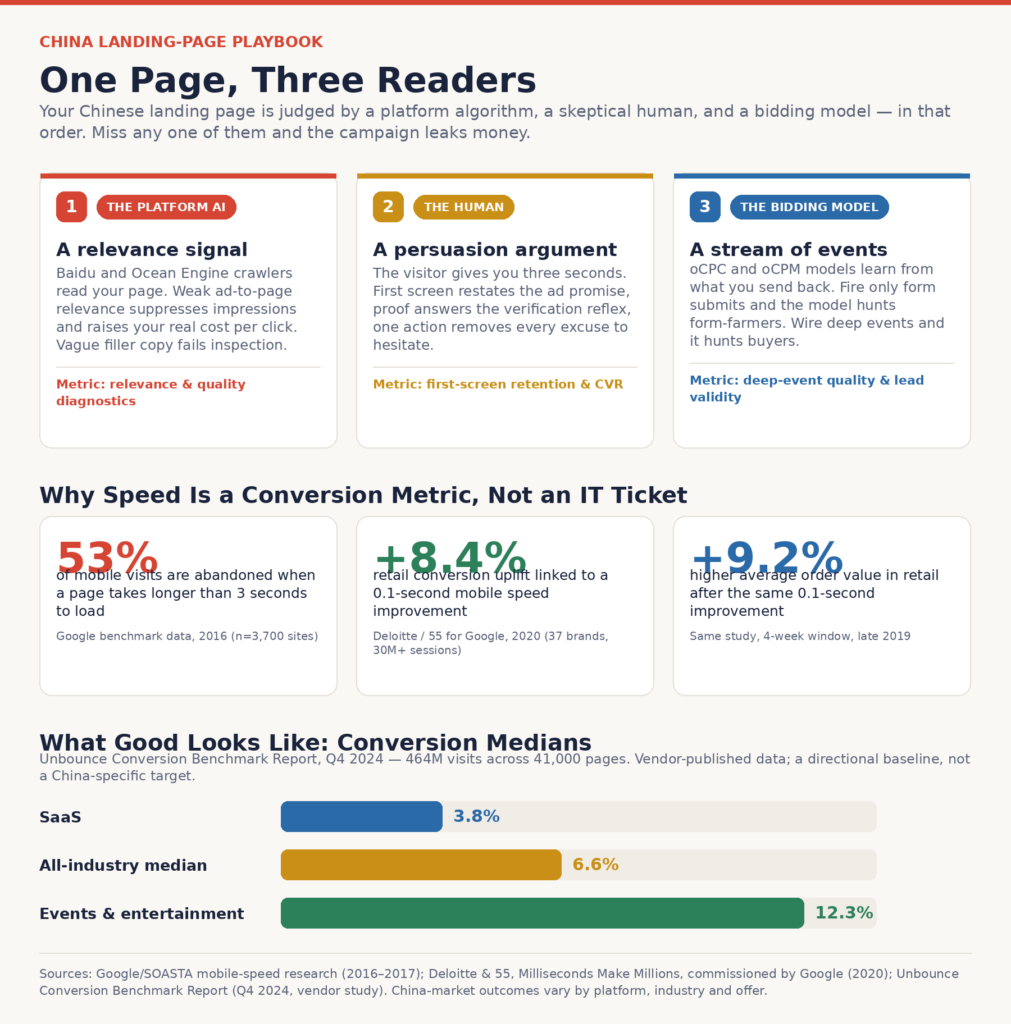
Here is the mental model that changes how you build. A Western landing page traditionally answers to one judge: the visitor. A Chinese paid-traffic landing page answers to three, and they read in sequence.
Reader One: The Platform’s AI
Baidu’s marketing help center is blunt about this: its systems crawl your page, compute relevance between the search query, the ad creative, and the page content, and restrict impressions when the three don’t line up. Pages that fail quality diagnostics — broken links, desktop-only layouts, fake forum widgets with dead buttons, oversized floating bars — get flagged inside the advertiser dashboard with repair instructions. Google formalizes the same idea in its Quality Score documentation, where landing page experience sits alongside expected click-through rate and ad relevance as one of three quality components. Google is careful to note that higher-quality ads typically cost less per click — a tendency, not a coupon. The direction of the mechanism is identical on both sides of the Pacific: the machine reads your page before the market does.
Reader Two: A Skeptical Human
The visitor gives you about three seconds, and they arrive pre-suspicious. Chinese consumers have been burned by bait-and-switch funnels for two decades; their reflex is verification, not admiration. They are not asking “is this brand impressive?” They are asking “can I check this?” Your page’s job is to answer that question faster than their thumb can swipe away.
Reader Three: The Bidding Model
Modern Chinese ad platforms optimize toward the conversion events you feed back. If the only signal you send is “form submitted,” the model learns to find people who submit forms — professional form-fillers included. Ocean Engine’s official event-management documentation explicitly encourages advertisers to pass back deeper events such as credit approval or loan disbursement through the API, alongside the shallow on-page conversion, so the model can optimize toward business outcomes instead of button presses. The page is where that signal chain begins.
The First Screen: Win the Zero-to-Three-Second Verdict
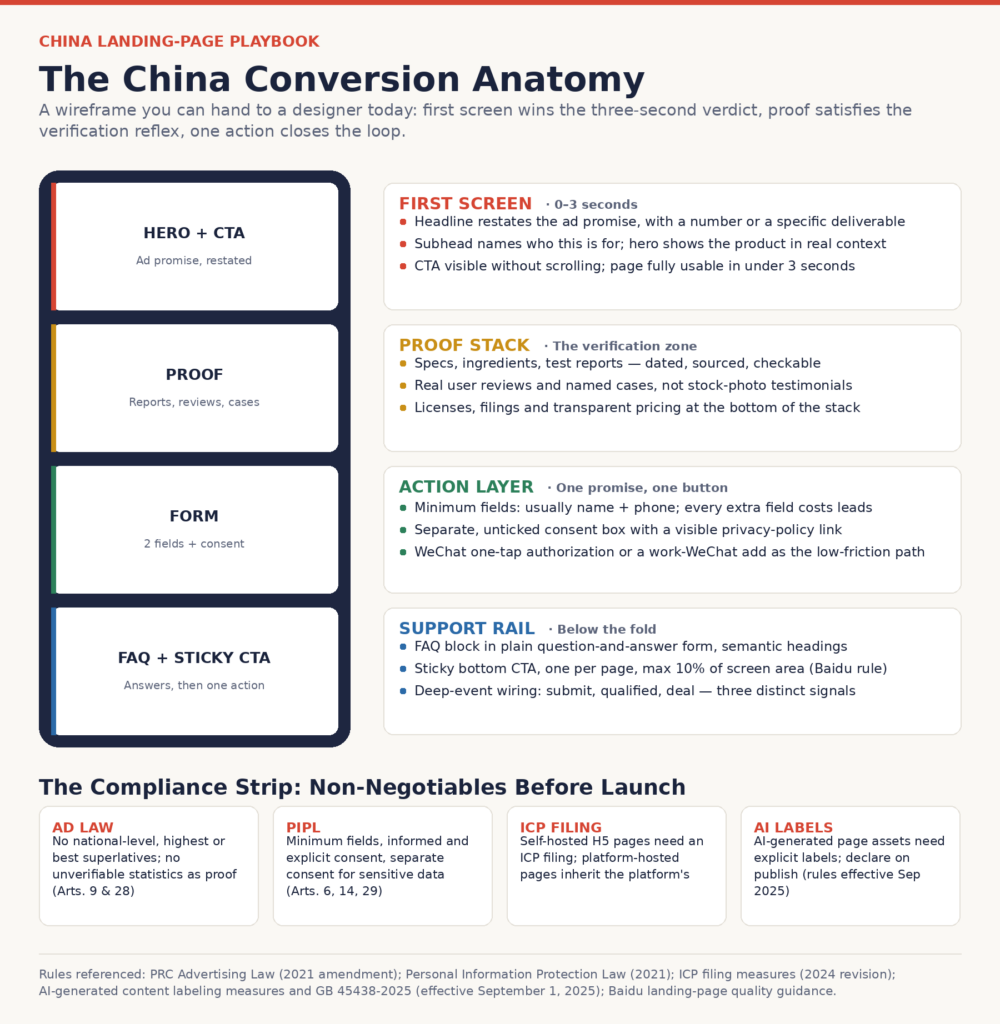
The first screen has one job: restate the ad’s promise with more specificity than the ad itself. If the creative promised a quote in ten minutes, the headline says ten minutes — not “industry-leading service solutions.” Vague superlative copy fails twice: the relevance crawler can’t match it to the query, and the human can’t match it to the click they just made.
The working pattern is simple. Headline equals the ad promise, sharpened with a number or a concrete deliverable. Subhead names who this is for. Hero visual shows the product in real context, not a stock-photo handshake. The call to action is visible without scrolling. And underneath the first screen, a short self-introduction block — roughly fifty to one hundred words stating who you are, what you sell, and what happens after the visitor acts — gives both the crawler and the human an unambiguous anchor. One page, one promise, one action. Every additional offer you bolt on dilutes all three.
Speed Is a Conversion Metric, Not an IT Ticket
The data here is old but stubbornly consistent. Google’s benchmark research found that 53% of mobile visits are abandoned when a page takes longer than three seconds to load — a figure drawn from aggregated analytics data across 3,700 sites back in 2016, and still the most-cited threshold in the industry because nothing since has contradicted it.
The revenue side comes from “Milliseconds Make Millions,” a study commissioned by Google and conducted by Deloitte with data firm 55, covering 37 European and American brand sites and more than 30 million user sessions over four weeks in late 2019. A 0.1-second improvement in mobile speed correlated with an 8.4% lift in retail conversions and a 9.2% increase in average order value; travel conversions rose 10.1%. Note the conflict of interest — Google paid for the study, and Google sells speed. But the methodology was audited, no UX redesigns occurred during the window, and the sample is large. Treat the exact percentages as directional and the lesson as solid: in a market where nearly all paid traffic lands on a phone, shaving load time is a growth lever, and platform-hosted pages exist precisely because they render near-instantly.
The Proof Stack: Design for the Verification Reflex
Chinese consumers verify in a fairly predictable order, and your page should stack evidence the way they consume it.
Lead with hard specifics: parameters, ingredient lists, test reports with dates and issuing institutions. Follow with real user reviews and named customer cases — screenshots and specifics beat polished video testimonials with actors. Then credentials: licenses, filings, certifications, displayed where a skeptical visitor can actually find them. Close with price transparency, because a hidden price reads as a trap.
Two anti-patterns deserve special warnings. First, stock photos and unverifiable claims are not just weak persuasion — under China’s Advertising Law, using fabricated or unverifiable research results, statistics, or survey data as proof material legally constitutes false advertising. Second, fake countdown timers that reset on refresh are the kind of manufactured urgency that regulators and platforms increasingly treat as deceptive. If your scarcity is real, say why it’s real. If it isn’t, delete the widget.
The Action Layer: Forms, Consent, and One Button
Every form field is a tax on conversion, and China’s Personal Information Protection Law makes most of that tax illegal anyway. Article 6 requires that collection be limited to the minimum scope needed for the stated purpose. If you’re booking a callback, you need a phone number — not a job title, company size, and home address.
Consent design matters as much as field count. PIPL Article 14 requires consent to be voluntary and explicit, given on a fully informed basis. In practice: an unticked checkbox, a visible privacy-policy link, plain language about what happens to the data. Sensitive categories — financial accounts, health data, location tracks, anything involving minors under fourteen — trigger a separate-consent requirement under Article 29. Pre-ticked boxes and bundled authorizations are exactly the patterns the law was written to kill.
Where the ecosystem allows it, take the friction out entirely. WeChat’s native advertising pages support one-tap phone-number authorization, replacing manual typing with a single confirmed tap. For B2B and high-consideration offers, an “add our work-WeChat account” button can outperform a form outright — it converts a cold lead into a private-domain contact you can nurture, instead of a row in a spreadsheet nobody calls.
Wire the Deep Events or Fly Blind
Decide before launch what fires when. Form submit is event one. Sales-qualified lead is event two. Closed deal is event three. The platform builders make the first trivial; the second and third require an API connection from your CRM back to the ad platform, and they are worth the engineering hours. A campaign optimized on qualified leads costs more per conversion and less per customer — which is the only ratio your CFO actually cares about. If you take one operational habit from this playbook, make it this: never let a campaign run for a month on submit-only signals and then wonder why lead quality collapsed.
H5, Mini-Program, or Native Builder: Pick the Container First
The format decision comes before design, because it determines your speed ceiling, your data ownership, and how much the platform trusts you.
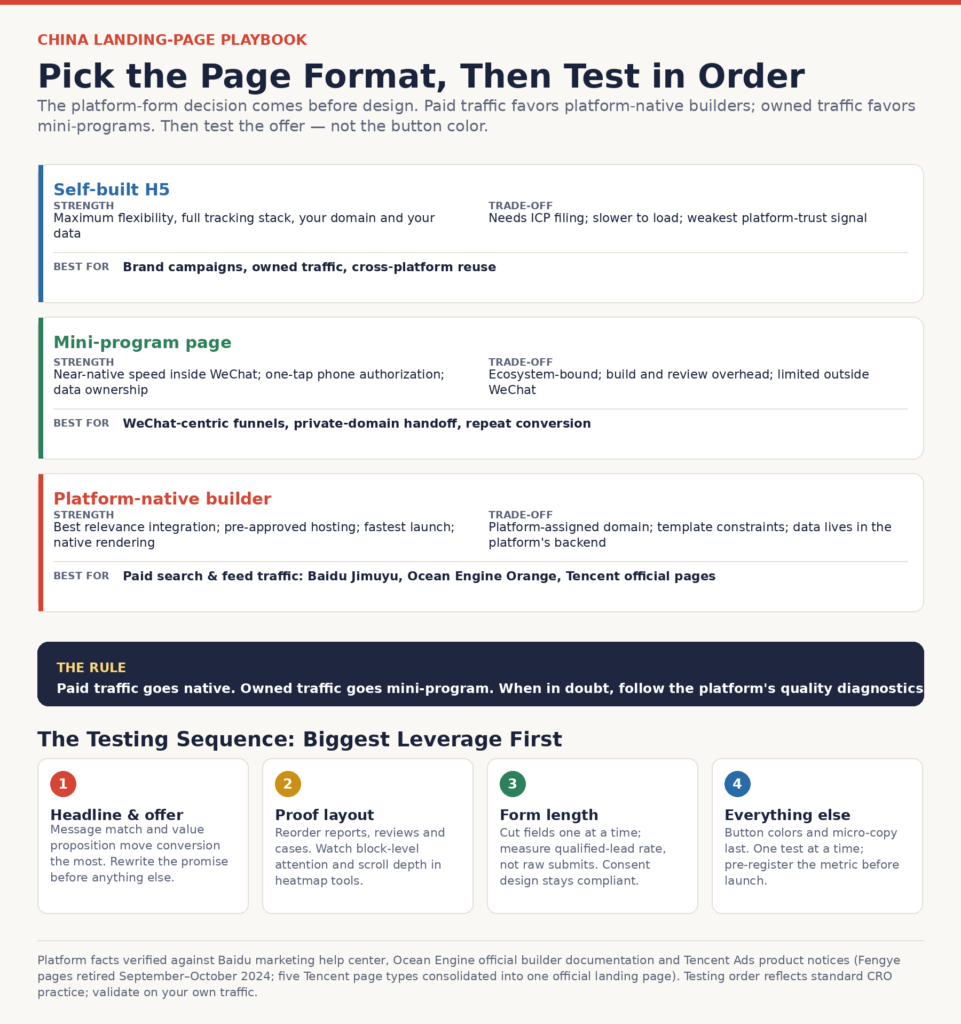
Self-built H5 pages give you maximum flexibility, your own domain, and your full tracking stack — but they need an ICP filing to be hosted in mainland China, they load slower, and they carry the weakest platform-trust signal. Mini-program pages load near-natively inside WeChat, support one-tap authorization, and keep data in your own backend — at the cost of being ecosystem-bound. Platform-native builders — Baidu’s Jimuyu, Ocean Engine’s Orange Site Builder, Tencent’s official landing pages — offer the tightest relevance integration, pre-approved hosting, and instant rendering, in exchange for template constraints and a platform-assigned domain.
This corner of the market moves fast, so date your knowledge. Baidu pushed advertisers toward hosted Jimuyu pages in 2021, with mandatory hosting for risk categories such as medical and health products; industry reporting at the time indicated the full-industry mandate was narrowed to risk industries, though that narrowing was never formally published as policy. Tencent retired its Fengye e-commerce page tool entirely — creatives containing Fengye pages have been rejected since September 2024, and merchant access ended that October — then consolidated five separate landing-page products into one unified official landing page with WeChat native rendering. If your agency’s playbook still recommends Fengye, your agency’s playbook is two years out of date.
The working rule: paid traffic goes native, owned traffic goes mini-program. When you’re unsure, follow the platform’s own quality diagnostics — they tell you, in writing, what the machine wants.
The Testing Protocol: Offer First, Button Color Last
Most landing-page testing programs die of trivia. Teams burn six weeks on button colors while the headline still mismatches the ad. Test in leverage order instead.
First, headline and offer — message match and value proposition move conversion more than everything else combined. Second, proof layout: reorder reports, reviews, and cases, and watch block-level attention in heatmap tools; Ptengine, which has deep roots in the China market, offers conversion heatmaps that show which page sections actually precede conversions rather than merely attracting clicks. Third, form length: cut fields one at a time and measure qualified-lead rate, not raw submits. Everything else comes last. One test at a time, metric pre-registered before launch, and on small budgets, accept that you’re looking for large effects — a small-traffic page cannot reliably detect a 3% lift, so don’t pretend it can.
What “Good” Looks Like: Calibrate Your Benchmarks
Unbounce’s Conversion Benchmark Report — vendor-published, so hold it loosely — analyzed 464 million visits across 41,000 landing pages and found an all-industry median conversion rate of 6.6% as of Q4 2024, ranging from 3.8% in SaaS to 12.3% in events and entertainment. No China-specific dataset of comparable scale exists publicly, so use these numbers as a sanity check, not a target. A high-ticket B2B page converting 2% into qualified opportunities may be an excellent page; a low-price consumer offer converting 2% is a leak. Benchmark against your own industry, your own offer economics, and above all your own previous version.
The Compliance Checklist Before Launch
Run this list every time, because in China compliance is a conversion feature — rejected pages convert at zero. Advertising Law: no “national-level,” “highest,” or “best” superlatives, no unverifiable statistics, category qualifications uploaded. PIPL: minimum fields, informed explicit consent, separate consent for sensitive data, privacy policy linked. ICP filing for any self-hosted page. And since September 2025, AI-generated content labeling: under the national labeling measures and their mandatory standard GB 45438-2025, AI-generated images and copy used on your page need explicit labels, and publishers must declare AI content when posting. If your design team generates hero images with AI — and whose doesn’t — build labeling into the workflow, not onto the end of it.
Seven Failure Modes to Audit This Week
Message mismatch between ad and first screen. Proof-free pages that assert instead of demonstrate. Form greed — eight fields where two would do. Load times over three seconds. Platform-format mismatch, like sending paid Baidu traffic to an unfiled overseas-hosted page. Submit-only event wiring. And testing button colors while all six of the above sit unfixed. Print the list. Walk your live pages against it. Most teams find at least three.
The Bottom Line
The landing page is not the last step of the campaign; in China it is the campaign’s load-bearing wall. The platform AI reads it and sets your traffic ceiling. The human reads it and decides in three seconds. The bidding model learns from it and decides who you meet next month. Build one page that serves all three readers — specific promise, checkable proof, one compliant action, deep events wired — and the ads you already have will finally get the page they deserved.





