You raised your bids. Nothing happened. Your competitor lowered hers — and scaled. If you buy media on Douyin, you have either lived this moment or watched it happen to someone on your team, usually at 11 p.m., usually with a spreadsheet open.
The instinct is to blame the black box. And yes, Qianchuan — ByteDance’s ad platform for Douyin e-commerce — is opaque. But it is not random. It is a prediction machine, and prediction machines have appetites. They eat signals. The operators who win in 2026 are not the ones who pay the most per click; they are the ones who feed the model best.
This piece is about the mechanism layer: how ranking actually works, what the 2026 rebuild called Chengfang changes, which rules quietly gate your delivery, and which human levers still matter. Not account setup. The physics under the dashboard.
The ranking equation: what eCPM hides
Strip away the jargon and auction-based ad systems rank candidates by expected revenue per thousand impressions — eCPM. In simplified form, your rank is your bid multiplied by the model’s predicted click-through rate, multiplied by its predicted conversion rate. The live system layers content-quality and experience factors on top, but the multiplication is the soul of it.
Sit with that for a second. Your bid is one factor among several, and the other factors are the model’s belief about your asset. If the system predicts that people will click your video and then actually buy, it can charge you less per impression and still make more money than it would from a higher bidder with a limp creative.
Here is the arithmetic. Advertiser A bids CNY 50 per conversion with a predicted 2% CTR and 1.5% CVR: eCPM of about 15. Advertiser B bids CNY 30 with 4% CTR and 3% CVR: eCPM of about 36. B wins the slot at 60% of the bid. The model did the discounting. (These numbers are illustrative, not benchmarks — but the direction is the whole game.)
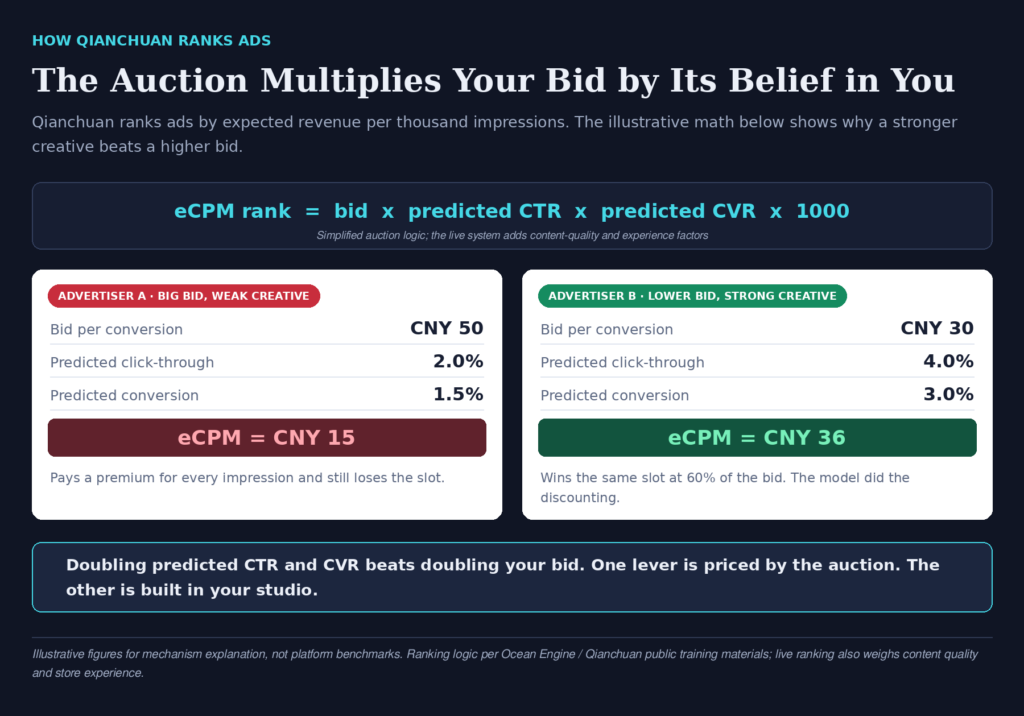
So when raising your bid does nothing, the equation is telling you something polite but brutal: the constraint is not your money. It is the multiplier. Bid-only optimization fights the math. Creative and conversion quality use the math.
Quanyu vs standard: two philosophies of control
Before Chengfang, the platform’s big fork was standard promotion versus Quanyu — whole-domain promotion. Standard campaigns optimize paid traffic: you pick audiences, set bids, and the system hunts conversions inside ad inventory. Quanyu flips the objective. Per the official product documentation in the Douyin E-commerce Learning Center, one “super plan” per account optimizes the entire livestream room’s payment ROI — paid and organic traffic together — across the feed, the livestream plaza, the mall and search.
Two details from that documentation deserve more attention than they usually get. First, switching on whole-domain livestream delivery immediately pauses every other non-whole-domain livestream campaign on the same account, brand contract buys excepted. This is not a mode you A/B test casually; it is a regime change. Second, the platform claims whole-domain delivery lifts total livestream GMV by 15–20% at stable ROI, with ROI attainment above 90% — and explicitly notes these figures are medians from internal beta clients. Vendor-reported, favorable-sample, your-mileage-varies. Treat them as a hypothesis to test, not a promise to book.
The philosophical shift matters more than the toggle: you stop managing campaigns and start managing a target. Which brings us to 2026.
Chengfang: three engines, one ledger
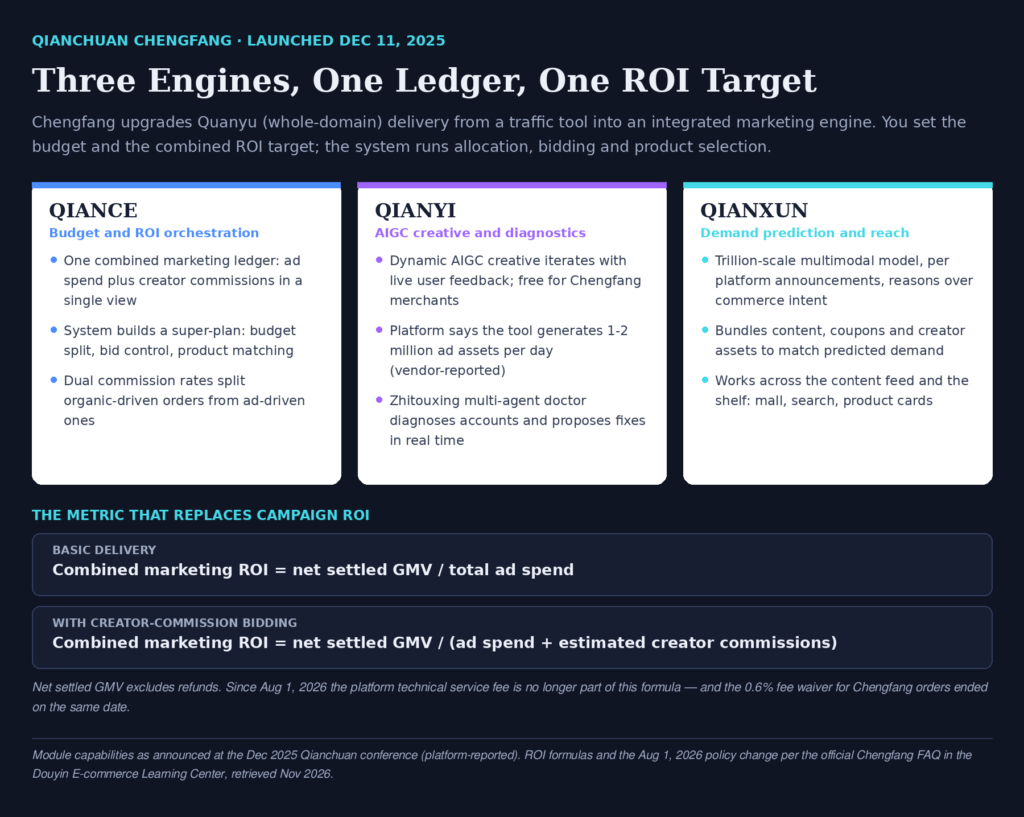
At the Qianchuan conference in Shanghai on December 11, 2025 — months after the Qianchuan team was folded into the Douyin e-commerce business unit in March 2025 — the platform launched Chengfang, an upgrade built on top of whole-domain delivery. Official launch materials describe three modules, and the names are worth knowing because your account team will use them constantly.
Qiance: the budget brain
Qiance integrates budget and ROI into one instruction. You set total budget and a combined ROI target; the system builds the super plan, allocates spend, adjusts bids and matches products. The genuinely new part is the ledger: ad spend and creator commissions get accounted together, so the system can shift money toward whichever business lever — not whichever campaign — returns more. A dual-commission structure splits orders driven by a creator’s organic reach from orders driven by your ad spend, with different rates for each. The failure mode changes accordingly. You no longer lose money mainly by setting the wrong bid. You lose it by setting the wrong target.
Qianyi: creative becomes infrastructure
Qianyi is the AIGC layer: dynamic creative generation that iterates against live user feedback, plus Zhitouxing, a multi-agent diagnostic assistant that reads your account and proposes fixes. The platform says the creative tooling generates one to two million marketing assets per day across merchants — a vendor-reported figure, free of independent audit, but directionally consistent with what operators see in their asset libraries. The strategic read: creative volume is now nearly free. Creative direction — the brief, the claim library, the angles worth testing — becomes the scarce input. AIGC multiplies whatever you feed it, including mediocrity.
Qianxun: the prediction layer
Qianxun is the recommendation engine underneath, built on what official announcements call a trillion-scale multimodal parameter model trained on Douyin’s viewing and commerce behavior. (You may see the name “LMC3” in practitioner videos; it does not appear in the written official announcements, so treat it as informal shorthand.) The pitch is that the model reasons about why a user might buy — someone binge-watching winter travel content gets cold-weather gear recommendations bundled with a coupon and a creator review — rather than merely matching keywords. The operator implication is the flywheel: paid traffic validates content, validated content earns organic distribution, and acquisition costs fall. The trap is measurement: organic lift caused by your ads still shows up looking like “free” traffic. Platform ROI is not incremental ROI. Keep running holdouts.
The metric that now runs your account
Under Chengfang, the core bidding metric is combined marketing ROI, and the official FAQ defines it precisely. With basic delivery, it equals net settled GMV divided by total ad spend — the same yardstick as whole-domain net-settled ROI. Switch on creator-commission bidding and the denominator grows: net settled GMV divided by ad spend plus estimated creator commissions. Your ROI number will drop when you enable that. Nothing got worse. The ruler got more honest.
And the ruler keeps changing. The official GMV caliber manual documents two upgrades: since July 1, 2025, payment GMV excludes refunds issued within one minute of payment in livestreams plus same-day abnormal orders; since July 1, 2026, it also excludes one-minute refunds on cart add-on (“filler”) purchases. Historical data is not restated. In December 2025 the platform also auto-switched volume-maximizing campaigns to net-settled bidding. If your dashboard ROI “fell” around any of these dates, check the caliber before you check your creative. Compare like with like, or you will kill winning plans and nurse losing ones.
One more timeline correction that many 2026 playbooks still get wrong: the celebrated 0.6% technical service fee for Chengfang orders — announced in January 2026 across all categories and both content and shelf scenarios — ended on August 1, 2026. The official FAQ is explicit: orders through July 31 keep the old treatment; new orders after that do not, and the service fee left the combined ROI formula on the same date. Budget accordingly.
The learning phase: patience is a strategy
Ocean Engine’s official cold-start documentation defines the learning phase cleanly: a conversion-bid campaign that accumulates 20 conversions within four days of first delivery passes; one that doesn’t, fails. Click- or impression-billed campaigns carry no learning label at all. Practitioner folklore quotes other thresholds — treat those as heuristics, not platform law.
What is law, in effect, is the list of things that interrupt learning. The official troubleshooting guidance and Chengfang FAQ keep repeating the same sins: frequent start-stop cycles, big bid swings, deleting your top-spending creative, budgets that hit their cap by lunch. After the August 2026 policy change, the platform’s own advice was to hold ROI targets steady for seven days and keep any single adjustment under 5%. That is not a vibe. That is the vendor telling you, in writing, that fidgeting costs money.
So the discipline is boring and hard: give a new plan at least three continuous days, per official guidance; judge full-day trends, not hourly moods; and when performance slides, diagnose before touching. Signal starvation, creative fatigue, a wrong target and a compliance flag look identical on a bad afternoon — and demand opposite treatments.
What the model rewards: the signal hierarchy
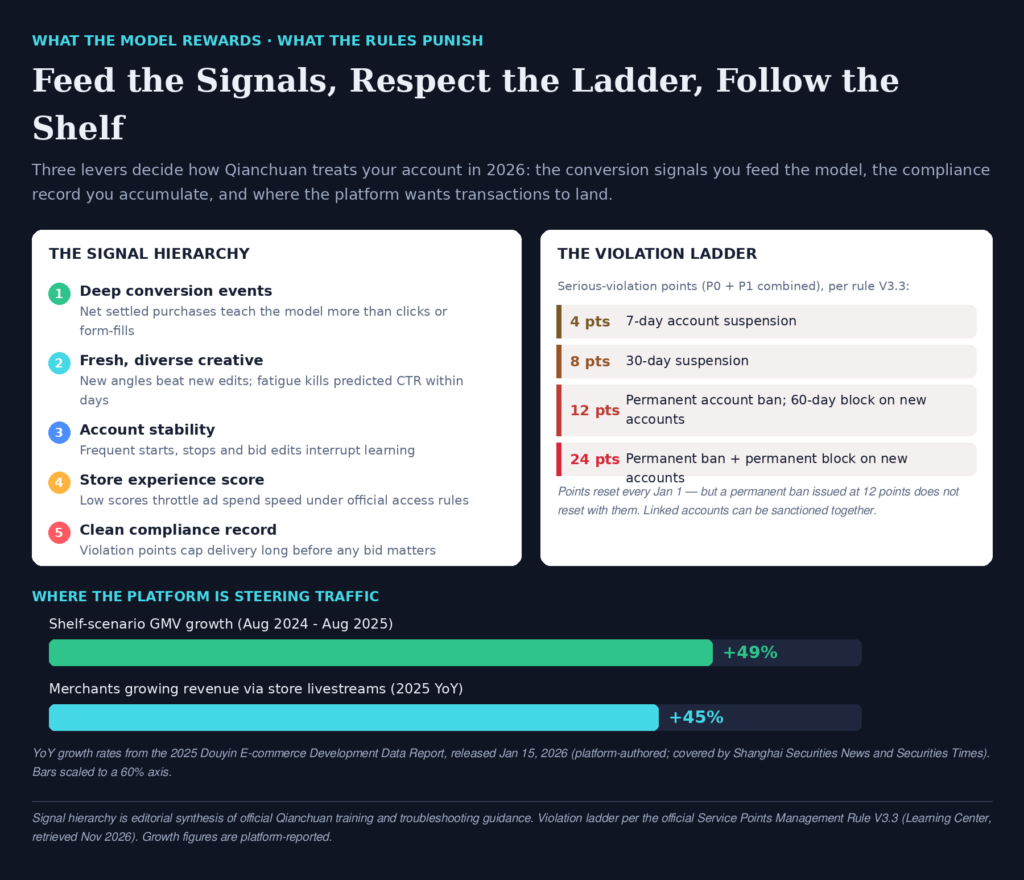
Pull the threads together and a hierarchy emerges. Deep, recent conversion events teach the model most — a net settled purchase beats a click, which is why refund-heavy “winning” products quietly poison accounts. Fresh creative in genuinely different angles keeps predicted CTR alive; practitioners widely report fatigue within days, and the platform’s guidance to keep replenishing assets agrees. Account stability protects the learning investment. Your store experience score gates the whole party: official rules state that low scores throttle ad spend speed, and certain brand ad products carry explicit score floors. And your compliance record sits above everything, because no bid survives a suspended account.
The compliance ladder: resets, and what doesn’t reset
Here we must correct a rumor that spread through operator circles in 2026: the claim that Qianchuan violation points became permanent, never resetting. The official Service Points Management Rule V3.3 says otherwise. Points accumulate annually and reset to zero at midnight on January 1 — the reset just doesn’t cancel penalties already in force.
But before you relax, read the ladder. Serious-violation points (the severe P0 and P1 tiers pool together) trigger a 7-day account suspension at 4 points, 30 days at 8 — and at 12 points, a permanent account ban, with new-account creation blocked for 60 days; at 24 points, both bans are permanent. General violations run 3, 7 and 30 days at 12, 24 and 36 points, repeating every 12 thereafter. Linked accounts under the same controller can be sanctioned together, and the appeal window is three working days. So the accurate story is sharper than the rumor: the counter resets; the execution at 12 points does not. One fraudulent qualification document can end an account permanently, reset or no reset. Compliance hygiene is not paperwork. It is capital protection.
Traffic politics: follow the shelf
Ad systems follow platform strategy, and Douyin’s strategy is written in its annual data report. The 2025 Douyin E-commerce Development Data Report, released January 15, 2026 and covered by Shanghai Securities News and Securities Times, reports shelf-scenario GMV up 49% year over year (August 2024 to August 2025), and a 45% increase in merchants growing revenue through their own store livestreams. These are platform-authored numbers — no independent audit — but the steering is unmistakable: the platform wants transactions landing on shelves and in store-run livestreams, and its 2026 policy package explicitly promises more organic reach for good commerce content without paid boosting.
The operator move is alignment. Build product cards worth ranking. Run your own livestream, not just creator rentals. Make creative that survives the trip from feed to shelf. You are not fighting the current; you are asking where it flows.
The human levers that remain
Automation took the joystick, not the job. What remains yours: defining conversion events and wiring deep ones properly; the offer and its pricing; creative direction and the claim library AIGC draws from; the ROI target, grounded in your actual break-even math rather than category folklore; kill rules and holdout tests; and compliance hygiene. What to stop doing: hourly bid tweaks, fragmenting spend across dozens of plans, editing creative mid-learning, and deleting top assets because a Tuesday looked soft.
Failure modes and honest boundaries
Three caveats keep this piece honest. First, most performance figures quoted anywhere about Qianchuan — including the ones here — originate from the platform itself; the vendor is also the referee, so run your own lift tests. Second, product names, fee policies and metric calibers changed three times in twelve months; the mechanism logic in this article is the durable layer, the specifics are dated November 2026 and must be re-checked at execution against the Learning Center’s rule pages. Third, “the system is still exploring” is sometimes true and sometimes a polite cover for audience saturation. The difference shows up in your data — frequency climbing, CTR sagging, CPM rising on unchanged creative — not in your account manager’s reassurance.
Summary
Qianchuan is not an auction you win with money; it is a prediction machine you feed with signals. The ranking math discounts strong creative and taxes weak creative regardless of bid. Chengfang consolidated budget, commissions and creative into one ROI instruction — which moved the operator’s job from bid micro-management to target-setting, signal quality and compliance. The counter resets every January; permanent bans don’t. The traffic is drifting shelf-ward. Feed the model deep conversions, fresh angles and a clean record, hold your targets steady, measure incrementality — and let the black box do the part it is genuinely better at.