Here is the strangest fact in Chinese social marketing: the platform most famous for authentic recommendation posts also runs the tooling that makes paid promotion fully legal — and most enforcement pain lands on teams trying to avoid that tooling. Xiaohongshu built Pugongying, its official brand–creator marketplace, precisely so commercial seeding could happen in daylight. Yet the accounts getting banned by the million belong to brands and agencies routing around it: unregistered deals, copy-paste notes, device farms, AI ghostwriters. If you run seeding on this platform, the question is not how to hide. It is how to operate so there is nothing to hide. This playbook walks through what detection actually looks for, what five years of enforcement receipts tell us, and the operating rules that let seeding scale without betting your brand’s search page on luck.
The Seeding Paradox
Xiaohongshu — RedNote to newer international users — serves more than 300 million monthly active users, and its own disclosures describe a platform where roughly seven in ten monthly users search, generating hundreds of billions of queries a year. People arrive with purchase questions. The answers they trust are first-person experience notes, the format locals call planting grass. That trust is the entire commercial asset. A fake note does not just mislead one reader; it devalues every honest note around it. Which is why the platform defends authenticity the way a bank defends its vault — and why, in 2026, it has the receipts, the models and the court judgments to do it.
What Actually Gets Flagged
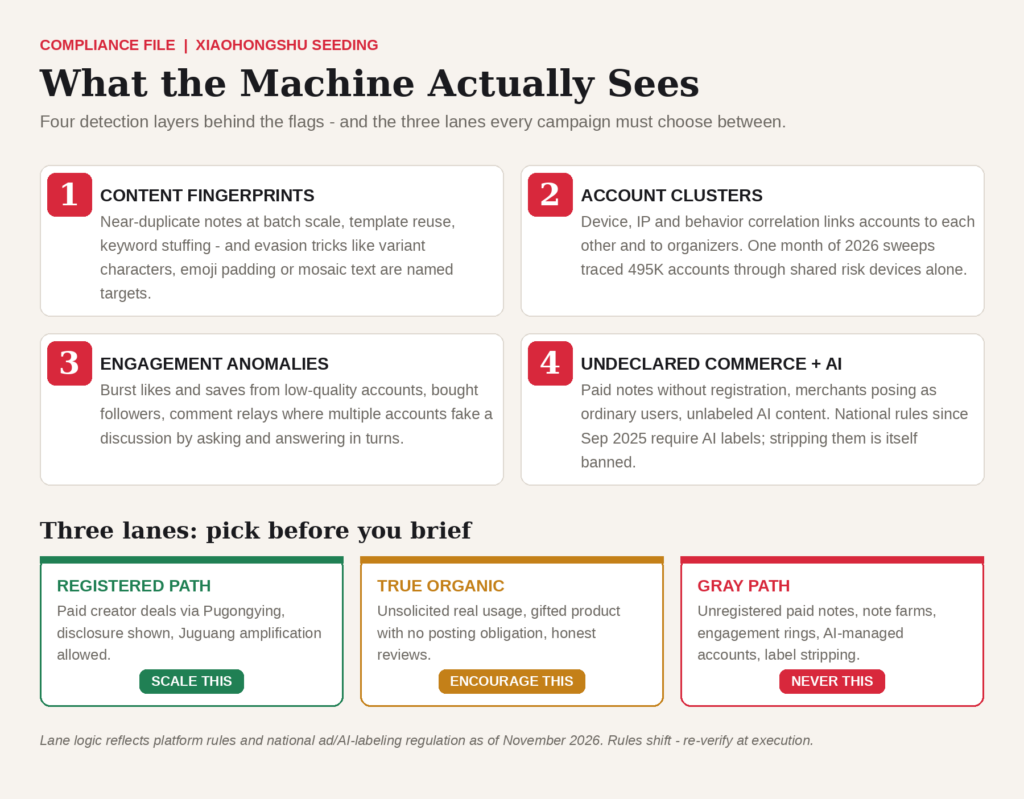
Strip away the rumors about shadow-bans and the detection surface is fairly legible. Four layers do most of the work.
Content fingerprints come first. Near-duplicate notes published at batch scale, template reuse, keyword stuffing. The November 2026 enforcement notice goes further and names the evasion tricks themselves: variant characters, emoji padding, mosaic-covered text. If your agency’s differentiation strategy is swapping a few synonyms, you are describing a pattern the platform explicitly hunts.
Account clusters come second, and they are the layer most brands underestimate. Device, IP and behavioral correlation tie accounts to each other and to the organizations behind them. In one month of 2026 sweeps, the platform traced 495,000 violating accounts through associated risk devices alone. Your notes are not judged as isolated posts; they are judged as a graph.
Engagement anomalies come third: burst likes and saves from low-quality accounts, bought followers, and the comment-section relay where multiple accounts fake a discussion by asking and answering in turns. The November notice treats coordinated comment marketing as a named violation category, not a gray area.
The fourth layer is undeclared commerce and AI. Paid notes without registration, merchants posting in a fake consumer voice — including fake help-me-choose posts that recommend their own product — and unlabeled AI content all sit here. Since September 2025, national rules require AI-generated content to carry labels, and stripping those labels is itself prohibited.
The Receipts: Five Years of Enforcement
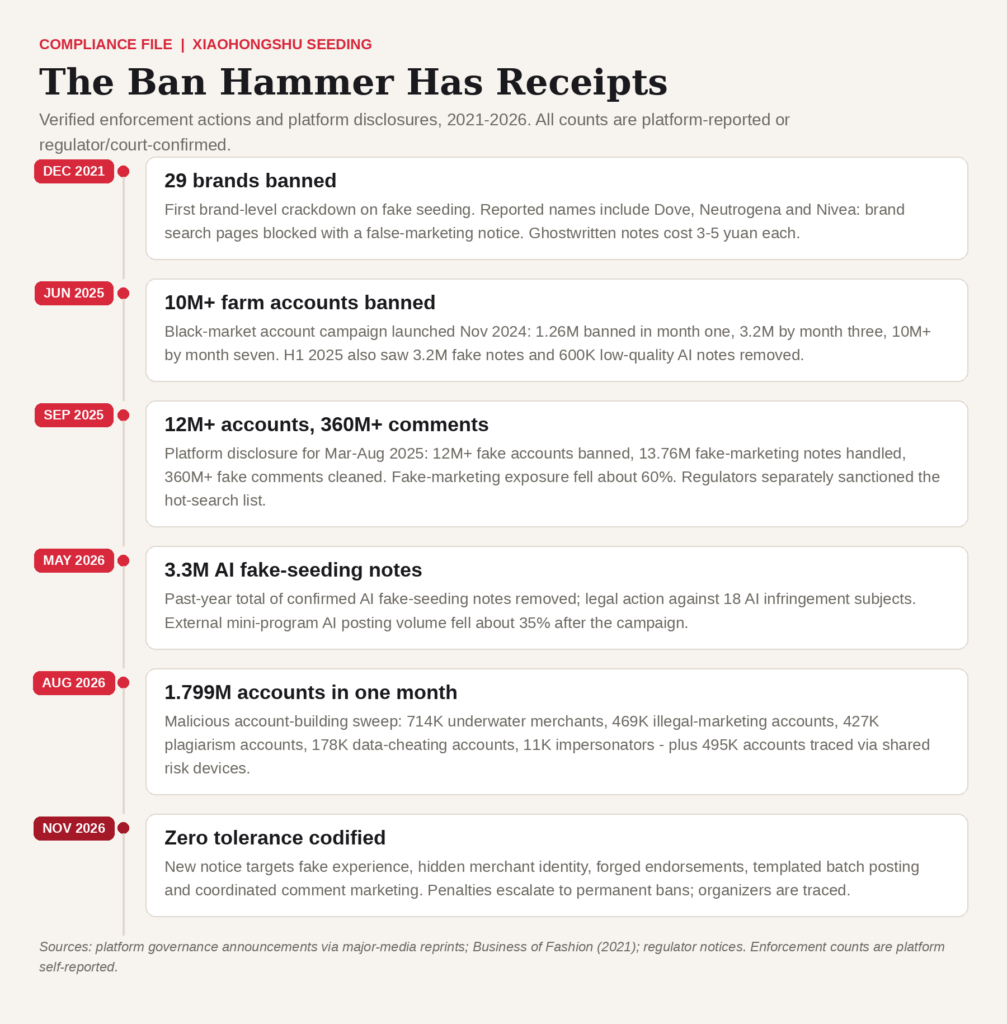
This is not theoretical risk. In December 2021, Xiaohongshu banned 29 brands in its first brand-level fake-marketing crackdown; search pages for names reportedly including Dove, Neutrogena and Nivea returned a blunt notice that the brand was suspected of false marketing and its content would not be shown. The economics underneath were absurd: investigative reporting found accounts with fewer than 200 followers earning three to five yuan per copy-pasted note. One third-party data snapshot from that period showed over 1,200 brand-related notes for Nivea in a month against just nine registered commercial notes. The gap between those numbers was the gray economy.
The machine scaled up fast. A farm-account campaign launched in November 2024 banned 1.26 million accounts in its first month, 3.2 million by month three, and over 10 million by month seven. At its June 2025 governance open day, the platform reported 3.2 million fake notes and 600,000 low-quality AI notes removed in half a year, powered by fifteen large detection models for content and more than fifty for account farms — with homogenization-based identification lifting recall by 72 percent. It also introduced a sincerity-score system that tilts traffic toward accounts judged genuine. Read that twice: compliance is not just penalty avoidance; it is a distribution input.
Three months later came the biggest disclosure yet: for March through August 2025, over 12 million fake accounts banned, 13.76 million fake-marketing notes handled, more than 360 million fake comments cleaned, and fake-marketing exposure down about 60 percent. That September, regulators separately sanctioned the platform’s own hot-search list for celebrity-gossip pollution — a reminder that Xiaohongshu itself answers to Beijing, and passes the pressure down.
2026 added three more markers. In January, Community Convention 2.0 merged the community and commercial rulebooks into 25 provisions across three sections, explicitly rejecting fake personas, disguised-ordinary-user marketing and undisclosed AI assistance. In April, three national regulators jointly summoned Xiaohongshu, Douyin and Taotian over the Youthit supplement scandal, where a brand’s claimed Melbourne address turned out to be an auto repair shop. And in August, a single month’s sweep handled 1.799 million accounts — 714,000 of them underwater merchants selling through DMs without disclosed business identity.
The Registered Path Is the Only Scalable Route
The legal path has a name: Pugongying, the platform’s official collaboration marketplace. A brand orders a creator deal inside it, the note carries a disclosure label, settlement is recorded, and the content passes platform review before it runs. Registered notes can then be amplified through Juguang, the ads system — unregistered notes cannot. Custom-cooperation notes are locked against deletion for thirty days, which sounds like a constraint until you realize it is also your proof of performance. Entry barriers are lower than most teams assume: widely reported current rules put creator eligibility at 1,000 followers, down from an older 5,000 bar, with modes spanning custom deals, open recruitment, small-creator programs and performance-based co-creation.
The Insurance Math
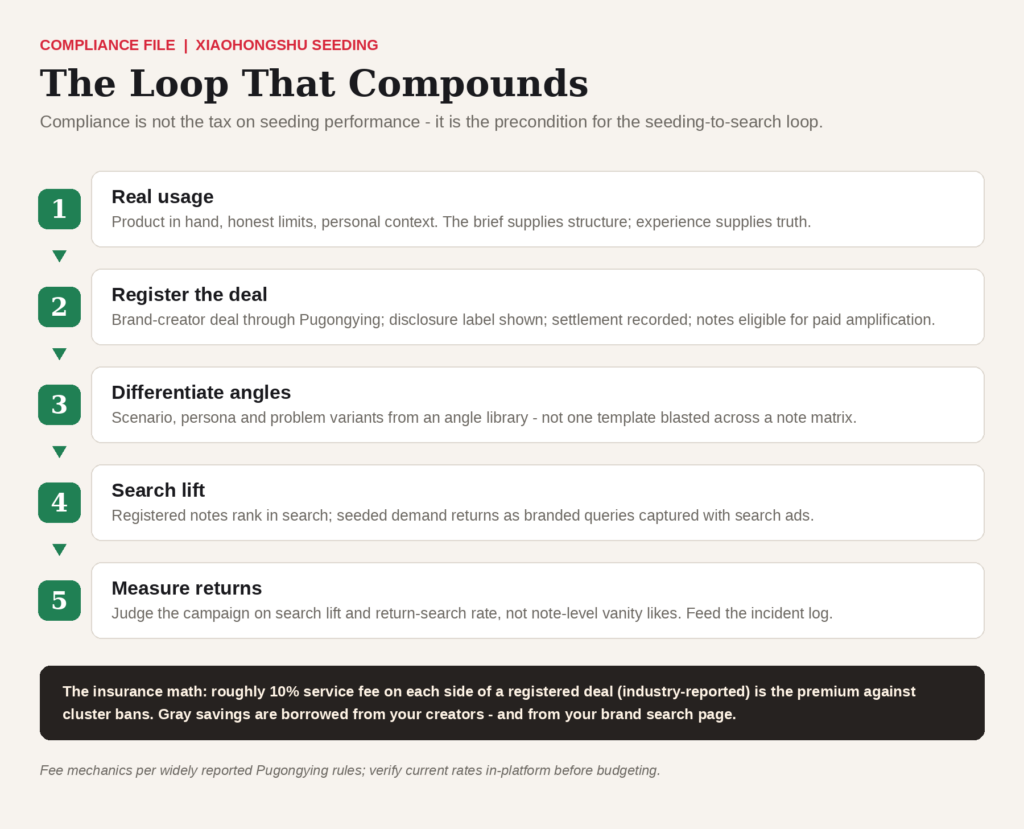
Yes, registration costs money. Industry-consistent reporting describes roughly a 10 percent service fee on each side: a creator quoting 100 gets 90, the brand pays 110. Teams treat that spread as a tax. Reframe it as an insurance premium. What does the premium buy? Immunity from the unregistered-commerce flag, eligibility for paid amplification, verified data, enforceable settlement — and distance from the account-cluster machinery that banned ten million farm accounts. What does going gray buy? A twenty percent-ish saving, externalized risk landed on your creators, and a brand-level search block as the tail outcome. The 2021 brands did not lose a campaign; they lost their search page. No media discount compensates for that.
Content That Reads Native Without Lying
Here is the part compliants get wrong: registered does not mean robotic. The disclosure label handles legality; the content still has to earn attention. The rule that survives every policy update is real usage. Product in hand, honest limits, personal context — the brief supplies structure, experience supplies truth. A note that says the serum stings for the first two days but settled by week two outperforms a flawless rave, because readers are pattern-matching for the texture of honesty. Academic fieldwork backs this: a nine-month ethnography of the platform’s creator economy, published at CSCW 2025, found marketers explicitly selecting creators who sound convincing but not too professional. The native feel is the product. You cannot fake it at scale — that is literally what the detection models are trained to catch.
Differentiation at Scale
So how do you run fifty notes without fifty clones? Angle libraries, not copy matrices. Build variants by scenario (commute, gym, travel), persona (student, new parent, night-shift nurse) and problem (sensitivity, budget, time). Each creator gets a distinct angle plus their own experience; nobody gets a fill-in-the-blank template. Company-owned account matrices can be legitimate when ownership is documented and each account genuinely tests different angles — but the moment the matrix becomes one template wearing fifty avatars, you have rebuilt the farm the platform bans. The difference is not cosmetic; it is the difference between an experiment and a fingerprint.
Claim Discipline
China’s Advertising Law and the platform’s rules agree on the red lines: no absolute claims, no medical or efficacy promises a cosmetic cannot keep, no invented timelines. The November 2026 notice names exaggerated efficacy and forged endorsements — borrowed celebrity names, fake expert backing — as violations. Build a claim library with an evidence annex per claim, and give creators the approved wording rather than letting them improvise under deadline. One rogue seven-day cure sentence can taint an otherwise clean campaign.
Account and Operation Hygiene
One person, one account is the platform’s reality; document any company-owned accounts with an ownership ledger and permissions. What kills clusters is well known: shared devices and IPs, synchronized posting schedules, engagement rings, purchased followers. And because platform risk assessment accumulates history, a burned device does not get forgiven when you swap the SIM. On the creator side, remember the human. The CSCW researchers found KOC payments routinely lumped into KOL budget lines, the labor invisible in corporate paperwork — sixteen creators and eight practitioners interviewed across nine months described work that is indispensable yet unrecognized. Teams that pay fairly, brief clearly and register properly are not just being ethical; they are keeping the supply side of their channel alive.
The AI Line: Assist Yes, Automate No
The AI question has a clean answer in 2026, and it is written in both regulation and case law. National labeling rules effective September 2025 require explicit and implicit labels on AI-generated content, obligate users to declare it when posting, and ban maliciously deleting or hiding labels — or building tools that do. Xiaohongshu’s own position draws three lines: AI assistance on real experience is welcome for polishing, formatting and templates; AI-generated or assisted content must be declared with the platform’s label; AI-managed accounts and fabricated-experience content are strike targets. The numbers behind that stance: over 3.3 million confirmed AI fake-seeding notes removed in a year, more than 1.1 million AI-managed accounts handled, and external mini-program AI posting down about 35 percent after dedicated action.
Then there is the judgment every operator should read. In China’s first AI-ghostwriting unfair-competition case, a paid tool marketed modules for one-click Xiaohongshu seeding copy that fabricated first-person experiences — memberships from 40 yuan a month. The Hangzhou Internet Court found unfair competition in February 2025; on final appeal in August 2025, the Hangzhou Intermediate People’s Court affirmed liability under the Anti-Unfair Competition Law’s general clause and settled damages at 100,000 yuan, applying a four-factor duty-of-care test for AI providers: generative service, targeted at a specific platform, inducing fabrication, run for profit. The court’s protected interest was the authentic content ecosystem itself. Translation for your team: the tool vendor is liable, and so is the brand that publishes the fabricated experience. Labeling tells readers who made the content; it never certifies the content is true. One reported Beijing case cuts the other way, too — a court found a platform breached contract by muting a user on algorithm-only AI suspicion without adequate explanation. Keep your drafts and source material; false positives happen, and evidence wins appeals.
Why Compliant Seeding Still Wins: The Search Loop
The strategic reason to stay registered is not fear. It is that seeding’s real payoff arrives through search. A reader sees a note, remembers the brand, and days later types the brand name into the search bar — the return-search behavior practitioners treat as the truest seeding KPI. Registered notes keep ranking; Juguang search ads catch the returning demand; the loop compounds. Gray notes are one enforcement sweep away from invisibility, and an invisible note generates zero return searches no matter how native it read. Compliance does not kill performance. Invisibility does. Measure search lift and return-search rate at campaign level, not likes at note level, and the registered path wins on the spreadsheet too.
When a Note Gets Flagged: The Crisis Playbook
Triage before panic. A single-note violation is a content problem; a cluster signal is an operations problem — and the treatments differ. Pause affected posting, audit the batch for fingerprints and shared infrastructure, and file the appeal: the platform’s published process promises human review within 48 hours through in-app account appeal. Talk to your creators immediately; ghosting the KOC whose account got restricted poisons the well you drink from. Log every incident — trigger, evidence, outcome — into your SOP library, because the November notice makes repeat counts escalate penalties. Your incident log is how the organization stops paying tuition twice.
The Explicit Ban List
No ambiguity here: unregistered paid deals at scale; note farms and bought engagement; comment relays; AI-managed accounts; label stripping; fabricated personal experience; medical or absolute claims; merchants in consumer cosplay. Every item maps to a named violation category in current announcements. If a vendor’s proposal requires any of them, the proposal is the problem.
Managing Agencies and Creators
Put the compliance in the contract: a registered-path clause, a content-differentiation standard, account-ownership documentation, and liability allocation for violations. The 2021 crackdown caught brands whose agencies ran gray operations without telling them — regulators and platforms do not accept the agency did it as a defense. Brief creators with the usage requirement, the approved claim library and the disclosure duty in writing. Pay on time, at registered rates. The cheapest seeding contract is the one that never triggers a cluster investigation.
Pre-Launch Checklist and Honest Boundaries
Before any campaign ships: deals registered, claims evidenced, AI usage declared, account ownership documented, angles genuinely differentiated, appeal path known. And one honest boundary: no playbook guarantees zero flags. Detection makes mistakes; rules shift — re-verify the current convention and notices at execution time. The goal is defensible compliance plus fast appeal, not evasion. What survives every policy cycle is the durable layer: real usage, registration, differentiation.
The Takeaway
Xiaohongshu turned authenticity into infrastructure — sincerity scores in the algorithm, disclosure labels on the content, court judgments protecting the ecosystem itself. You can experience that machinery as a threat or as a moat. The brands that treat the registered path as their operating system get amplification rights, clean data, durable search presence and creators who stay. The ones chasing the twenty percent discount are renting space in a graph that gets swept by the million. Seed like a citizen: real experience, declared commerce, distinct angles. The platform’s entire enforcement apparatus is, functionally, your competitive advantage — every fake note it removes makes your honest one worth more.