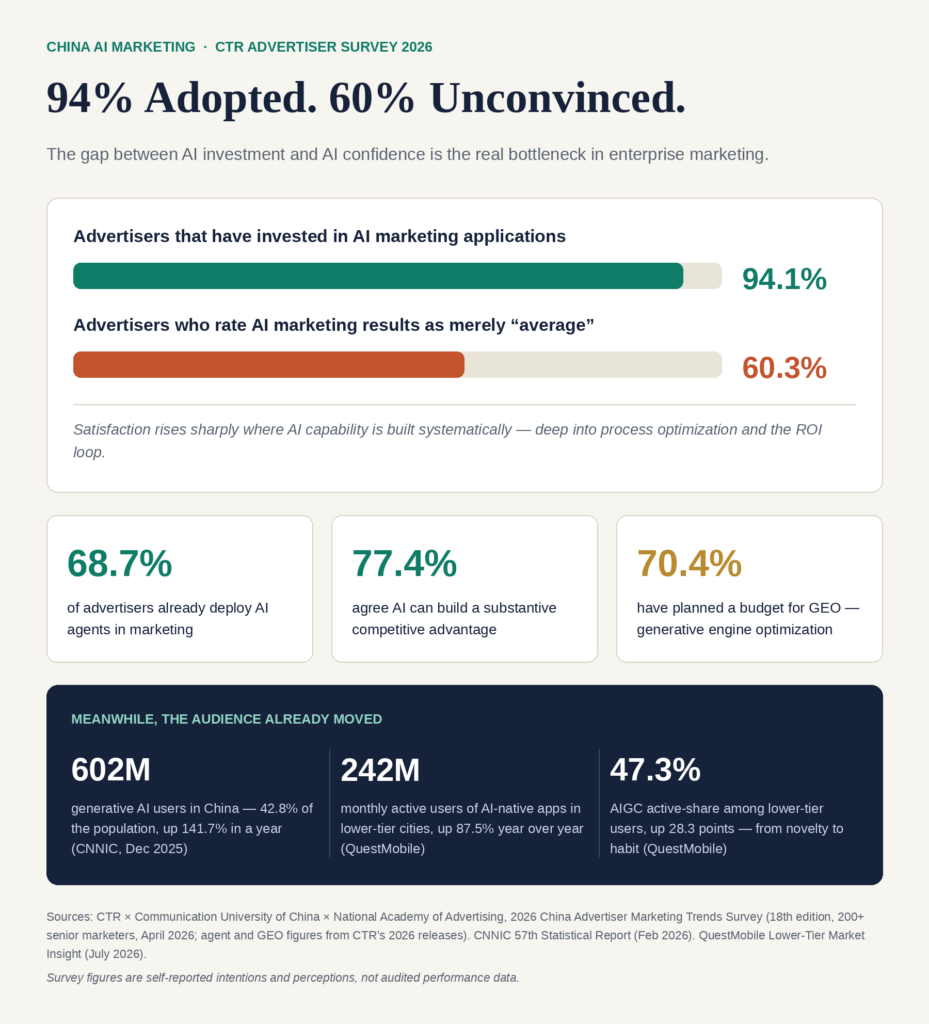
Here is a number that should keep every CMO awake: 94.1% of Chinese advertisers have already put money into AI marketing. And here is the number sitting right next to it: 60.3% of those same advertisers rate the results as merely “average.” Both figures come from the same survey — CTR’s 2026 China Advertiser Marketing Trends report, released in April with the Communication University of China and the National Academy of Advertising, now in its 18th consecutive year, drawing on in-depth interviews with senior marketing leaders at more than 200 companies.
Read those two numbers together and you get the defining paradox of AI marketing in 2026: adoption is nearly universal, conviction is not. The tools are in the building. The belief hasn’t moved in.
Why? The lazy answer is “the models aren’t good enough.” The better answer — the one CTR’s own data points toward — is that teams don’t dare ship what they can’t verify. The survey found that advertisers who build AI capability systematically, pushing it deep into process optimization and the ROI loop, report significantly higher satisfaction. The gap isn’t intelligence. It’s trust.
Why the Audience Makes This Urgent
You could shrug at advertiser ambivalence if consumers were ambivalent too. They aren’t. CNNIC — China’s official internet statistics body — reported in its 57th Statistical Report that generative AI users reached 602 million by December 2025, a 42.8% penetration rate, up 141.7% in a single year. That’s a government-counted figure, not a vendor forecast.
The shift runs deepest where marketers least expect it. QuestMobile’s July 2026 lower-tier market report found 242 million monthly active users of AI-native apps in third-tier cities and below, up 87.5% year over year, with AIGC active share hitting 47.3% — a 28.3-point jump. Your customers in county-level towns are asking AI assistants what to buy. Meanwhile the supply side is ballooning: iiMedia Research, a commercial research firm, estimates China’s AI large-model market at ¥49.5 billion in 2025, up 68.4% — a consultancy estimate rather than audited revenue, but directionally consistent with everything else.
The audience moved. The money moved. What didn’t move is the enterprise’s willingness to trust its own output. That’s the bottleneck this article is about.
Anatomy of the Distrust: Five Fears, One Pattern
Ask a marketing team what scares them about AI and you’ll hear the same inventory, in roughly this order: hallucinated claims published under the brand’s name; confidential data leaking into public models; unlicensed faces and voices in generated assets; ROI nobody can defend to the CFO; and labeling violations that turn a campaign into a regulatory incident.
Now look closer. Every one of those fears maps to a missing verification step — not a missing model. Hallucinated claims survive because nobody traces them to sources. Data leaks happen because nobody wrote down what may enter a prompt. The pattern is remarkably consistent: teams buy capability, skip verification, then experience the resulting incidents as “AI being unreliable.”
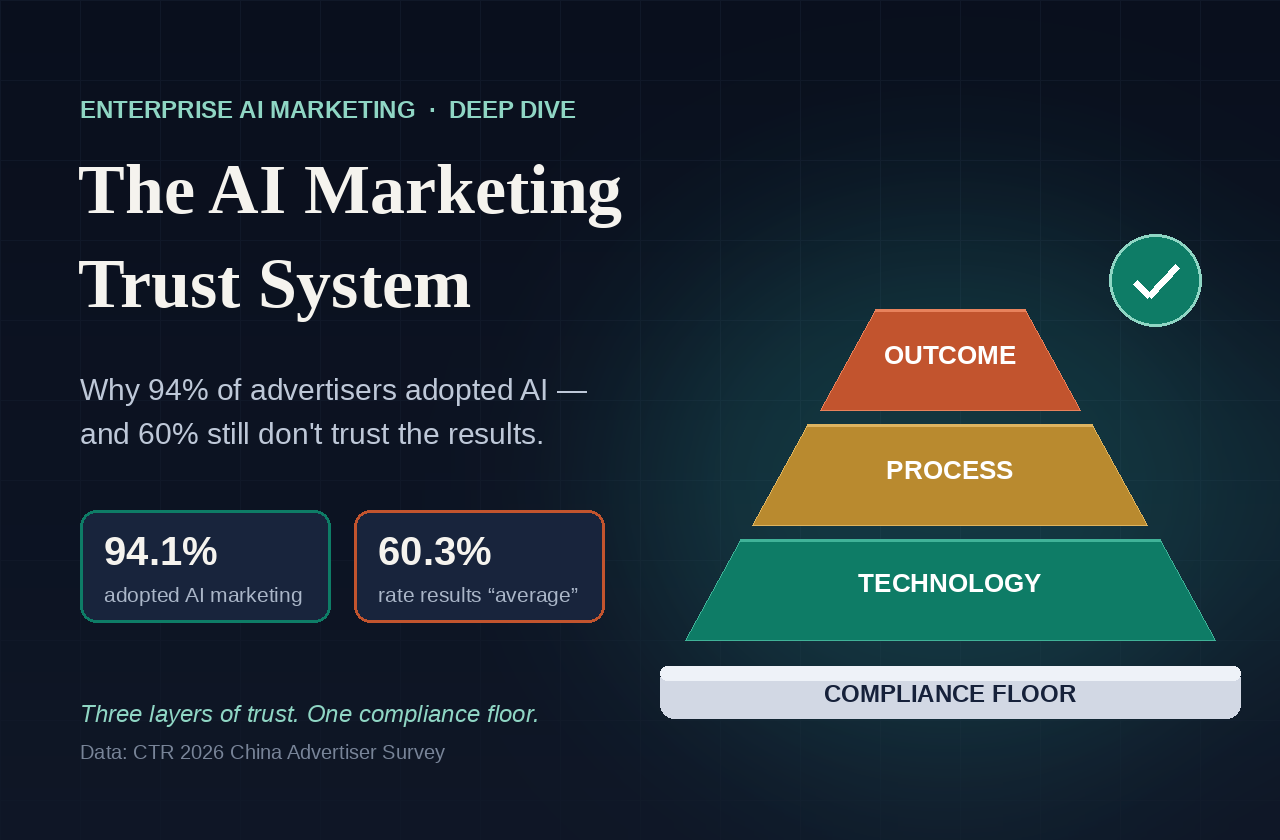
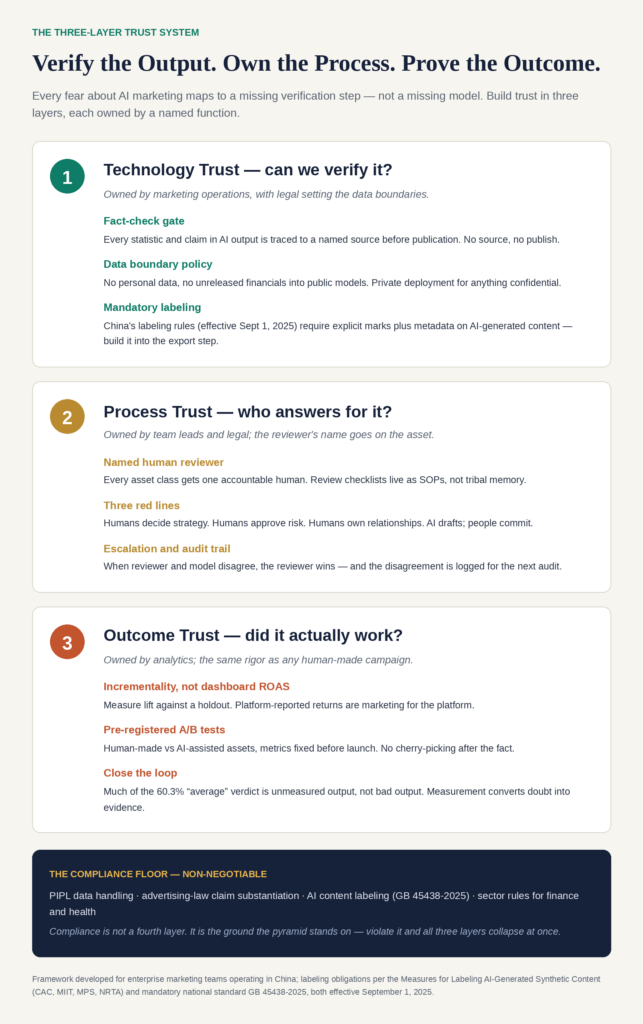
The fix is a trust system with three layers — technology trust, process trust, outcome trust — standing on a compliance floor. Let’s build it.
Layer 1: Technology Trust — Can We Verify the Output?
Technology trust answers one question: can anything this model produces be checked before a customer sees it?
The fact-check gate. Every statistic, every claim, every “studies show” in AI-generated copy gets traced to a named, checkable source before publication. No source, no publish. This sounds slow; in practice it catches the one sentence per campaign that would have caused the incident. It also happens to be exactly what AI search engines reward — verifiable, source-anchored content is what gets cited in AI answers, so the gate pays twice.
The data boundary. Write down, explicitly, what may enter a prompt: no personally identifiable information, no unreleased financials, no customer lists. This is not paranoia. Cisco’s 2025 Data Privacy Benchmark Study — a survey of roughly 2,600 privacy and security professionals across 12 countries, conducted by a security vendor with an obvious commercial interest in the findings — found 46% admitting employee information had been entered into generative AI tools, 42% non-public company information, and 31% customer data. Even the professionals who worry about leakage (64% of them) do the leaking. A written boundary plus approved tooling beats intentions every time. For anything confidential, use private deployments or enterprise API tiers with contractual no-training terms — and verify those terms, don’t assume them.
The Labeling Law Is Now Part of Your Stack
If you market in China, technology trust has a statutory component. The Measures for Labeling AI-Generated Synthetic Content, issued jointly by four departments — the Cyberspace Administration of China, MIIT, the Ministry of Public Security, and the National Radio and Television Administration — took effect on September 1, 2025, alongside a mandatory national standard, GB 45438-2025, that specifies exactly how labeling works.
The structure is dual: explicit labels that users can perceive (text notices, visual marks, audio cues) plus implicit labels embedded in file metadata identifying the content as AI-generated, the provider, and a content ID. Distribution platforms must check metadata and flag suspected AI content that arrives unlabeled. Users publishing AI-generated content must proactively declare it and apply the platform’s labeling function; maliciously deleting, tampering with, forging, or hiding labels is prohibited. There’s a narrow path to unlabeled exports — the provider must define responsibilities in the user agreement and retain logs for at least six months — but the declaration duty follows the content wherever you publish it.
Practical translation: labeling belongs in your export pipeline, not in a compliance memo. The team that wires metadata and visible marks into the asset-production step never thinks about this again. The team that doesn’t will discover the rule through a platform takedown.
Layer 2: Process Trust — Who Answers for This Asset?
Technology trust makes output checkable. Process trust makes someone responsible for checking it.
A named human reviewer per asset class. Ad copy, landing pages, social posts, generated video — each class gets one accountable name. Not “the team reviews it.” A person, written into the workflow. Accountability that belongs to everyone belongs to no one.
Checklists as SOPs. The reviewer’s judgment should be captured in a written checklist — claims substantiated, data boundary respected, labels present, brand voice intact — so review quality doesn’t depend on who’s on leave.
The three red lines. Humans decide strategy. Humans approve risk. Humans own relationships. AI drafts, generates, and accelerates everything in between; people commit. Teams that blur these lines don’t get faster — they get incidents that end with a blanket AI ban.
Escalation and the audit trail. When reviewer and model disagree, the reviewer wins, and the disagreement gets logged. That log is not bureaucracy; it’s your evidence in an audit, your training data for better prompts, and your defense when someone asks why a claim shipped.
Layer 3: Outcome Trust — Did It Actually Work?
Here’s the layer almost everyone skips, and the one that explains most of that 60.3% “average” verdict.
When a team can’t measure what AI contributed, it defaults to a shrug. The output might be excellent — but unmeasured excellence feels identical to mediocrity in a budget meeting. Much of the dissatisfaction in CTR’s survey plausibly reflects unmeasured output rather than bad output; the survey itself shows satisfaction climbing where AI reaches the ROI loop.
So measure AI-assisted campaigns with the same rigor as human ones. That means incrementality testing with holdouts, not platform-reported ROAS — which is, let’s be honest, marketing for the platform. It means A/B tests of human-made versus AI-assisted assets with metrics pre-registered before launch, so nobody cherry-picks the flattering segment afterward. And it means publishing results internally, wins and losses alike. Outcome trust closes the loop: the team stops arguing about whether AI “works” and starts knowing where it works.
The Compliance Floor Is Not a Fourth Layer
Underneath all three layers sits compliance: China’s Personal Information Protection Law for data handling, advertising-law requirements that claims be substantiated, the labeling regime described above, and stricter sector rules if you’re in finance or health.
The distinction matters. Layers are things you build incrementally; the floor is binary. You cannot be 70% compliant. And when the floor gives way — a data violation, a fraudulent claim, an unlabeled deepfake — all three layers collapse simultaneously, because every verification step you built is suddenly suspect. This is why the floor comes first in the build sequence even though it sits last in the diagram.
Two Paths: The Ban and the Dividend
Consider two composite patterns — illustrative, not case studies.
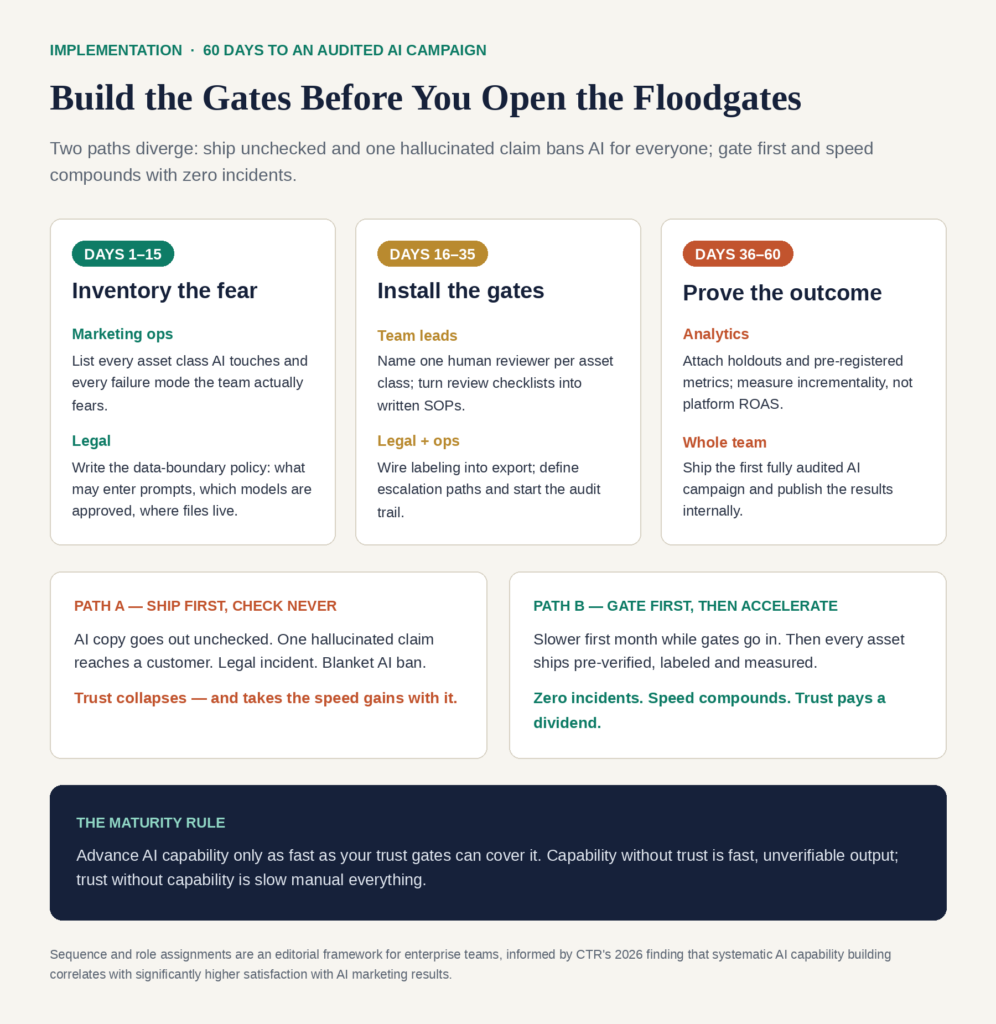
Path A: a team ships AI copy unchecked because velocity is the goal. One hallucinated product claim reaches a customer. Legal incident, apology, and a blanket AI ban. The speed gains evaporate, and the organization concludes AI is unsafe — when what was unsafe was the absence of gates.
Path B: a team spends its first month installing gates. It looks slower than Path A — for about four weeks. Then every asset ships pre-verified, labeled, and measured, review cycles shorten as SOPs mature, and the audit trail turns every near-miss into a process improvement. Zero incidents. Speed compounds. Call it the trust dividend: verification, done systematically, is an accelerant rather than a brake.
Building It: A 60-Day Sequence
Days 1–15: marketing ops writes the fear inventory — every asset class AI touches, every failure mode the team actually fears — and legal writes the data-boundary policy. Days 16–35: team leads name reviewers, checklists become SOPs, labeling gets wired into export, escalation paths and the audit trail go live. Days 36–60: analytics attaches holdouts and pre-registered metrics, and the team ships its first fully audited AI campaign — then publishes the numbers internally.
Ownership is deliberately split: ops owns technology trust, leads and legal own process trust, analytics owns outcome trust. Nobody owns everything, so nothing gets orphaned.
The Maturity Rule: Trust Gates Set the Speed Limit
One rule ties the system together: advance AI capability only as fast as your trust gates can cover it. Capability without trust is fast, unverifiable output — Path A with better tools. Trust without capability is slow manual everything. The interlock is the point. When your fact-check gate handles ten assets a day, don’t generate a hundred. When measurement covers two channels, don’t launch in six. The gates aren’t the ceiling on ambition; they’re the floor under it.
Honest Boundaries
Two caveats, stated plainly. First, trust systems reduce risk; they don’t eliminate it. Residual human judgment is the design, not a defect — a reviewer who rubber-stamps is just a slower model. Second, the headline figures here are survey self-reports: CTR’s 94.1% and 60.3% measure what 200-plus senior marketers say about investment and satisfaction, not audited campaign performance. iiMedia’s market size is a consultancy estimate, and Cisco’s privacy figures come from an interested vendor’s self-report survey. Directionally, they all point the same way — but treat them as weather vanes, not precision instruments.
Summary
Enterprise AI marketing’s bottleneck is not model capability — it’s verifiability. With 94.1% adoption against 60.3% lukewarm satisfaction, the winning move is a three-layer trust system: technology trust (fact-check gates, data boundaries, statutory labeling), process trust (named reviewers, SOPs, red lines, audit trails), and outcome trust (incrementality, pre-registered tests, published results) — all standing on a binary compliance floor. Build it in 60 days, let trust gates set the pace of capability, and the “average” verdict starts converting into evidence. The teams that win the AI marketing decade won’t be the ones that adopted first. They’ll be the ones whose output everyone — legal, finance, customers, and increasingly AI search engines — can trust.