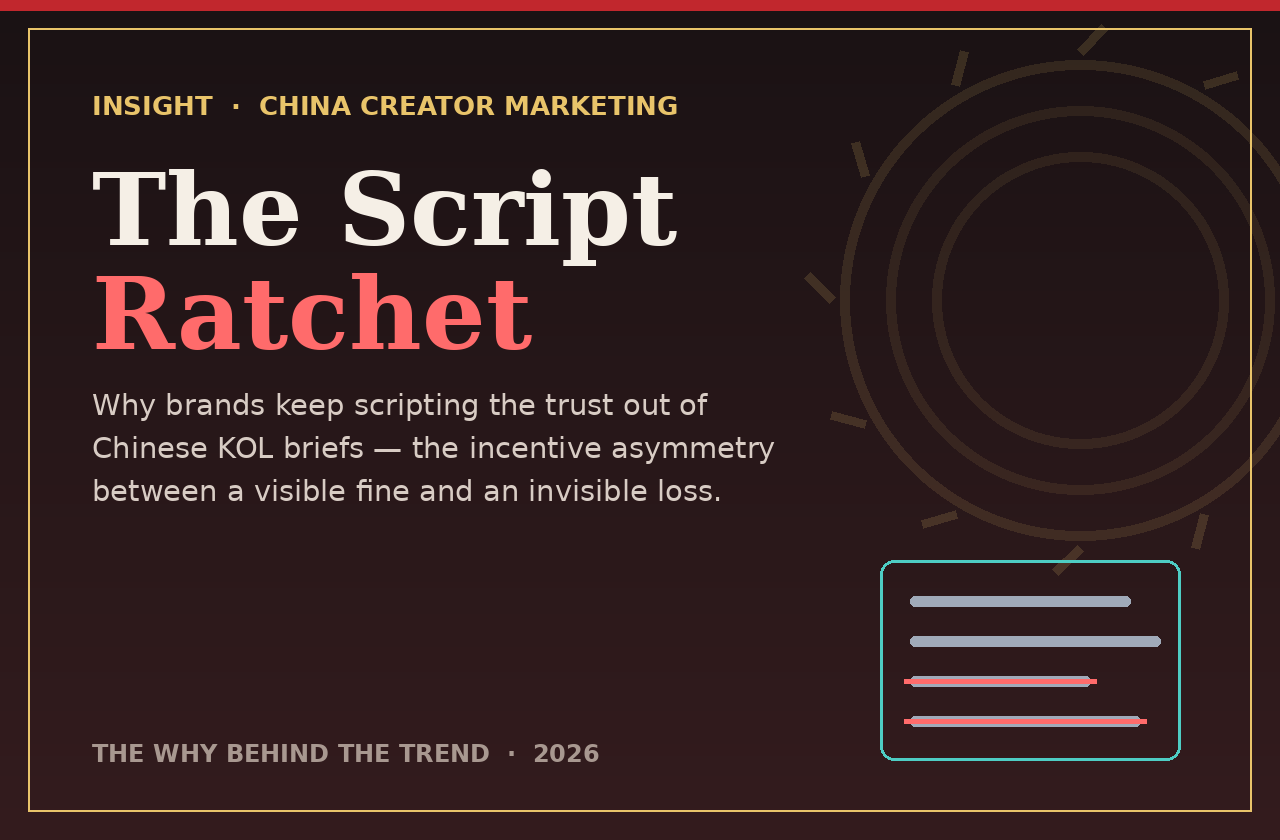
Every brand team running creator campaigns in China knows the same fact: audiences buy because they trust the creator, and scripted content kills that trust. Every one of those teams also keeps producing longer, tighter, more approval-heavy briefs. This is not hypocrisy. It is arithmetic — and until you see the arithmetic, you will keep losing the argument in the review meeting.
Start with what each side of the ledger looks like. A compliance failure is loud, dated and personally attributable. One banned superlative — “best,” “national-level,” anything implying supremacy — puts the advertiser on a statutory fine track of RMB 200,000 to one million under Article 57 of the Advertising Law. One missing advertisement label on a linked review post exposes the publisher to fines up to RMB 100,000 under SAMR Order 72. Someone signed off on that sentence. That someone can be named, and in a large organization, being nameable is career risk. So every incident adds a clause to the brief, and no clause is ever removed. The document ratchets one way.
Now price the other side. When an over-scripted post loses the creator’s voice, nothing happens on Tuesday. No fine arrives, no dashboard flashes red, no one gets blamed. The cost surfaces weeks later as an absence: the re-search that never comes. And that absence is enormous, because search is where Chinese purchase intent actually lands — Ocean Engine’s 2025 white paper reports that 53 percent of Douyin search behavior begins right after watching content, and Xiaohongshu disclosed in April 2025 that 70 percent of its monthly active users search actively. A scripted post that fails to trigger that verification loop has quietly burned the campaign’s entire downstream value. But in the attribution meeting, that loss gets filed under “the algorithm was tough this quarter.” Nobody’s name is on it.
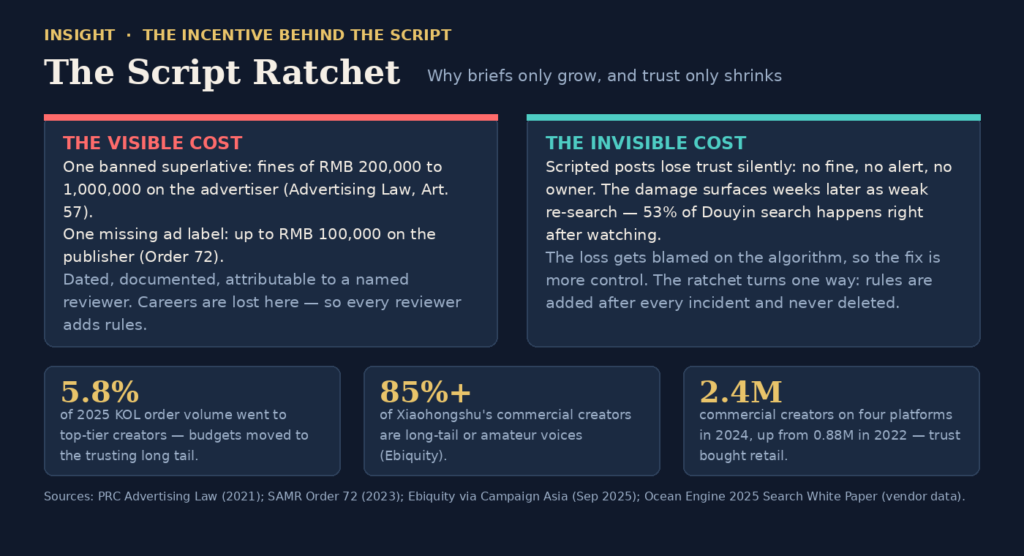
Here is the cruel twist. The market has already moved to exactly the creators whose asset is most fragile under scripting. Ebiquity’s 2025 research, reported by Campaign Asia, found that top-tier KOLs took just 5.8 percent of order volume, that more than 85 percent of Xiaohongshu’s commercial creators are long-tail or amateur voices, and that the commercial creator pool nearly tripled to 2.4 million in two years. Brands now buy trust at retail, from thousands of small creators whose followers actually believe them — then wholesale it away with a template written for a celebrity endorsement. The strategy migrated; the incentive structure didn’t.
What breaks the ratchet? Making the invisible cost attributable. Put branded-search lift over two to four weeks into the brief as the named KPI, with a named owner. Audit the must-avoid list quarterly and delete rules added out of fear rather than statute — the legal floor is four rules, not forty. And run one unscripted pilot creator against your templated cohort, comparing re-search, not day-one clicks. When the trust loss has a number and an owner, the review meeting finally prices both sides of the ledger. Until then, expect the brief to keep growing — and the trust to keep shrinking.