Ask a marketer how KOCs get paid and you will usually hear some version of “a small fee for a post.” Clean. Simple. Wrong — or at least, wrong in the way a map of a city is wrong when it leaves out the streets where people actually live.
In 2025, two researchers from the University of Michigan published the closest thing we have to a street-level map of China’s KOC economy. What they found is not a gig marketplace. It is a production system — one where ordinary users are recruited, screened, directed and often paid in product, exposure or possibility rather than wages. And the “authentic peer voice” that makes this content convert? It is an organized output, manufactured to spec by people whose labor rarely shows up on anyone’s books.
Let’s walk through the field evidence.
The Study That Pulled Back the Curtain
The anchor here is peer-reviewed, not a vendor blog. Huiran Yi and Lu Xian, PhD candidates at the University of Michigan School of Information, published “The Informal Labor in Creator Economy: The Making of Key Opinion Consumers From Ordinary Users on Xiaohongshu” in the Proceedings of the ACM on Human-Computer Interaction (CSCW 2025). Their term for what they observed: informal labor — work that is indispensable to the marketing machine yet systematically unrecognized by it.
What nine months of fieldwork actually means
The abstract describes nine months of online ethnographic work; the full paper details digital fieldwork running between December 2021 and September 2023, plus interviews with 16 Xiaohongshu creators and eight industry insiders — marketers, agency staff and platform employees in Shanghai. The first author had previously worked as a marketer for multinationals, which means she knew where the bodies were buried before she started digging. In the study’s framing, KOCs on Xiaohongshu typically hold 5,000 to 20,000 followers — big enough to matter, small enough to be cheap.
One caveat before we go further: ethnography establishes mechanisms, not market averages. Keep that in your pocket; we will need it later.
First, Kill the Fantasy: KOCs Are Made, Not Found
The romantic story says brands “discover” passionate customers who rave about products for free. The paper’s central finding is the opposite: the KOC role is produced, through negotiation among creators, marketers, corporations and the platform. Nobody stumbles into it fully formed.
The persona the algorithm hands you
One creator the researchers call Lexie posted about a job interview at a Fortune 500 company; the post went viral overnight because, she realized, the algorithm favored that employer’s name. She became a “workplace blogger” — not by choice, but by algorithmic assignment. Another creator, Jasper, built an aesthetics persona and then found he could not escape it: the algorithm had labeled him, and switching niches meant risking his visibility. Authenticity here is not discovered. It is curated, performed and maintained — continuous, unpaid work that happens before any brand shows up.
Follow the Money: The 35% Problem
Here is where the field notes get uncomfortable. When a brand budgets a fee for a KOC, how much arrives?
One cosmetics creator interviewed in the study — anonymized as Fan — described the arithmetic: social agencies and MCN intermediaries take roughly 55% of the reward, undocumented. The platform then takes its service fee, about 10%. What lands in the creator’s account: roughly 35% of what the marketer planned to pay.
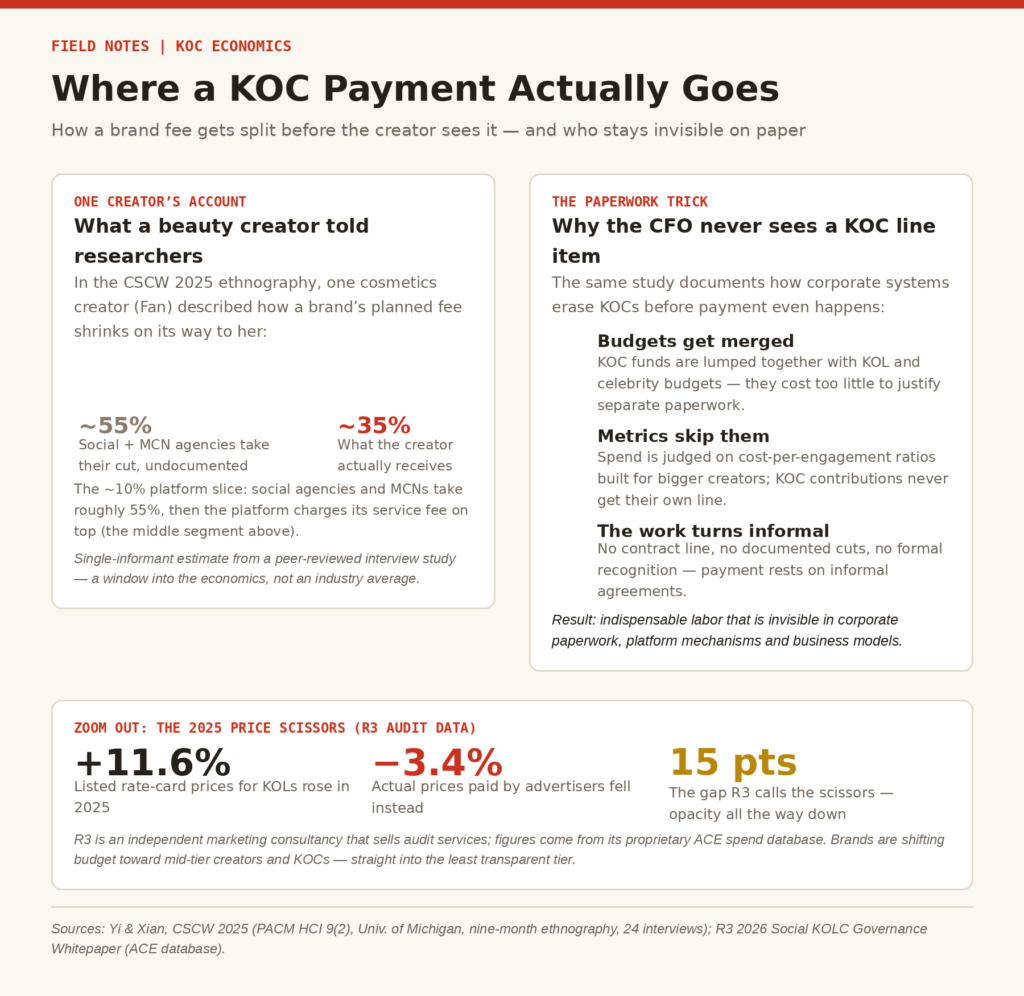
Treat those percentages honestly: they come from a single informant in a qualitative study, not an industry census. But the direction of travel is corroborated everywhere you look. The money leaks out through layers the creator cannot see, and no document records the leak.
The paperwork trick that erases a workforce
Why does nobody fix this? Because in corporate systems, KOCs barely exist. The study documents marketers merging KOC budgets into KOL and celebrity line items — in one marketer’s words, “because KOCs cost only little money.” Itemizing hundreds of tiny payments is clerical work nobody wants, so the workforce disappears into a budget smear. Performance gets judged on engagement-cost ratios designed for bigger creators. No line item, no contract trail, no recognition — payment rests on informal agreements. You cannot govern what you refuse to write down.
Zoom out and the opacity has a price tag. R3, an independent marketing consultancy (which, full disclosure, sells audit and advisory services), reported in its 2026 governance whitepaper that listed KOL rate-card prices rose 11.6% in 2025 while actual prices paid by advertisers fell 3.4% — a 15-point “scissors gap” drawn from its proprietary ACE spend database. Campaign Asia’s coverage put the market at roughly US$16.8 billion. The same research says brands are shifting budget away from expensive top-tier KOLs toward mid-tier creators and KOCs. Read that again: money is flowing toward the least transparent tier of the market.
The Assembly Line: Inside One Documented Operation
Academia tells you the mechanism. Trade reporting shows you the factory floor.
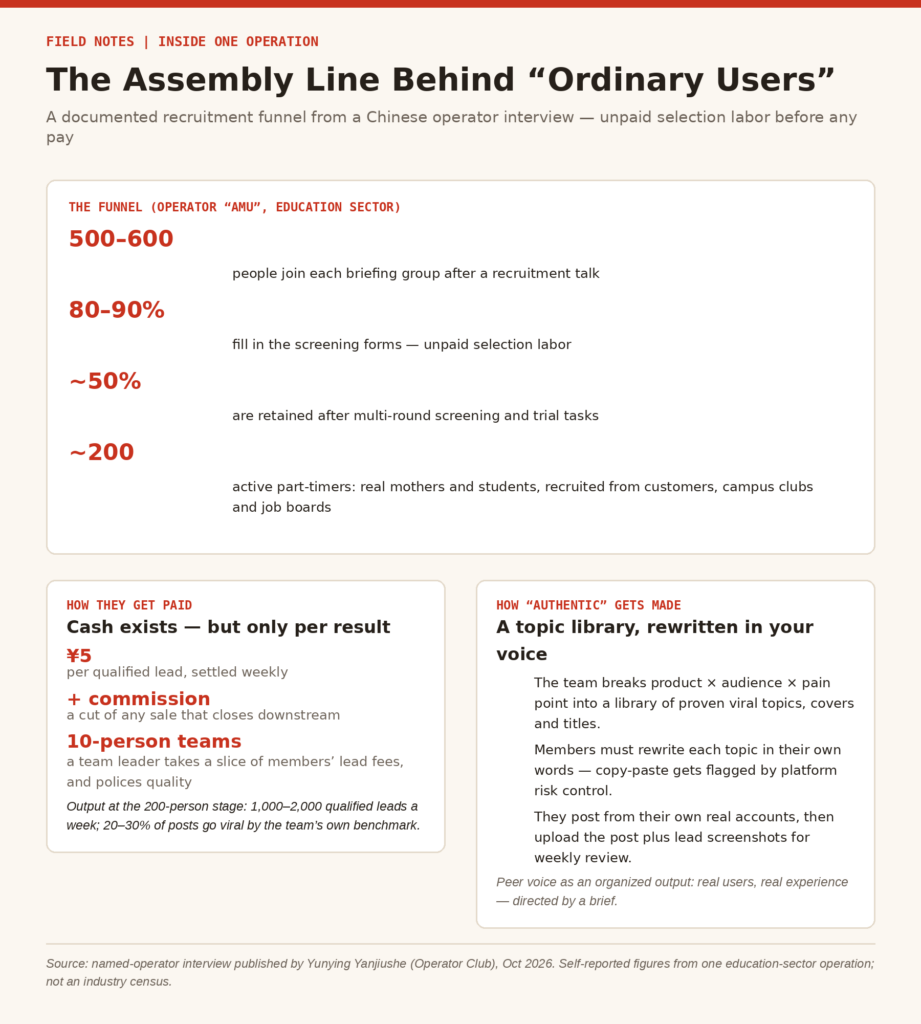
In October 2026, the Chinese operator community Yunying Yanjiushe published interviews with practitioners running “ordinary-user matrices” at scale. One of them — an education-sector operator named Amu, formerly a growth specialist at major training companies — described recruiting roughly 200 real part-timers: mothers and university students, sourced first from his existing customer base, then campus clubs and job boards. These figures are self-reported by one operator about one business; they are a documented specimen, not a statistical sample.
The funnel is unpaid work
Watch the selection machinery: a recruitment talk pulls 500–600 people into a briefing group. Around 80–90% fill in screening forms. After multiple screening rounds and trial tasks, roughly half are retained. Every hour in that funnel — the form-filling, the trial posts, the waiting — is labor invested before any compensation exists. Economists would call it unpaid selection labor. The people in the group just call it trying to get picked.
Those who survive get paid per result: ¥5 per qualified lead, plus a commission on sales that close downstream. Ten-person teams with a leader who takes a cut of members’ lead fees and polices quality. At the 200-person stage, Amu reports 1,000–2,000 qualified leads a week and a 20–30% viral-post rate by his team’s own benchmark. Notice what this is not: a fee for posting. Cash exists at the bottom tier — but only when the content performs. The risk sits with the creator; the content asset stays with the brand.
Authenticity, manufactured to spec
The content workflow is the part marketers should study twice. The team decomposes product × audience × pain point into a library of proven topics, covers and titles. Members must rewrite each topic in their own voice — copy-paste gets flagged by platform risk control as batch marketing. They post from their own real accounts, then upload the post plus lead screenshots for weekly review.
So the “spontaneous peer recommendation” is real experience, voiced by a real user, inside a template, directed by a brief, verified by a supervisor. The ethnography found the same pattern from the brand side: marketers cast a wide net across many small creators, prize the earned engagement they call “tap water” — cheap, seemingly self-flowing — and review posts word by word. One marketer’s requirement is the whole game in six words: KOCs “should not sound too expert.” Ordinariness is the deliverable.
Two Economies Sharing One Feed
Xiaohongshu does have a formal marketplace: Pugongying, known in English as Dandelion, where brand deals are registered, labeled and settled. Third-party guides consistently describe an entry bar around 1,000 followers and a platform service fee near 10% — figures the platform does not officially publish, though the fee matches the ethnography’s interview account. What is officially real, and documented in the paper: unregistered advertising gets punished. One marketer recalled both Chinese and international brands being removed from the platform’s search results for ten days over unapproved ads.
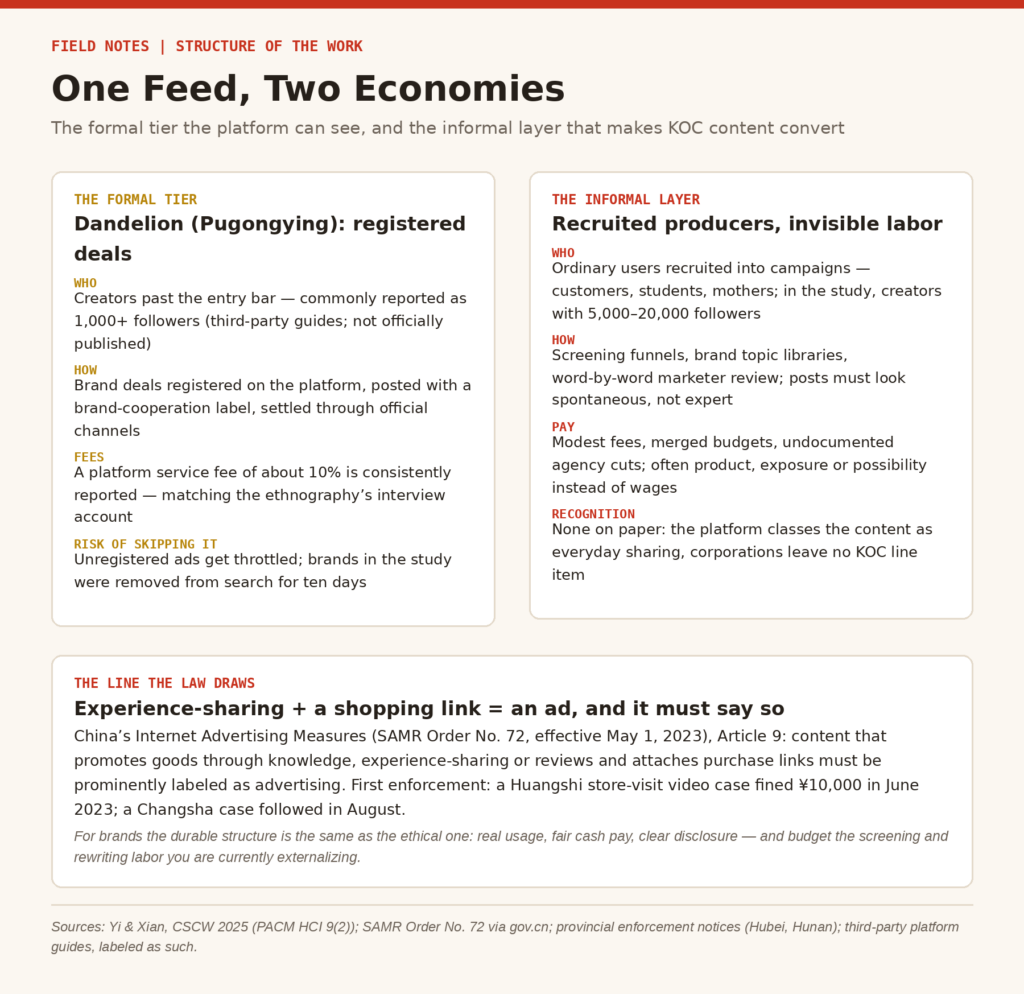
Below that registered tier sits everything we have described: the recruited, the screened, the rewritten. The platform classes their output as everyday sharing rather than commercials, which suits everyone except the people doing the work. Their labor generates commercial value while being officially categorized as having none.
Where the law draws the line
China’s regulator has already answered the “is this an ad?” question. The Internet Advertising Measures (SAMR Order No. 72), effective May 1, 2023, state in Article 9 that content promoting goods through knowledge introductions, experience-sharing or consumer reviews, with purchase links attached, must be prominently labeled as advertising. Enforcement started immediately: the first national case, in Huangshi in June 2023, fined a company ¥10,000 for unlabeled store-visit videos; a Changsha case followed that August. The “it’s just genuine sharing” defense has a statutory expiry date.
What Everyone Gets Wrong
“They get free stuff, so it’s fine”
Free product can be fair compensation for a spontaneous hobbyist. But when participation is recruited, screened, templated and reviewed to brand specifications, it is work — and the unpaid funnel, the rewriting and the performance risk are real costs someone is absorbing. The informal-labor framing is an academic finding published in a top HCI venue, not an activist slogan.
“So KOC content is fake”
No. This is the inference the evidence does not support. The study’s creators often performed personas rooted in their real lives — Lexie really worked at that company; the mothers in Amu’s operation really used the courses they reviewed. The format can be genuine even when organized. The ethical variables are real usage, fair pay and honest disclosure — not whether a brief existed. Manufactured authenticity becomes fraud only when the experience is fabricated or the commercial relationship is hidden.
The Counterargument, and Its Limit
Fair pushback: nine months on one platform, 24 interviews, plus one operator’s self-reported funnel — this cannot quantify a US$16.8 billion market. Correct. It doesn’t try to. What it establishes is mechanism: how KOCs are made, who directs the work, where the money leaks. And the mechanism is independently corroborated — the ethnography’s marketer interviews and the operator’s trade account describe the same assembly line from opposite ends.
There is also a genuine empowerment story the headlines miss. The paper documents creators using KOC income to assert independence from parents, hedge against layoffs, and negotiate fair rates — though notably, the ones who negotiated well had insider marketing knowledge. The opportunity is real but unevenly accessible. Both things are true: this work is exploited, and this work is a lifeline. Any analysis that keeps only one of those truths is selling you something. The backdrop matters too: youth unemployment for the 16–24 cohort hit a record 21.3% in June 2023 under the old statistical series, and roughly 200 million Chinese were in flexible employment by the end of 2021. When the formal job market freezes, the informal one absorbs the overflow — on whatever terms it offers.
What Brands Should Actually Do
Four moves, all of which happen to be both the ethical fix and the compliance fix:
- Pay cash, not just product. Result-only pay at the bottom tier externalizes all risk onto the least powerful party. A modest base fee plus performance upside is durable; product-only deals at scale are where astroturfing scandals breed.
- Brief for real experience. Supply the topic library and constraints, but require actual usage and honest limits. Scripted output from people who never touched the product is detectable, disposable and increasingly illegal.
- Disclose clearly. Experience-sharing plus a purchase link is an ad under Order 72. Label it. The ¥10,000 fines are small; the platform penalties and trust damage are not.
- Budget the labor you are externalizing. If you recruit ordinary users, their screening and rewriting time is part of your customer acquisition cost. Put it on the books. The 35% problem is not just unfair — it is unmeasured, and unmeasured spend is exactly what R3’s scissors gap punishes.
The Bottom Line
The field evidence — a peer-reviewed nine-month ethnography plus named-operator interviews — shows that Xiaohongshu KOCs are made, not found: recruited through customer bases and campus groups, screened through unpaid funnels, directed by brand templates and platform algorithms, and frequently compensated in product and possibility rather than wages. The authenticity that converts is an organized output. For brands, the operational conclusion and the ethical one are identical: pay fairly, require real usage, disclose clearly, and write down the labor you currently pretend is free. That is where the scandals come from — and it is also where the penalties land.