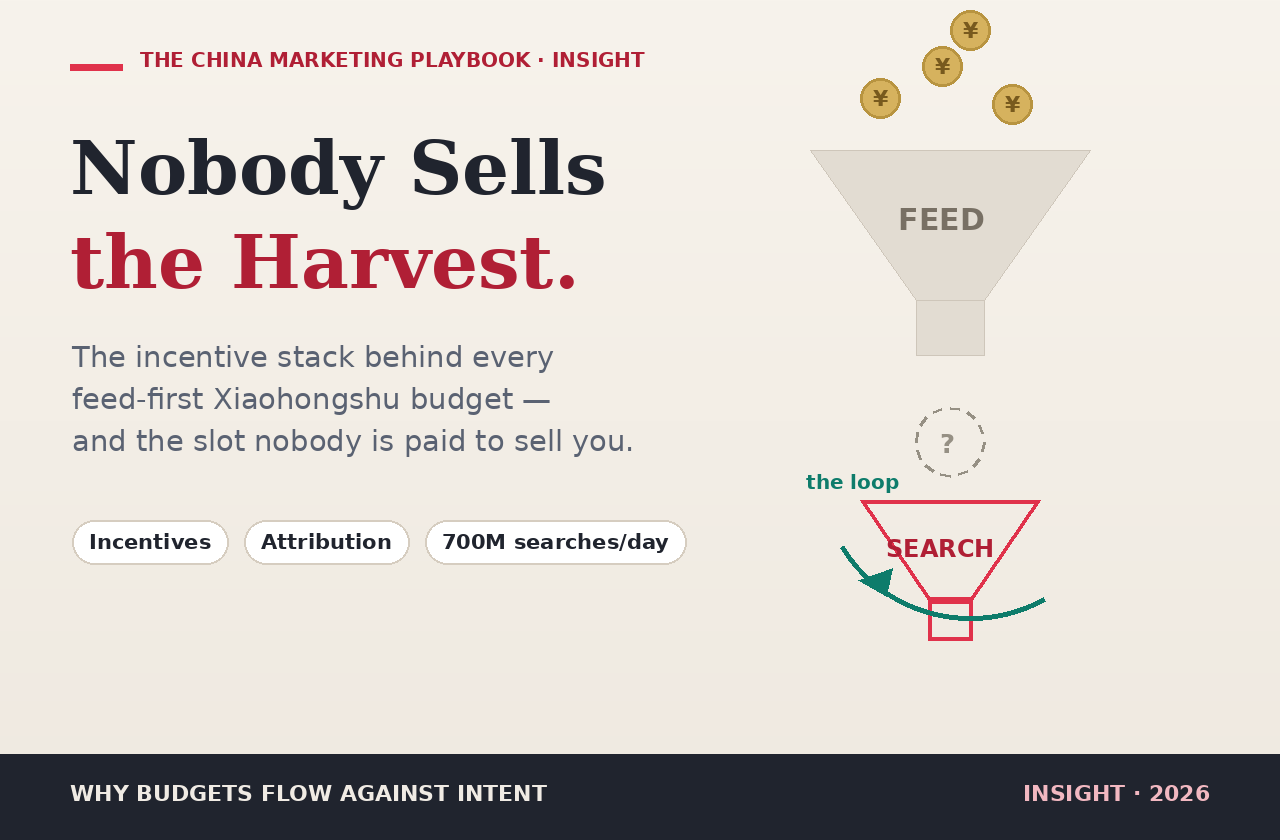
Ask any agency for a Xiaohongshu proposal and you will get a seeding plan: creator notes, feed campaigns, engagement dashboards. Ask the platform’s own data where intent lives and you get the opposite answer — over 700 million searches a day, roughly half of all traffic, close to 90% of queries actively typed. So why does every proposal fund the feed first? The answer is not ignorance. It is incentives. Follow the money through three layers of the sales stack and the “mistake” stops looking like a mistake at all.
The Platform Sells What It Has Too Much Of
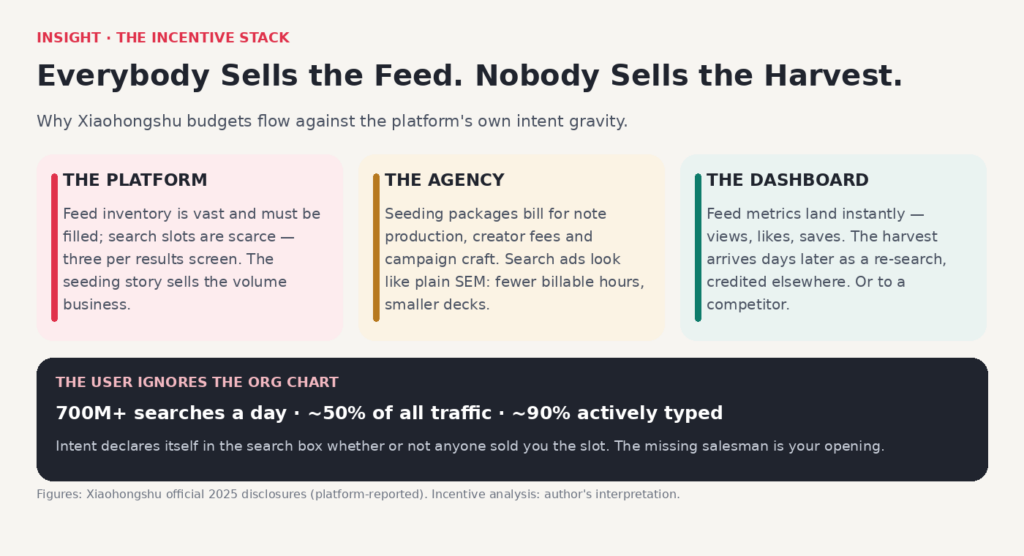
Xiaohongshu’s feed inventory is effectively infinite — every scroll generates new slots. Search inventory is scarce: three sponsored positions on a standard community results screen. An ad business grows by filling abundant inventory, so the commercial narrative naturally glorifies seeding, the product that makes feed slots valuable. Nobody builds a conference keynote around “buy the three slots that already work.” The platform’s search products exist and perform; they simply have no evangelist, because scarcity doesn’t need marketing. Abundance does.
The Agency Bills for Craft, Not Plumbing
Agencies earn on production: note creation, creator management, campaign storytelling. Seeding packages are rich with billable craft. Search campaigns smell like plain search-engine marketing — keyword lists, bid rules, negative-keyword hygiene. Less glamour, fewer hours, smaller decks. An agency optimizes for the retainer it can justify, not the conversion path your customer actually walks. This is not cynicism; it is compensation design doing exactly what compensation design does.
The Dashboard Pays the Feed Instantly
The third layer is measurement. Feed campaigns deliver metrics the same afternoon: impressions, likes, saves, comments — a weekly report that looks alive. Search harvests demand days later, and the payoff is structurally misattributed: the re-searching user converts on a branded query that last-click reporting credits to “organic brand strength,” not to Tuesday’s seeding note. Feed gets dopamine; search gets rounding errors. Teams defund whatever their dashboard cannot see, and no vendor is paid to fix your attribution.
Why This Is Your Opening
Here is the discovery worth acting on: every layer of the stack profits from feed-first, and none profits from telling you so. The user, meanwhile, ignores the org chart entirely — they browse, get curious, and type. That re-search moment is the most valuable and least-sold slot in Chinese social commerce. Competitors who inherit your seeding-driven demand are not smarter; they are simply standing where nobody was paid to stand. Buy the harvest yourself, measure the loop yourself, and let the incentive stack keep selling everyone else the feed. The gap between where money flows and where intent flows is not a market inefficiency. For you, it is the strategy.