Every marketing platform sells you a story about trust. Douyin sells excitement. Xiaohongshu sells aspiration. Zhihu, China’s largest question-and-answer community, sells something less glamorous and — for certain products — far more powerful: a documented answer from someone who actually knows what they’re talking about.
That difference sounds cosmetic. It isn’t. It decides which products convert, how long your content keeps selling, and whether an AI engine will quote you when your customer stops browsing and starts asking. In March 2026, Zhihu reported its first full-year adjusted profit in fifteen years of existence. The number was tiny. The signal was not. Let’s unpack what actually converts on Zhihu, how the machinery works, and why the platform’s real asset might be the one AI engines are hungry for.
The First-Profit Pivot: A Smaller, Stranger Zhihu
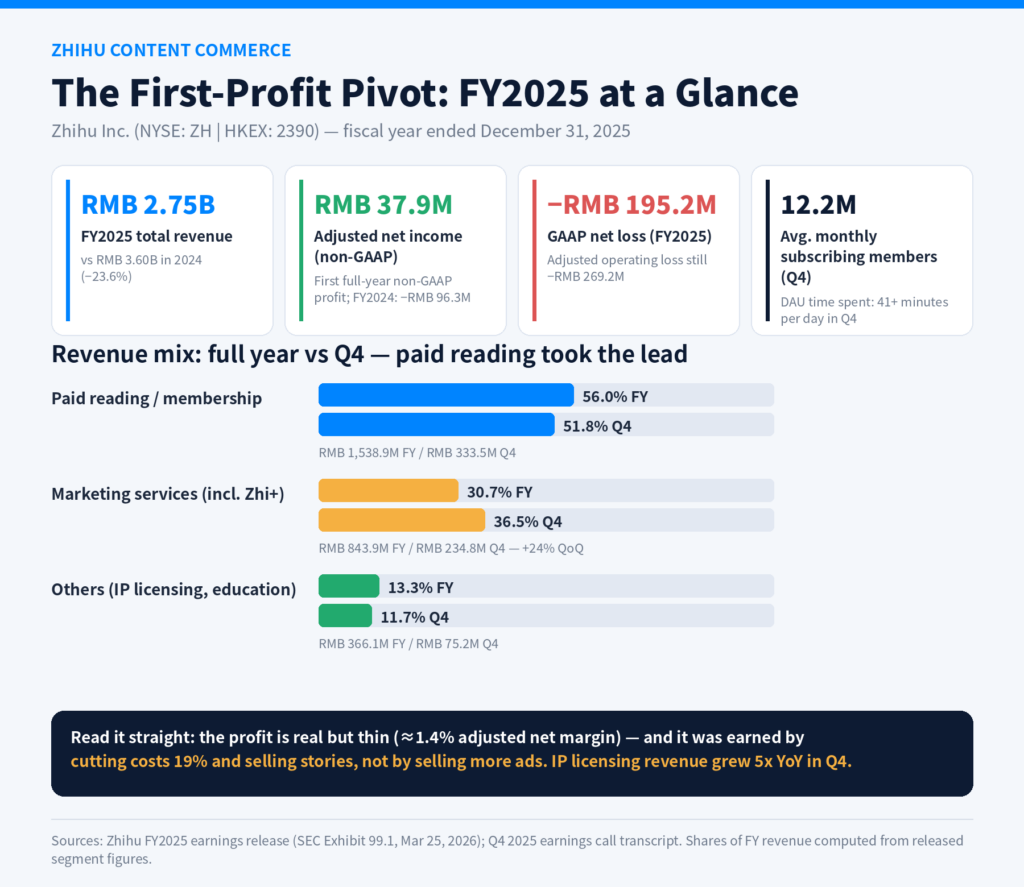
Start with the numbers, because they’re honest in a way press releases rarely are. For fiscal 2025, Zhihu reported total revenue of RMB 2.75 billion — down 23.6% from RMB 3.60 billion in 2024. On that shrinking base, it earned an adjusted (non-GAAP) net income of RMB 37.9 million, reversing a RMB 96.3 million adjusted loss a year earlier. First full-year adjusted profit ever.
Read the fine print before you applaud. GAAP net loss was still RMB 195.2 million, including a RMB 126.3 million goodwill impairment. Adjusted operating loss was RMB 269.2 million; the adjusted profit exists largely because investment and interest income — over RMB 300 million combined — papered over the operating gap. Total operating expenses fell 19%. This was a profit earned by discipline, not by demand.
The revenue mix tells the deeper story. Paid reading — mostly serialized fiction on the Yanyan Stories app — now contributes 56% of full-year revenue. Marketing services, the business brands actually buy, fell to 30.7% for the year, though it rebounded to 36.5% in Q4 with a 24% sequential recovery. Average monthly paying members stood at 12.2 million in Q4, and daily active users spent over 41 minutes a day on the platform. Zhihu got smaller, quieter, and profitable. The question for marketers: what’s left that’s worth buying?
Three Platforms, Three Trust Currencies
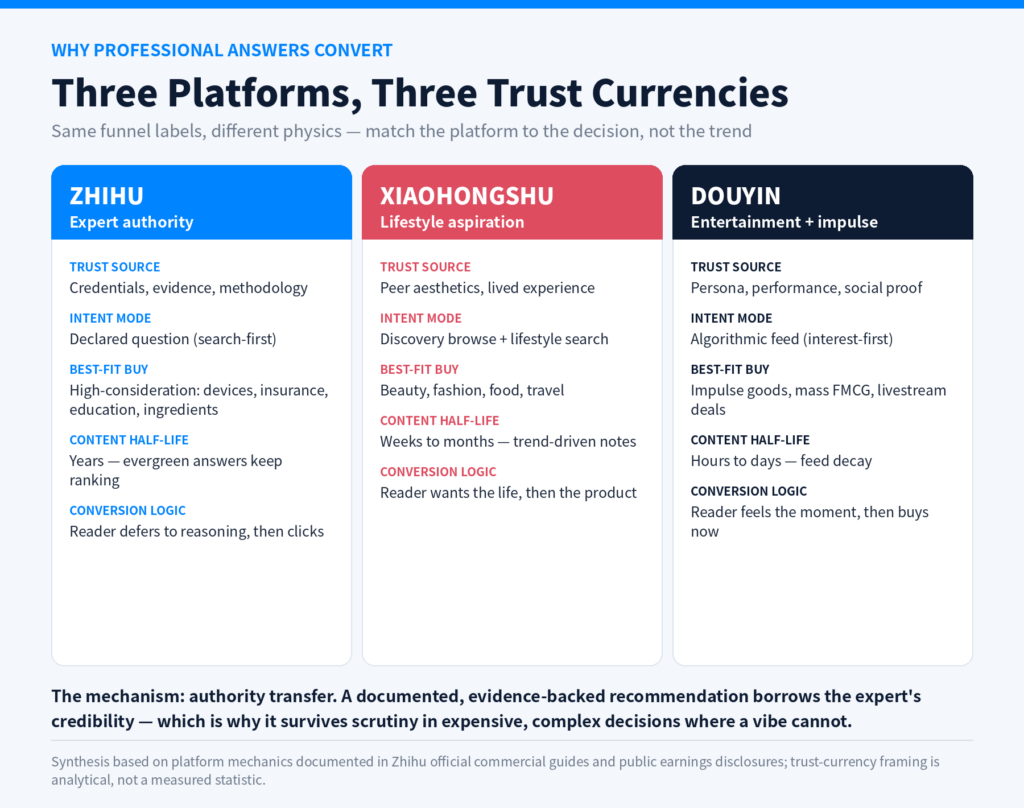
Here’s the frame that makes everything else click. Xiaohongshu runs on lifestyle aspiration — you see a peer living slightly better than you, and you buy your way toward it. Douyin runs on entertainment and impulse — the algorithm catches you in a feeling, and the livestream closes the deal before the feeling fades. Zhihu runs on expert authority — you arrive with a declared question, and you defer to whoever answers it with evidence.
These aren’t interchangeable audiences at different price points. They’re different decision machines. Aspiration converts beauty and fashion. Impulse converts snacks and gadgets on discount. Authority converts the purchases people are afraid to get wrong: laptops, insurance policies, graduate programs, skincare actives, baby formula. High price, high complexity, high regret. That’s Zhihu’s country.
The 2025 Edelman Trust Barometer’s brand-trust special report adds a useful global echo: people now trust the brands they use (80%) more than government (54%) or media (55%) — and among the 55% who use generative AI platforms, 91% use them for shopping-related research. Trust is migrating toward demonstrated competence, and the research itself is migrating into AI answers. Keep that second point in mind; it becomes Zhihu’s plot twist.
The Expert-Answer Funnel, Step by Step
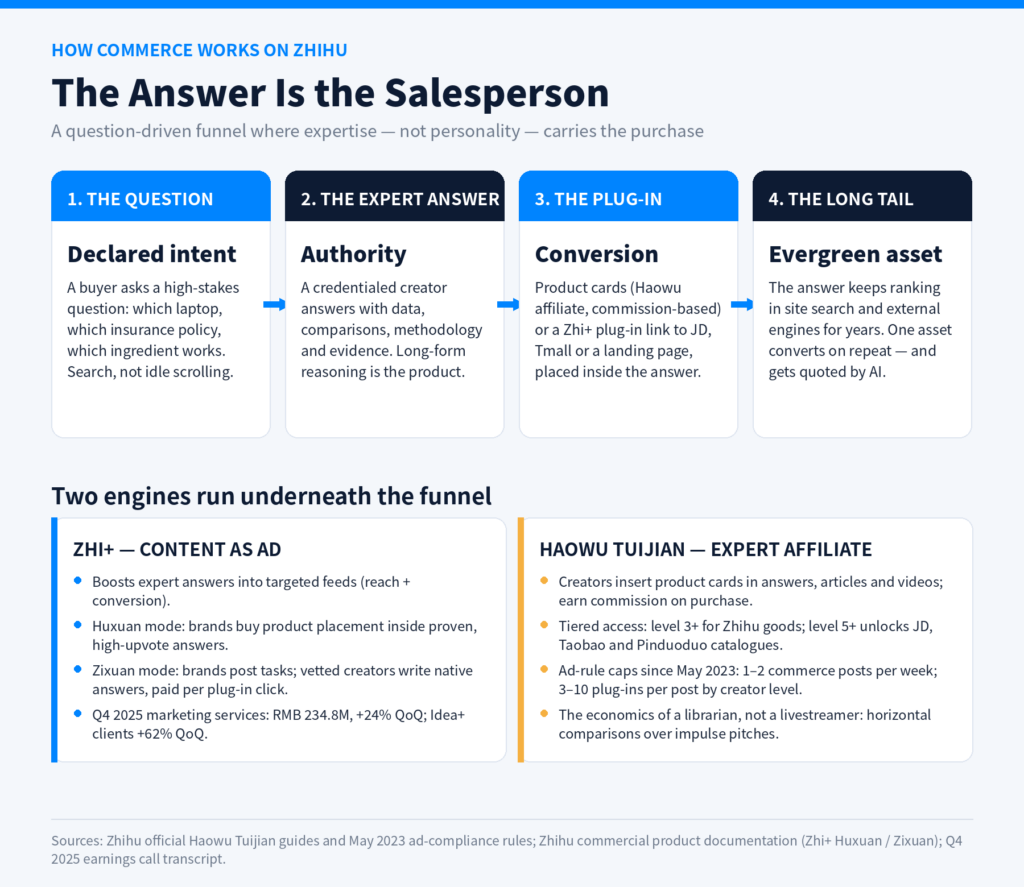
The mechanics are almost embarrassingly simple. A user types a question — “which air purifier actually removes formaldehyde?” — which is intent declared in plain language, not inferred from scrolling behavior. A credentialed creator answers with measurements, comparisons, and methodology. Inside that answer sits a commerce component: a product card or a plug-in link. The reader, having followed the reasoning, clicks.
Notice what’s absent: no persona, no parasocial bond, no countdown timer. The answer is the salesperson. And because the question keeps getting asked, the answer keeps selling — for years. Zhihu answers rank in the platform’s own search and in external engines, which means one well-built answer behaves like an annuity, not an ad. Compare that with a feed post whose economic life is measured in hours.
This is why content half-life is the metric that separates Zhihu from its louder rivals. On Douyin you rent attention. On Zhihu you build inventory.
Zhi+: The Ad That Is an Answer
Zhihu’s commercial engine is called Zhi+, and it inverts the usual ad logic: instead of interrupting content with advertising, it turns content into advertising. Two modes matter. Huxuan lets brands buy their way into already-proven answers — a commercial placement or modification inside a high-engagement post that has already earned community trust. Zixuan works the other direction: brands post briefs, vetted creators write native answers, and the brand pays on commerce plug-in clicks. Both ride the same principle — the ad must survive being read as an answer.
The recovery is visible in the results. Q4 marketing services revenue hit RMB 234.8 million, up 24% sequentially, and the newer Idea+ format — native advertising in short-form posts — grew client numbers 62% quarter-over-quarter with average daily client spend up 200%. Small numbers, but a real inflection after a deliberate purge of low-quality advertisers.
Haowu Tuijian: The Expert as Affiliate
The second engine is Haowu Tuijian, launched before Double 11 in 2019: creators insert product cards into answers and articles, earning commission when readers buy through them, with catalogues spanning JD, Taobao and Pinduoduo. The cultural detail matters more than the plumbing — Zhihu’s affiliate norm is the horizontal comparison, not the hype pitch. And the platform enforces scarcity: under its May 2023 advertising-compliance rules, most creators may publish only one or two commerce posts per week, with three to ten product plug-ins per post depending on level. Scarcity is the point. An expert who sells everything is an expert in nothing.
Why Authority Converts: Four Mechanisms
Why does a 3,000-word answer outsell a 15-second video for a RMB 8,000 laptop? Four mechanisms, stacked.
First, authority transfer. The reader isn’t trusting the product; they’re trusting the reasoning, and the recommendation inherits that trust. A spine researcher who tests seven pillows with a materials-fatigue machine and MRI imaging — a real, widely covered Zhihu case — isn’t endorsing a pillow. He’s demonstrating a method, and the method is what you buy into.
Second, high-consideration fit. Expensive, complex purchases need exactly what feeds can’t carry: comparison tables, failure modes, edge cases. The long answer isn’t a bug of the format; it IS the service.
Third, declared intent. A question typed into a search box is the purest intent signal in marketing. The reader has already raised their hand.
Fourth, compounding. Answers persist, accumulate upvotes and rankings, and keep converting. Your fifth month of traffic costs nothing. Try that with a boosted post.
The AI Twist: Zhida and the Citation Economy
Now the plot twist. Zhihu spent fifteen years accumulating something it didn’t know it was building: one of the largest corpora of reasoned, attributed, human-generated Chinese-language expertise on the internet. Then AI arrived, and that corpus became infrastructure.
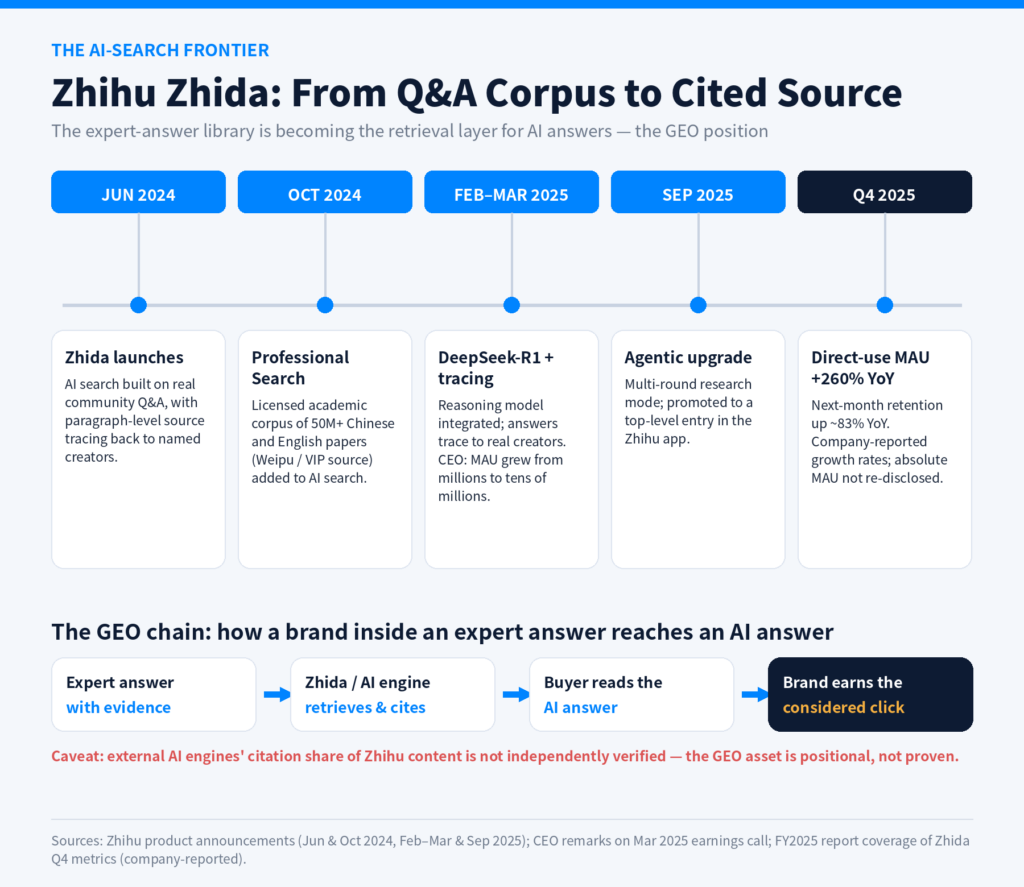
Zhihu Zhida, the company’s AI search product, launched in June 2024 with a signature feature: paragraph-level source tracing back to named human creators. In October 2024 it added Professional Search, integrating over 50 million licensed Chinese and English academic papers. In early 2025 it plugged in DeepSeek-R1 for reasoning, and the CEO said monthly users had grown from millions to tens of millions — a company-reported figure, so hold it loosely. By September 2025 Zhida had gone agentic, running multi-round research, and earned a top-level entry in the app. The company reported Q4 direct-use MAU growth above 260% year-over-year, with next-month retention up roughly 83%.
The strategic logic is what marketers should study. Zhou Yuan’s formula — high-quality content times expert network times AI capability — is really a claim about retrieval: when AI engines answer questions, they need sources that are attributable, evidence-bearing, and defensible. An expert answer is exactly that. A vibe is not. In the GEO era, being quotable is the new being findable.
The Brand Playbook: Five Moves
So what do you actually do with this? Five moves, in order.
One: audit your category fit. If your product sells on impulse or aesthetics, Zhihu is a supporting channel at best. If it sells on being right — specs, ingredients, coverage, outcomes — it may be your highest-converting text channel in China.
Two: map the question set. List every question a buyer asks before purchasing your category: comparisons, ingredient breakdowns, “is X worth it,” failure stories. That list is your content calendar and your GEO keyword map simultaneously.
Three: seed credentialed answers. Work with creators whose authority is verifiable, and let them write in their own method-first voice. Boost the winners through Zhi+ rather than mass-producing placements. The scarce permission to post commerce content is a feature — it keeps the channel credible.
Four: respect the disclosure rules. China’s internet advertising measures apply; Zhihu’s own caps and labeling requirements exist for a reason. Sponsored reasoning that pretends to be neutral is how the entire trust currency gets debased.
Five: measure on the right clock. Track answer rankings, plug-in clicks and assisted conversions over quarters, not days — and add a GEO layer: query the major AI engines with your category’s buying questions and log whether your brand appears in the answers. Answer-share is becoming a metric, not a metaphor.
Honest Caveats: Where This Thesis Can Break
Let’s not sell you a certainty. Four risks deserve daylight.
The scale ceiling is real: Zhihu’s monthly audience is tens of millions, a fraction of Douyin’s or Xiaohongshu’s, and the professional niche that makes it defensible also caps it. The profit is thin — roughly a 1.4% adjusted net margin, flattered by non-operating income — and the pivot toward paid fiction raises a fair question about whether the knowledge community is being slowly hollowed out by its own revenue mix. Authenticity is fragile: fake experts and undisclosed placements would erode the one asset that matters, which is why verification and disclosure aren’t compliance chores but existential maintenance. And the GEO upside is positional, not proven: no independent measurement shows how often external AI engines actually cite Zhihu. Treat it as a strong hypothesis with early company-reported signals, not a bankable fact.
Conclusion: Earn the Citation
Zhihu’s commerce works because expertise is a different currency than attention — scarcer, slower, and harder to counterfeit. The expert answer converts the considered purchase, compounds for years, and now sits exactly where AI engines go looking for sources they can defend. The first profit came from cost discipline and serialized fiction. The durable moat, if there is one, is the corpus of reasoned answers and the network that keeps producing it.
For brands, the instruction is unusually clear: pick categories where being right beats being liked, own the questions your buyers actually ask, seed answers that could survive cross-examination, and measure whether machines quote you. The answer is the salesperson. In the AI era, it’s also the source. Earn both.