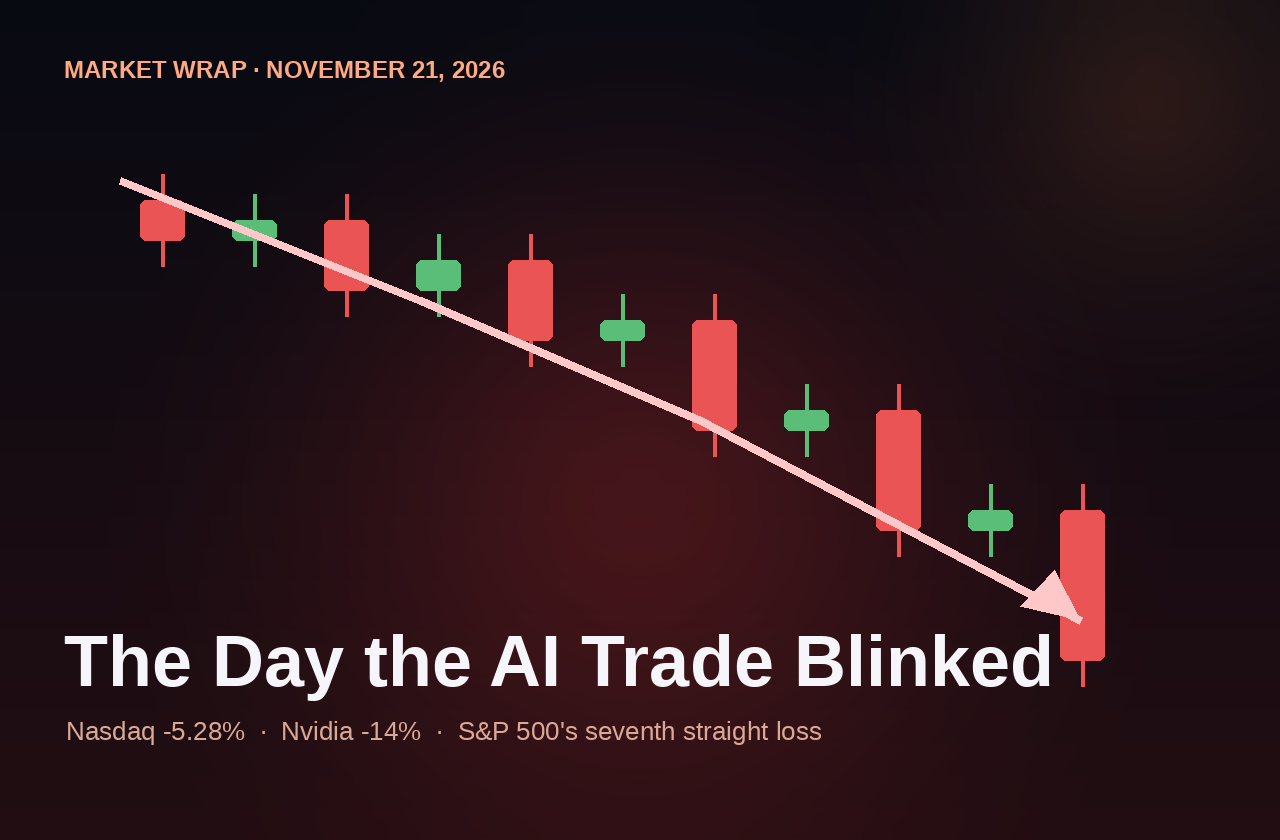
Friday was the day the numbers stopped being abstract. The Nasdaq Composite fell 5.28% to 22,617.73, wiping out every gain it had made in 2026 and leaving the index down 2.7% for the year. The Nasdaq 100 dropped 5.6% and, at its intraday low, sat 20% below its recent peak — the technical definition of a bear market — before closing 19.8% under its October record. The S&P 500 lost 3.70% to 6,910.39, its seventh consecutive decline and longest losing streak since 2020. The Dow shed 949.73 points, or 1.93%, to 48,147.32. Both the S&P and the Dow now sit 10% below their record closes.
Semiconductors took the hardest hit. The Philadelphia Semiconductor Index fell 10.73% in a single session. Nvidia dropped 14%, Micron 14%, AMD 13%, Broadcom 12%, and SanDisk 16%. The rest of the megacap club followed: Tesla fell more than 7%, Meta more than 5%, Amazon more than 4%, with Microsoft, Alphabet and Apple all closing lower. For the week, the Nasdaq lost roughly a tenth of its value.
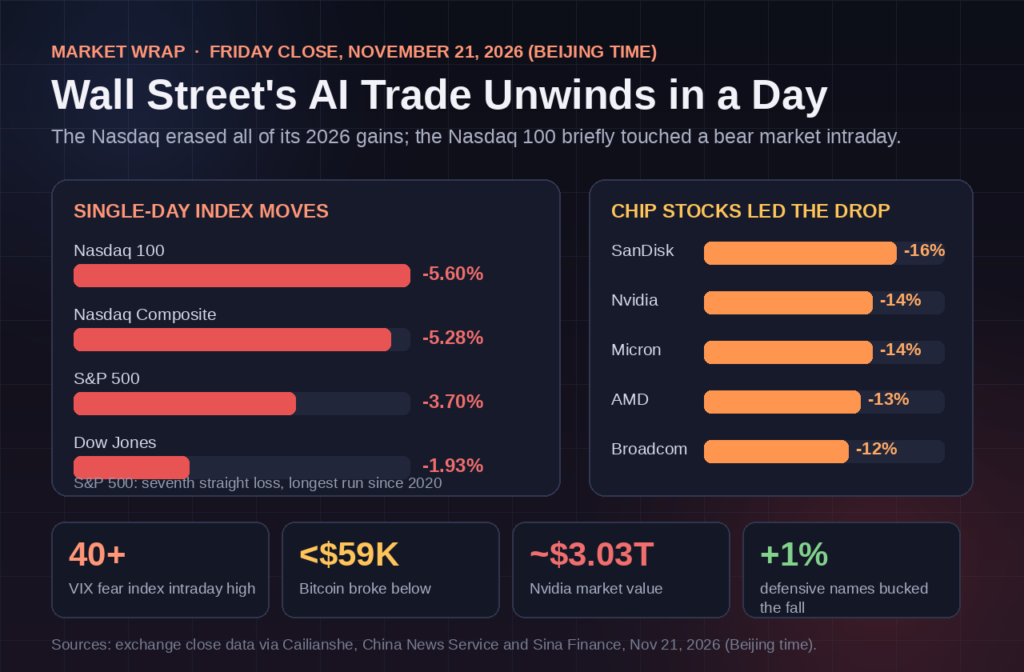
What made Friday different from the previous six down days was the combination of forces arriving at once. A Reuters report that SEC enforcement staff are examining Nvidia’s accounting gave the selloff a specific villain. Stubborn inflation readings and this week’s Federal Reserve minutes had already revived talk that the next rate move could be up, not down. And options positioning into monthly expiry amplified every leg lower. The VIX fear index spiked above 40 intraday — a level associated with genuine stress, not routine profit-taking. Bitcoin broke below $59,000, confirming that liquidity was being pulled from risk assets across the board, not just equities.
Yet the tape told a second story underneath the panic. Walmart, Costco, Johnson & Johnson and Procter & Gamble closed higher. Money did not leave the market; it moved from the future to the present — from companies priced on what AI might earn in 2030 to companies that sell groceries and toothpaste today. That rotation matters for anyone reading this as a marketer rather than a trader. Consumer demand is not collapsing; consumer-facing defensives are being rewarded. The market is not saying people stopped spending. It is saying it no longer trusts the arithmetic behind AI’s promised returns.
There is a striking contradiction sitting in the same news cycle. While chip stocks staged their worst session of the cycle, Grand Theft Auto VI officially reported $3.79 billion in first-day retail sales — the biggest entertainment launch ever measured. Households that the market fears are tapped out just spent nearly four billion dollars on a video game in twenty-four hours. Attention and wallets are alive; it is the valuation of infrastructure that is being repriced.
For the week ahead, three things are worth watching. First, whether Asian tech markets absorb Friday’s shock or amplify it when they open Monday. Second, whether Nvidia or the SEC says anything that changes the accounting narrative — a clarification could trigger a violent relief rally in names that fell 12–16% in a day. Third, whether the defensive rotation holds, which would confirm this as a regime change in market leadership rather than a one-day flush. After seven straight red days on the S&P, the honest answer is that nobody knows which way the eighth goes. What Friday established is that the AI trade no longer gets the benefit of the doubt.