
Three facts sit next to each other in the 2026 measurement data, and nobody has reconciled them.
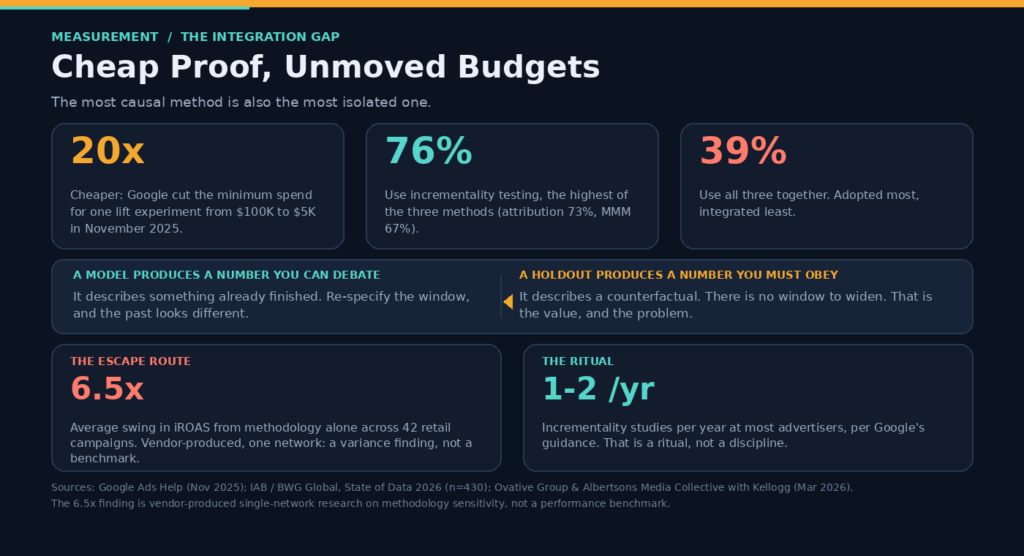
Incrementality testing is the most adopted of the three advanced measurement methods: 76 percent of US buy-side decision-makers use it, against 73 percent for attribution and 67 percent for marketing mix modeling. It is also, since November 2025, the cheapest it has ever been — Google cut the minimum spend threshold for a single experiment from upwards of $100,000 to $5,000, and improved its models so conclusive results arrive up to 50 percent more often.
And it is the least integrated. Only 39 percent of those same teams use incrementality, attribution and MMM together. Between 60 and 75 percent say advanced measurement still falls short on rigor, timeliness, trust or efficiency.
Cheaper and easier should mean more integrated. It does not. Price and difficulty cannot explain this, because both moved in the direction that predicts the opposite. Something else is doing the work, and it is not statistical.
The asymmetry is in what each method asks of you
Here is the mechanism, and it is embarrassingly simple once you see it.
A model produces a number you can debate. An attribution report describes conversions that already happened, distributed across windows you chose. Change the lookback, the model specification, the channel taxonomy, and the past rearranges itself into a different story. That is not fraud; it is the ordinary flexibility of describing something finished. Models are, structurally, negotiable.
A holdout produces a number you must obey. It withholds spend from a matched control and reads the difference. There is no window to widen, no specification to swap, no taxonomy to redraw. The result is not a description of what happened; it is a measurement of what would not have happened. That is precisely why it is valuable — and precisely why it is dangerous inside an organization.
Attribution and MMM are committees. Incrementality is a verdict.
The verdict has an owner, and the owner has a quarter
Now follow the incentive. A lift test does not produce a fact about advertising in general. It produces a fact about a specific channel, a specific budget, and — unavoidably — a specific person who defended that channel last quarter.
If the test says the channel is incremental, nothing much changes: the person is vindicated, the budget renews, and the test joins a slide. If the test says the channel is barely incremental, or that its interval brushes zero, the person now holds a defensible number that argues against their own plan. The organization has handed a mid-level manager the ammunition for their own budget hearing.
So the rational move is not to run the test. It is to run it in a form whose output can be survived. That is how 20x cheaper proof produces 39 percent integration. Google’s own guidance notes that most advertisers historically ran only one or two incrementality studies a year. One or two is not a measurement program; it is a ritual performed at a safe distance from the budget cycle.
The escape routes are well maintained
Once you accept that the constraint is political, the observed behaviors stop looking like incompetence and start looking like engineering.
The first escape route is methodological variance. A March 2026 analysis by Ovative Group and Albertsons Media Collective, with Kellogg School of Management professors, held 42 retail campaigns constant and varied only the matching methodology; iROAS outputs moved by an average of 6.5x. The research is vendor-produced, covers one network’s onsite inventory and has no randomized benchmark, so read it as a finding about sensitivity, not a performance benchmark. But its organizational implication is exact: where a number can legitimately be computed six ways, the organization will eventually pick the way that survives the meeting. A metric with a 6.5x error band is not a constraint. It is an option.
The second escape route is estimand laundering. A go-dark holdout measures lift against zero spend; a heavy-up test measures marginal lift against normal spend. Feed the second into an MMM built on a zero-spend counterfactual and you have compared two different quantities — which Google’s Meridian documentation explicitly flags as not recommended. Nothing about this is dishonest in isolation. It becomes an escape route only when it is chosen after the number is known.
The third is the pre-commitment gap. Almost every methodology guide now says to write the decision rule before launch. Almost none say what happens when the rule fires and the person who wrote it is the person it fires on.
What actually removes the premium
The fix is not better statistics, because the statistics are already good enough to be inconvenient. The fix is to move the cost of acting off the individual and onto the process.
Pre-commit in writing, with a named owner and a date, before assignment is drawn. Compute break-even iROAS from margin before launch, so the line cannot be redrawn after the result lands. Fund the test from a central experimentation budget rather than the tested channel’s own P&L, so the channel owner is not paying for their own audit. And publish results into a shared evidence library where a null result is a completed deliverable rather than a career event.
None of that is measurement science. All of it is the reason the science gets used.
The uncomfortable implication: as long as causal proof remains a verdict delivered to someone who must then argue against themselves, its falling price will keep buying more tests rather than better budgets. Twenty times cheaper proof, unchanged incentives, 39 percent integration. That is not a gap in capability. It is a price the organization has decided not to pay.



