Google’s plan to run artificial intelligence in orbit acquired a launch vehicle on Thursday. Blue Origin announced that its New Glenn rocket will carry a set of Google computing satellites into sun-synchronous orbit in the first quarter of 2029 — the first dedicated heavy-lift mission booked for Project Suncatcher, the Alphabet research effort exploring whether solar-powered data centers in space can eventually compete with the ones sprawling across Earth’s deserts. Each satellite will carry Google-designed TPU chips and deliver roughly the computing capacity of a single data-center rack.
The mission is a technology demonstration, not a service launch, and Google is candid about the horizon. “Project Suncatcher is a long-term moonshot to scale AI infrastructure in space by tapping into the abundant solar power in orbit,” said Travis Beals, the project’s senior director. The orbital choice is the point: a sun-synchronous path along the day-night terminator keeps solar panels in nearly continuous sunlight, sidestepping the intermittency that plagues terrestrial solar. Google disclosed the research about a year ago and has already flown a refrigerator-sized prototype as a rideshare on a SpaceX rocket — so Thursday’s news is less about whether chips can work in space and more about whether they can work there at a price anyone would pay.
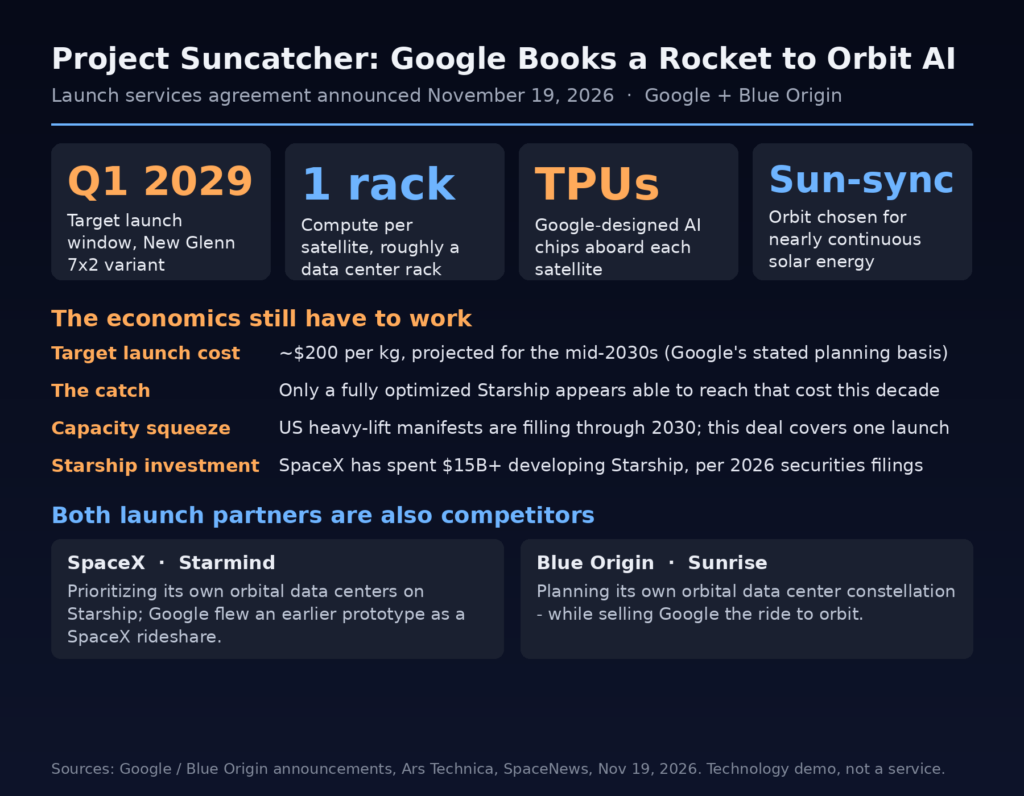
That price question is where the story gets uncomfortable, and Ars Technica’s analysis lays out the arithmetic. Google’s own planning basis assumes launch costs falling to around $200 per kilogram by the mid-2030s. The only vehicle plausibly capable of reaching that figure this decade is SpaceX’s Starship — and it would likely take a fully optimized future version lifting some 200 metric tons to orbit. SpaceX has spent more than $15 billion developing Starship, according to its 2026 securities filings, and has strong incentives to prioritize its own payloads, including its Starmind orbital data-center ambitions, over third-party customers. Meanwhile, US commercial heavy-lift capacity is filling up through 2030, which is part of why booking a 2029 slot now makes sense even for a moonshot.
The awkward geometry extends to Thursday’s partner. Blue Origin will fly the mission on the 7×2 variant of New Glenn, its smaller configuration, and by the 2030s plans a larger 9×4 version — but that vehicle could still carry a cost disadvantage against a fully reusable, high-cadence Starship. And Blue Origin is itself planning an orbital data-center constellation, Project Sunrise. Google, in other words, is buying rides from two companies that both intend to compete with it at the destination. The single-launch agreement could grow into more missions, but the strategic question Ars raises is blunt: can a company credibly plan a large constellation of orbital data centers without owning its own rocket? The options — wait for a new launcher, buy one, or build one — all cost years or billions.
Set against the week’s other space-computing news, the contrast is instructive. SpaceX just sold $30 billion of debt collateralized by terrestrial GPU rentals, and its lenders reportedly tried to bar the pledged chips from leaving Earth. Google is booking launches to send chips up. The bond market is pricing AI compute as a ground-bound cash-flow machine; the research labs are hedging that the economics eventually invert. Both can be right on their own timelines — which is precisely why Suncatcher is structured as a demonstration with a 2029 date rather than a service with a price list.
For enterprises, nothing about procurement changes this quarter, and anyone selling you “space data center” capacity today is selling a slide deck. But the underlying pressure is real and terrestrial: AI’s power appetite is colliding with grid limits, land disputes and permitting queues, and the world’s largest compute buyers are visibly willing to fund escape routes. Watch three markers over the next few years — New Glenn’s flight cadence after its earlier pad setback, Starship’s cost curve and outside-customer pricing, and whether Google expands the Blue Origin contract beyond one launch. The rocket is booked. The business case is still in orbit.






