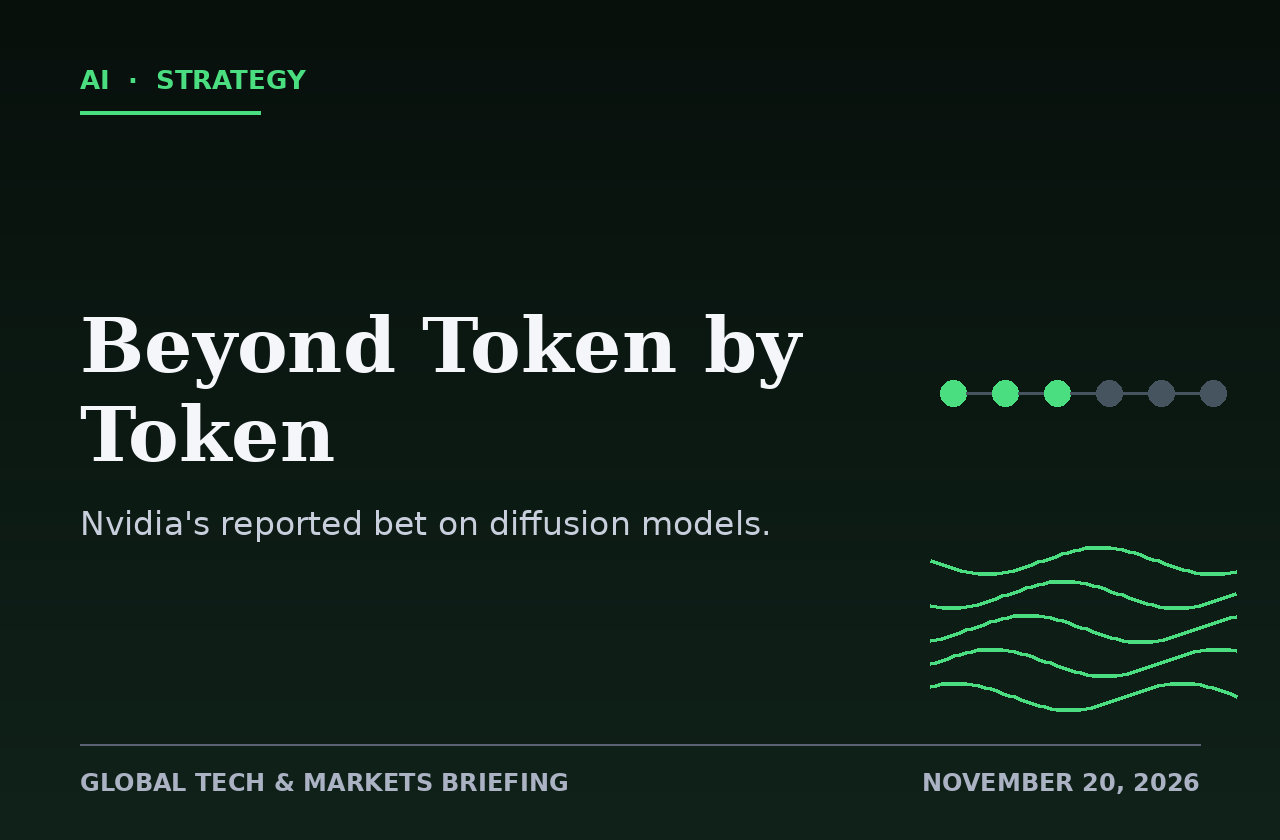
Nvidia, a company that sells the shovels, keeps buying gold mines. The Information reported Friday that the chipmaker is in advanced talks to acquire Inception, a Palo Alto startup whose Mercury models generate text by diffusion rather than the token-by-token approach behind ChatGPT and Claude. The price is at least $500 million, possibly more, with performance-based earnouts for incoming staff. Neither company has commented, and no deal has been announced — but the strategic logic is legible even in rumor form.
Inception was founded in 2024 by three professors — Stanford’s Stefano Ermon, who serves as CEO, UCLA’s Aditya Grover and Cornell’s Volodymyr Kuleshov — and builds what it calls the first commercial-scale diffusion large language model. The distinction is not academic trivia. Autoregressive models write left to right, one token at a time, each step waiting on the last. Diffusion models start with noise and refine the whole output in parallel passes, the technique that powers image generators like Stable Diffusion. Applied to text, Inception claims throughput five to seven times higher than comparable autoregressive models, first-token latency under 300 milliseconds, and per-task costs up to 70% lower. Those figures are the company’s own; no independent evaluator has reproduced them yet, and buyers should treat them accordingly. But even discounted, the direction matters: latency and cost are the two variables gating real-time voice agents, interactive coding and high-volume content generation.
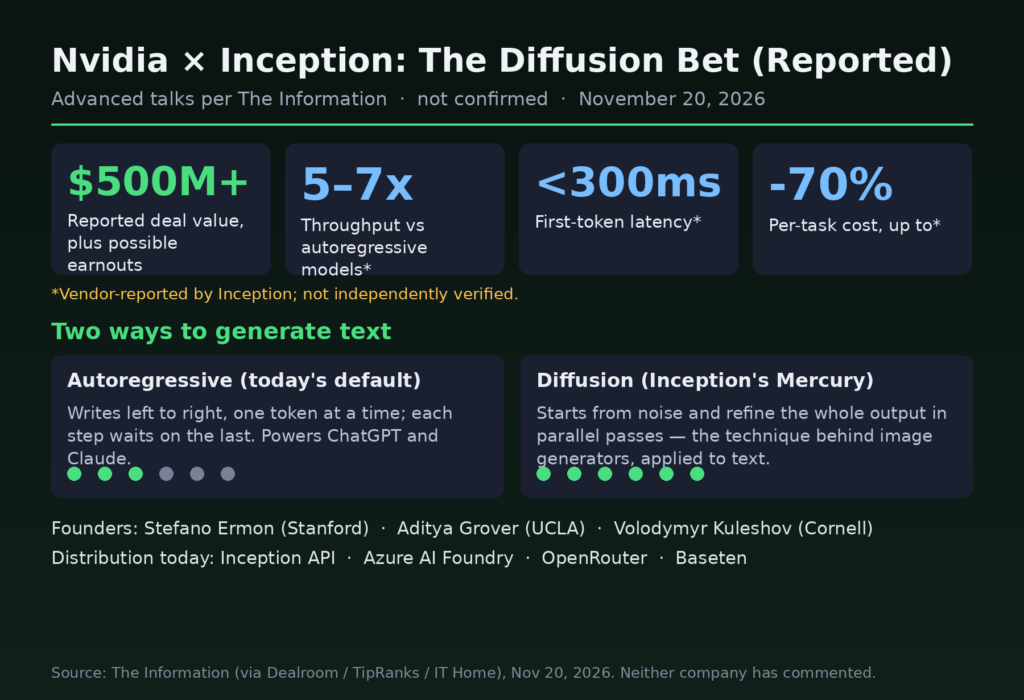
Mercury is not a lab demo. It is already distributed through Inception’s own API, Microsoft’s Azure AI Foundry, OpenRouter and Baseten — meaning paying customers route production traffic through it today, and Microsoft had reportedly shown acquisition interest of its own before Nvidia’s talks advanced. According to the report, all three founders are expected to join Nvidia full-time, folding the team into Nemotron, Nvidia’s family of open models aimed at enterprise and government workloads, with extensions toward physical AI for robotics.
Read that alignment carefully. Nvidia’s most important customers — OpenAI, Anthropic, Google — are all designing their own silicon or buying alternatives. The company’s answer is to move up the stack: open models that showcase its hardware, distributed to the enterprise buyers who will never build a frontier lab but will run private inference. A diffusion architecture is a particularly Nvidia-shaped bet. Parallel refinement is compute-hungry in ways that map beautifully onto GPUs, and if text generation shifts even partially from sequential decoding to parallel denoising, demand per query rises. The chipmaker is not just hedging against its customers’ independence; it is funding a paradigm that would sell more of its chips.
There is also the small matter of timing. The talks reportedly began before Jensen Huang’s departure as CEO, and they are surfacing while Nvidia absorbs a governance crisis, six straight days of stock declines, and a state subpoena. An acquisition of this size will not fix any of that. But it signals that the research roadmap — Vera Rubin’s successors, Nemotron’s expansion, robotics — is still being written by people placing bets, not just managing fallout.
For AI buyers, two practical notes follow. First, diffusion LLMs are now a category with a potential trillion-dollar sponsor; if your workload is latency-sensitive or cost-bound at scale, pilot them alongside autoregressive options rather than ignoring them. Second, validate the claims yourself — the 5–7x numbers are vendor-reported, and the first independent benchmarks after any deal announcement will be the ones worth reading. The rumor is unconfirmed. The architectural question it raises is not.