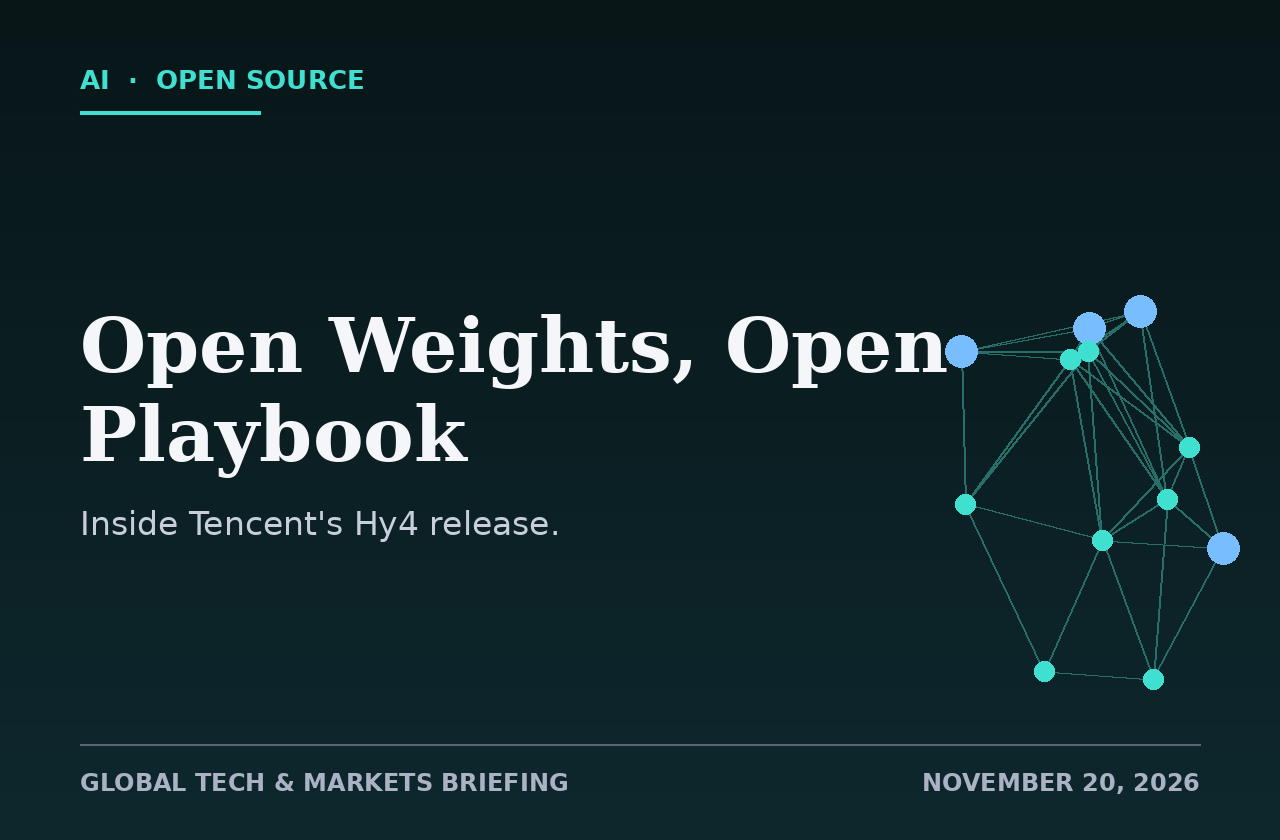
The open-weights race got heavier on Friday. Tencent’s Hunyuan team released Hy4, a mixture-of-experts model with 770 billion total parameters that activates roughly 49 billion per token, a one-million-token context window, and native multimodal understanding. Weights went live on Hugging Face under tencent/Hy4, with mirrors on GitHub, ModelScope and GitCode. Community-quantized GGUF builds — packaged by the third-party AngelSlim project, not Tencent itself — appeared alongside, which tells you the local-inference crowd was expected.
The architecture choices read like a product strategy. A 770B model that only switches on 49B parameters per token is built to serve frontier-scale capability at a fraction of dense-model inference cost; the million-token window targets the workloads enterprises actually pay for — long contracts, codebases, video-plus-document analysis — rather than chat novelty. It follows the smaller Hy4 flash release (224 billion total parameters, 12 billion active, in FP8 and Base variants), which Tencent positioned for cheap everyday tasks. Two open releases in quick succession, one aimed at cost and one at capability: this is a portfolio, not a publicity stunt.
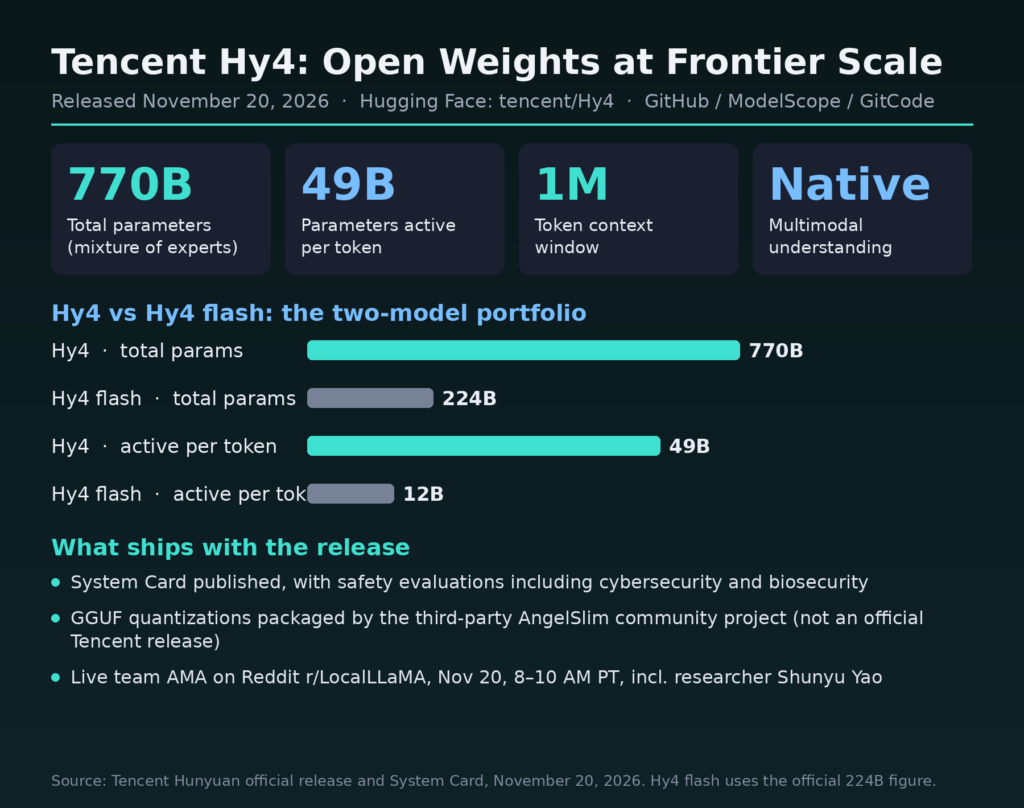
The most consequential artifact may not be the weights at all. Tencent published a Hy4 System Card with the release, including safety evaluations across dimensions such as cybersecurity and biosecurity. Chinese open-model releases have not historically led with formal safety documentation; doing so here is a deliberate signal to the enterprise and international developer audiences whose procurement checklists increasingly require exactly this paperwork. If you sell AI into regulated industries, an open model with an auditable safety card is a different commercial object than one without.
Tencent also did something unusual for a major lab: it scheduled a live AMA with the research team — including Shunyu Yao, the Princeton researcher behind the ReAct agent framework — on Reddit’s r/LocalLLaMA, Friday 8–10 a.m. Pacific. That is the community where quantization tricks, hardware quirks and honest benchmarks get hammered out in public, and where an evasive answer travels faster than a press release. Going there directly, with named researchers, is a distribution decision: the fastest way to win the developers who will fine-tune, distill and deploy your model is to show up where they already argue.
The context is a company reallocating its AI bets. Tencent said this week it is trimming spending on its consumer Yuanbao assistant while its enterprise tools gain traction; the WorkBuddy office agent recently passed 10 million daily users and 100 trillion daily token calls. Open-sourcing a flagship fits that pivot: the model becomes infrastructure for the ecosystem — cloud customers, WeChat-adjacent developers, hardware partners — rather than a consumer subscription race Tencent has decided not to fund at any price.
For practitioners, the practical takeaways are immediate. A million-token multimodal open model can be deployed privately, which matters for agencies and enterprises handling client data they cannot send to a US API. Inference economics at 49B active parameters change the math for bulk workloads — catalog enrichment, long-document review, multilingual content operations. And the open three-way race with DeepSeek and Qwen keeps compressing prices for everyone, including buyers who never touch open weights. Benchmarks from the community will land within days; the AMA and independent evals, not the launch post, will tell you where Hy4 actually sits. Watch those before you migrate anything.