Thirteen years after GTA 5, Rockstar Games released Grand Theft Auto 6 on Thursday, and the early numbers point to the biggest entertainment launch ever recorded. Analytics firm Sensor Tower, in estimates cited by Reuters, put sales at 24.58 million copies by Thursday evening — including pre-orders — worth roughly $2.36 billion. That is nearly triple the $800 million GTA 5 generated in its first 24 hours in 2013, and it approaches the entire $2.5 billion theatrical gross of this year’s highest-grossing film. One day of a video game, against a year of cinema’s best.
The caveats belong up front. Rockstar and its parent Take-Two Interactive have published no official sales figures, describing demand only as “unprecedented.” Sensor Tower’s numbers are modeled from email-receipt panels tracking millions of consumers and public gaming-platform profiles — credible, but estimates. PlayStation accounted for about 75% of units, Xbox the rest; the game launched only on PS5 and Xbox Series X|S, at $79.99 for the standard edition, with no PC version announced. Research firm Niko Partners expects revenue to top $3 billion by year-end, and Take-Two has guided to $3.35–$3.5 billion in net bookings for the December quarter, against about $1.6 billion in the prior quarter.
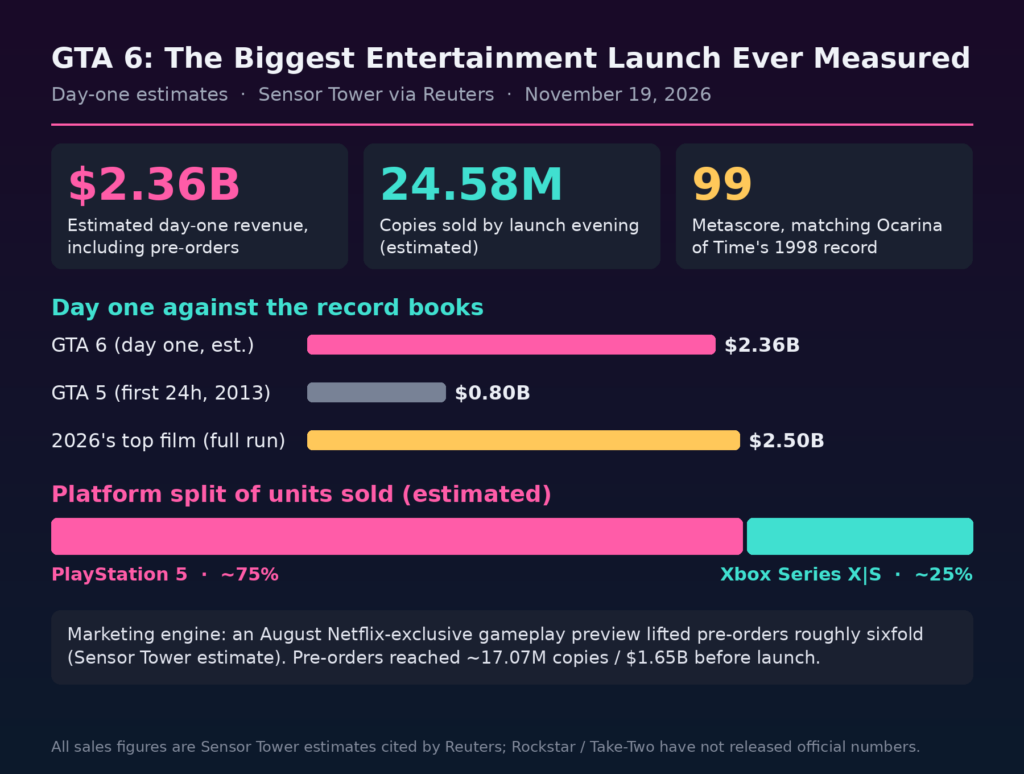
For marketers, the more interesting story is how the demand was built. Rockstar largely skipped the conventional advertising blitz. In August it premiered an extended gameplay preview exclusively on Netflix — a streaming audience, not a gaming channel — and Sensor Tower estimates pre-orders jumped sixfold afterward. By November 18, the day before launch, pre-orders alone stood at roughly 17.07 million copies and $1.65 billion. Thirteen years of pent-up demand, one exclusive content event, and a fandom that does the distribution for you: that is the whole campaign. The lesson generalizes beyond games — for brands with genuine cultural equity, an exclusive content moment can outperform a full quarter of media spending.
The halo effects are already visible in retail. UK department store John Lewis reported console and accessory sales up 62% in the three weeks before launch versus a year earlier, and electronics retailer Currys reported PS5 hardware sales up 149% and DualSense controller sales up 55%, according to Anadolu Agency. A game with a development budget estimated by Reuters at over $1 billion is selling the hardware it runs on — a platform economics lesson console makers have understood since the Wii.
Culture did the rest. Reviews landed at a 99 Metascore, matching The Legend of Zelda: Ocarina of Time’s 1998 record, with IGN calling it a masterpiece. Streaming data firm Streams Charts counted a concurrent viewership peak above 7.88 million across Twitch, YouTube and Kick within three hours of unlock, a record for a game launch. Employers got involved: Chinese business media reported Logitech gave its roughly 7,000 employees a paid day off, Palworld studio Pocketpair closed for five days, and UK HR firm BrightHR estimated British workers booked about 83,000 days of leave around launch, at a cost near £12.4 million. When a product launch becomes an HR policy question, the marketing department has already won.
Take-Two, for its part, is holding off on the victory lap with unusual discipline. Shares rallied into launch day, among the Nasdaq-100’s strongest performers Wednesday, according to Reuters. CEO Strauss Zelnick has publicly refused to declare success before the numbers are official. TD Cowen named the stock a top pick for 2027 and made the sharpest observation of the week: the timing and scale of GTA 6 Online matter more to the share price than the launch sales themselves. GTA 5 shipped nearly 235 million copies over its life largely on the back of its online mode — the recurring-revenue engine is the real asset.
That points to the next beats in the playbook: an official first-week sales announcement, a PC version date, and the Online reveal. Each is a fresh attention event, spaced deliberately apart. Launch day belongs to the players. The quarters that follow belong to the spreadsheet — and to any marketer paying attention to how little advertising it took to get here.






