Here is an uncomfortable thought experiment. You spend a quarter building the most citable content in your category — original data, clean structure, expert bylines. Then a customer asks ChatGPT which vendor to pick, and the assistant has never heard of you. Not because your content lost. Because it never entered the room.
That is what a crawler block does. It is not a ranking penalty you can watch in a dashboard. It is an absence. Google’s own AI-features documentation is blunt about the prerequisite: to appear as a supporting link in AI Overviews or AI Mode, a page must be indexed and eligible to show a snippet. No crawl, no index, no answer. Every later optimization — entity clarity, answer-first writing, digital PR — sits on top of this gate. Fail the gate and the rest is decoration.
This module is the gate audit. Four layers, one acceptance bar: crawlable, readable, schema-valid, and confirmed by evidence rather than configuration. Let’s open the door properly.
The Crawler Landscape: One Company, Three Doors
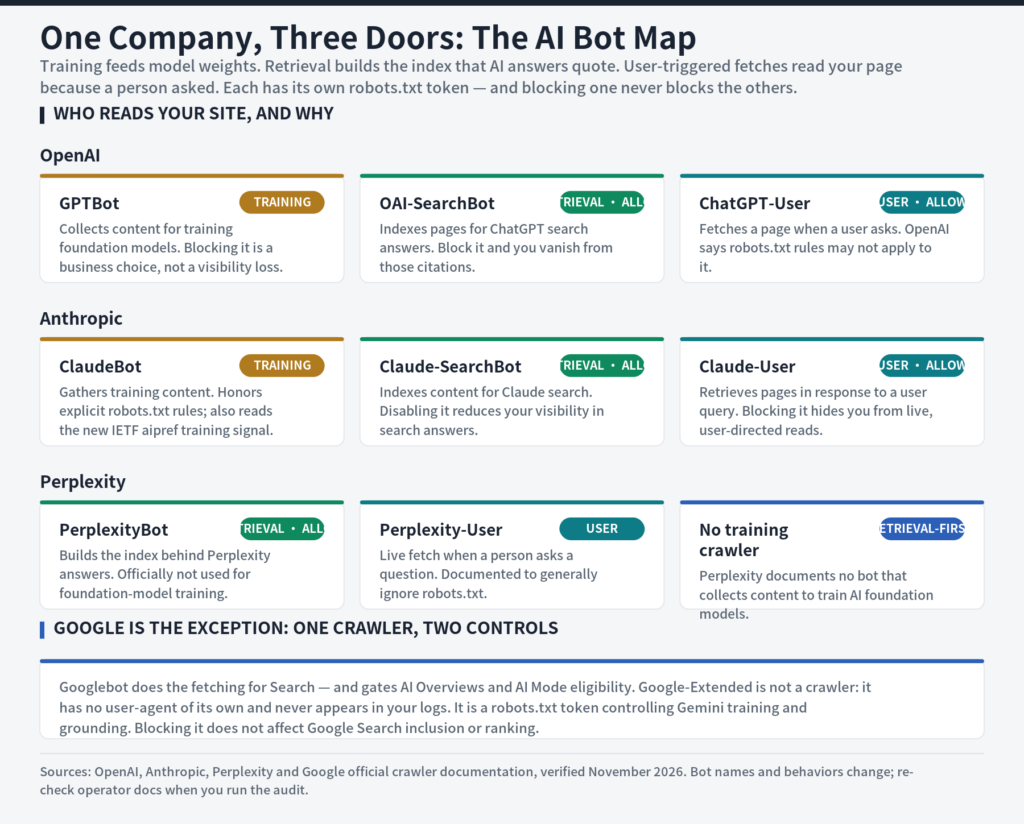
The most common mistake in AI crawler policy is treating “the AI bots” as one thing. They are not. Each major operator runs several bots with separate user-agent tokens, separate purposes, and separate robots.txt controls. OpenAI’s crawler documentation could not be clearer: each setting is independent of the others.
OpenAI runs GPTBot to collect training content, OAI-SearchBot to index pages for ChatGPT search answers, and ChatGPT-User to fetch a page when a person asks for it. Anthropic mirrors the split: ClaudeBot for training, Claude-SearchBot for search indexing, Claude-User for user-directed reads. Perplexity documents PerplexityBot for its citation index — explicitly not for foundation-model training — and Perplexity-User for live fetches. ByteDance’s Bytespider and Meta’s Meta-ExternalAgent round out the training-heavy crowd.
Training vs Retrieval: The Distinction That Decides Everything
Blocking a training crawler is a business decision. Blocking a retrieval crawler is a visibility amputation. OpenAI states that sites opting out of OAI-SearchBot will not be shown in ChatGPT search answers. Anthropic says disabling Claude-SearchBot reduces your visibility in user search results. Perplexity recommends allowing PerplexityBot outright. These are the bots that put you inside a cited answer — and they are the ones teams block by accident.
One nuance most audits miss: user-triggered fetchers play by different rules. OpenAI says robots.txt rules may not apply to ChatGPT-User because a human initiated the visit. Perplexity documents that Perplexity-User “generally ignores robots.txt rules” for the same reason. A Disallow line aimed at them is mostly a statement of intent, not enforcement.
The Inherited-Block Problem
Where do accidental blocks come from? History. A “block unknown bots” rule written in 2022 predates every retrieval bot in this article. An anti-scraping template arrived with Disallow rules already inside. A security contractor solved an incident and never wrote the decision down. The HasData AI Crawler Block Index — a July and September 2026 scan of 10,894 domains by a commercial data provider, published with its dataset on Zenodo — found news publishers blocking AI crawlers at roughly five to six times the open-web rate. Publishers have a reason: their pages earn money on display. A brand site copied that posture without copying the business model, and the block landed on precisely the bot that answers buyers’ questions.
The robots.txt Audit: Read It Bot by Bot
Start with the file itself. List every Disallow rule and ask, per bot: who wrote this, when, and why? Then check the wildcard trap. Under the robots standard (RFC 9309), a crawler obeys the most specific group that names it — and a named group replaces the wildcard group entirely. Add an OAI-SearchBot group and forget to copy your /admin/ restrictions into it, and you have just opened a door you meant to keep shut. The reverse trap is quieter: a wildcard Disallow silently covers every bot you never named.
The Allowlist Decision
The defensible default for a brand site: allow retrieval and user-triggered bots explicitly, and make the training decision separately, in writing. OpenAI even documents that if you allow both its bots, one crawl may serve both purposes — and that robots.txt changes take about 24 hours to propagate into search results. Perplexity documents a similar 24-hour window. Patience is part of the audit.
Google needs its own paragraph because it breaks the pattern. Googlebot fetches for Search and gates AI Overviews eligibility. Google-Extended is not a crawler at all — Google’s documentation states it has no separate HTTP user-agent string, so you will never see it in a log. It is a robots.txt token governing Gemini training and grounding, and Google is explicit that sites allowing it are eligible to appear and receive clicks via grounding in Gemini Apps. Blocking it does not affect Search inclusion or ranking — but it does trade away Gemini citations. Decide with eyes open.
Page-Level Controls: The Second Gate
robots.txt controls fetching. Meta robots and X-Robots-Tag control showing. A noindex page cannot appear in AI Overviews; nosnippet and max-snippet limit what Google’s AI features may quote, per Google’s AI-features guide. Audit these per template, not per site — one stray noindex on a product template can blank out a catalog.
There is also a new gate that most checklists have not caught up with: the Search generative AI control in Search Console, rolled out to all websites worldwide on August 31, 2026. It is a property-level switch that excludes your links and content from AI Overviews, AI Mode and Discover’s generative features — links included — while leaving classic Search untouched. It does not affect training. If someone on your team flipped it during a licensing debate, your AI visibility is off at the source, and no robots.txt edit will fix it. Check Settings, and check inheritance: child properties follow their parent by default.
The Edge: Where Blocks Actually Live
Now the layer that decides most audits: the CDN, WAF and bot-management stack. robots.txt is a request. A firewall rule is enforcement. When they disagree, the firewall wins.
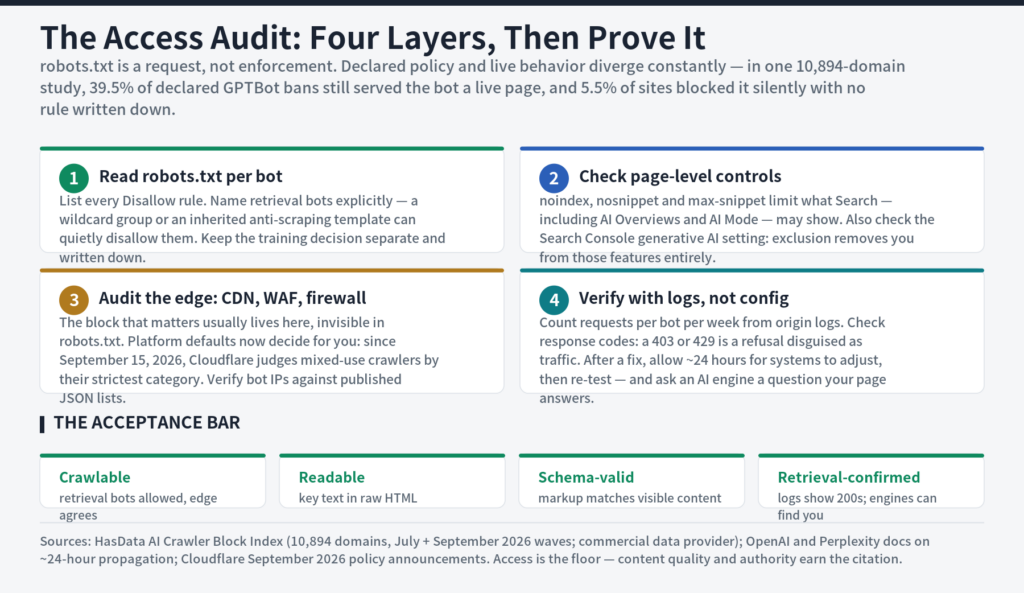
The HasData study quantified the gap, and it is large: 39.5% of sites that declared a GPTBot ban in robots.txt still served the bot a live page when it actually knocked (July 2026 wave; 34.9% by September), while 5.5% of tested sites blocked GPTBot at the edge with nothing written in robots.txt at all. Declared policy and observed behavior are two different ledgers. Yours needs both.
Platform defaults now make this decision for you if you let them. Cloudflare has default-blocked AI crawlers for new domains since July 2025, and on September 15, 2026 it moved to a three-category system — Search, Agent, Training — with a strictest-rule twist: a mixed-use crawler like Googlebot, Applebot or Bingbot gets blocked entirely on sites that block Training, unless the operator holds Cloudflare’s “Accountable” designation (Apple, Google and Microsoft received it at launch). Cloudflare’s own network figures put mixed-use crawlers at 36.6% of verified crawler traffic, with fewer than 1% of owners blocking search but 17% restricting training. Read that again: one in six sites intends to restrict training, and the strictest-rule mechanism can quietly convert that intent into a search block. Audit your edge settings before you audit anything else.
The JavaScript Divide
Access granted? Good. Now the second failure mode: the crawler arrives and finds nothing to read.
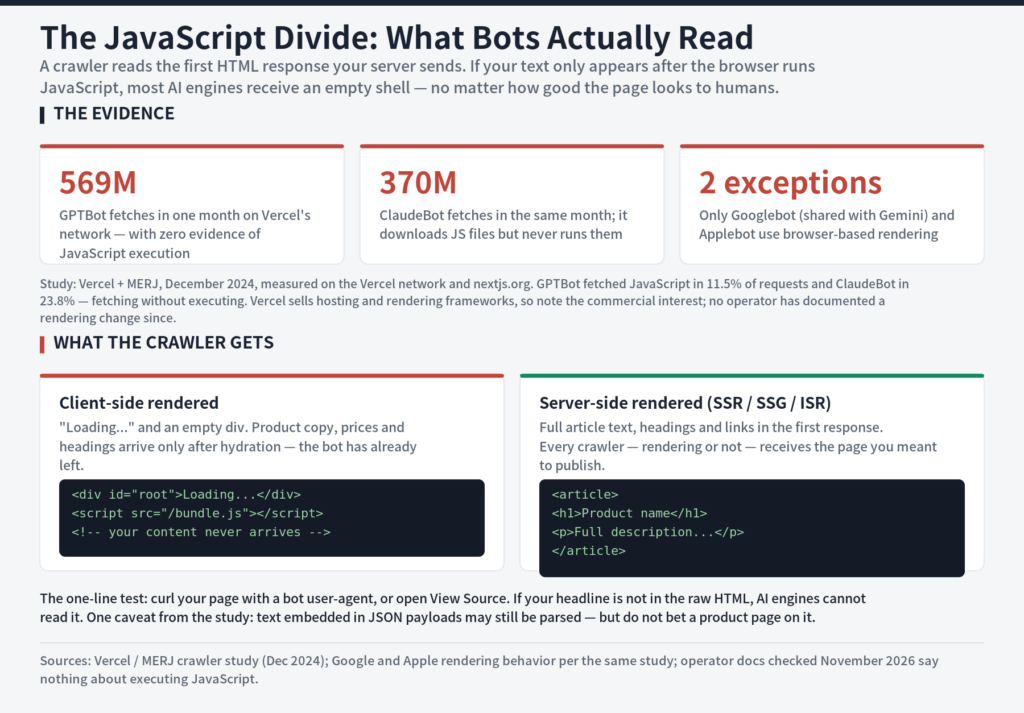
The foundational measurement here is the Vercel and MERJ crawler study from December 2024, run on Vercel’s network and nextjs.org. In one month it logged 569 million GPTBot fetches and 370 million ClaudeBot fetches — and found no evidence that any major dedicated AI crawler executes JavaScript. They download your scripts (11.5% of ChatGPT requests, 23.84% of Claude’s) and never run them. The documented exceptions are Google’s crawlers, whose rendering service is shared with Gemini, and Applebot. Two honesty labels belong on this data: it is from late 2024 and no operator has documented a rendering change since, and Vercel sells hosting and server-rendering frameworks, so it has a commercial interest in the conclusion. The direction, though, matches every operator doc: none promises rendering.
So if your product copy, prices or headings materialize only after client-side hydration, most AI engines receive a loading spinner. The study offers one consolation — text embedded in JSON payloads inside the raw HTML may still be parsed — but do not bet a product page on a maybe.
The One-Line Test and the Hygiene Checklist
The test costs nothing: fetch your page with a bot user-agent, or just open View Source. If the headline is missing from the raw HTML, you have a rendering problem, not a content problem. Server-side rendering, static generation or incremental regeneration all fix it. While you are in there, tidy the discovery aids: a current sitemap, clean canonicals and hreflang, fast responses. The same study found AI crawlers wasting roughly a third of their fetches on 404s — against 8% for Googlebot — which means broken URLs burn a much larger share of the (smaller) crawl attention AI engines give you. Speed and hygiene are budget levers, not vanity metrics.
Schema Deployment: Deploy It, but Don’t Oversell It
Here is where this playbook must break with GEO folklore. The standard advice says structured data is a citation lever. The best available evidence says otherwise — and pretending otherwise would fail the honesty bar this series holds itself to.
Ahrefs — an SEO tool vendor, so note the interest — ran the cleanest test to date, published May 2026: 1,885 pages that added JSON-LD between August 2025 and March 2026, each matched against three control pages with similar prior citation levels, analyzed difference-in-differences across 30 days before and after. Result: about +2.4% in AI Mode, +2.2% in ChatGPT, a slight decline in AI Overviews — statistically indistinguishable from nothing. The caveat matters: every page already had 100+ AI Overview citations, so the study cannot speak to undiscovered pages. Google’s own guidance agrees from the other side: no special schema and no llms.txt file is needed for its AI features.
Does that make schema useless? No — it makes it plumbing. Organization markup with consistent name, logo and sameAs links declares your entity. Article markup with author and dateModified carries freshness and authorship signals. And a smaller exploratory study (730 citations across 75 queries, published on Zenodo in February 2026 by an independent researcher — small sample, treat as directional) found one real exception: Product and Review schema with populated concrete attributes — prices, ratings, specifications — was cited substantially more often than generic schema types, especially on lower-authority domains. Extractable facts, not decorative tags. Deploy the three core types, validate them against visible content, and spend your next sprint on content and authority instead of more markup.
The FAQPage Plot Twist
The outline for this module carried a 2023 caveat: FAQ rich results were restricted to authoritative government and health sites. That is now history twice over. On May 7, 2026, Google deprecated FAQ rich results entirely — reporting and Rich Results Test support ended in June, API support in August. FAQPage remains a valid Schema.org type and Google says unused markup causes no harm. But the claim that “AI extraction still uses it” is unproven for generic FAQ schema; the Ahrefs null result covers pages carrying exactly this kind of markup. Keep FAQ content because answer-shaped sections are genuinely extractable prose. Keep or drop the markup as housekeeping. Just do not buy a citation strategy with it.
The Verification Workflow: Evidence, Not Config
An audit that ends at configuration is a guess with extra steps. Four proofs close it out.
First, logs. Count requests per bot per week from origin logs — not the CDN dashboard — and check response codes, because a 403 or 429 is a refusal that traffic charts happily report as visits. Second, fetch-as-bot or View Source on your key templates: the actual text must be in the raw HTML. Third, validate your schema against the page’s visible content. Fourth, the exposure test: ask ChatGPT, Claude, Perplexity and Google’s AI Mode a question your content answers, and watch whether retrieval found you. After changes, wait out the documented ~24-hour propagation before judging, and remember recovery takes recrawl cycles, not minutes. And verify bot identity before trusting any of it: user-agent strings are trivially spoofed, so match source IPs against the JSON lists each operator publishes (OpenAI, Anthropic and Perplexity all maintain them).
Risks and Honest Caveats
Three moving parts deserve a warning label. The training-opt-out layer is being standardized as you read this: on October 30, 2026, Anthropic began honoring the IETF AIPREF draft’s machine-readable no-training signal, and Google announced it will support the shared robots.txt policy token alongside other providers in 2027. Explicit per-bot rules keep priority — but the vocabulary is evolving, so re-read operator docs each quarter. Paywalls remain a genuine tradeoff: gated content is invisible to crawlers, and the access-versus-monetization call belongs to the business, not the SEO team. And on blocking itself, the strongest academic evidence cuts against the reflex: a Rutgers and Wharton study (arXiv, revised April 2026) tracked 30 newspapers with a staggered difference-in-differences design and found blocking GenAI crawlers was followed by roughly a 7% weekly traffic decline within six weeks — including human visits, not just bot removal. It is an early-period, publisher-specific, observational estimate with modeled traffic inputs; do not port the number to your SaaS blog. Port the direction: closing the door has a price, and the price is paid in discovery.
Conclusion: Crawlable Before Credible
The audit in one breath: map every bot by purpose, allow retrieval and user-triggered access explicitly, decide training in writing, check meta controls and the Search Console AI switch, audit the edge where blocks actually live, server-render what matters, deploy schema as plumbing rather than magic, and prove all of it with logs and exposure tests. None of this earns a citation by itself — content quality and authority do that. But all of it is prerequisite. The assistant cannot recommend a page it was never allowed to read. Open the door first. Then go earn the answer.